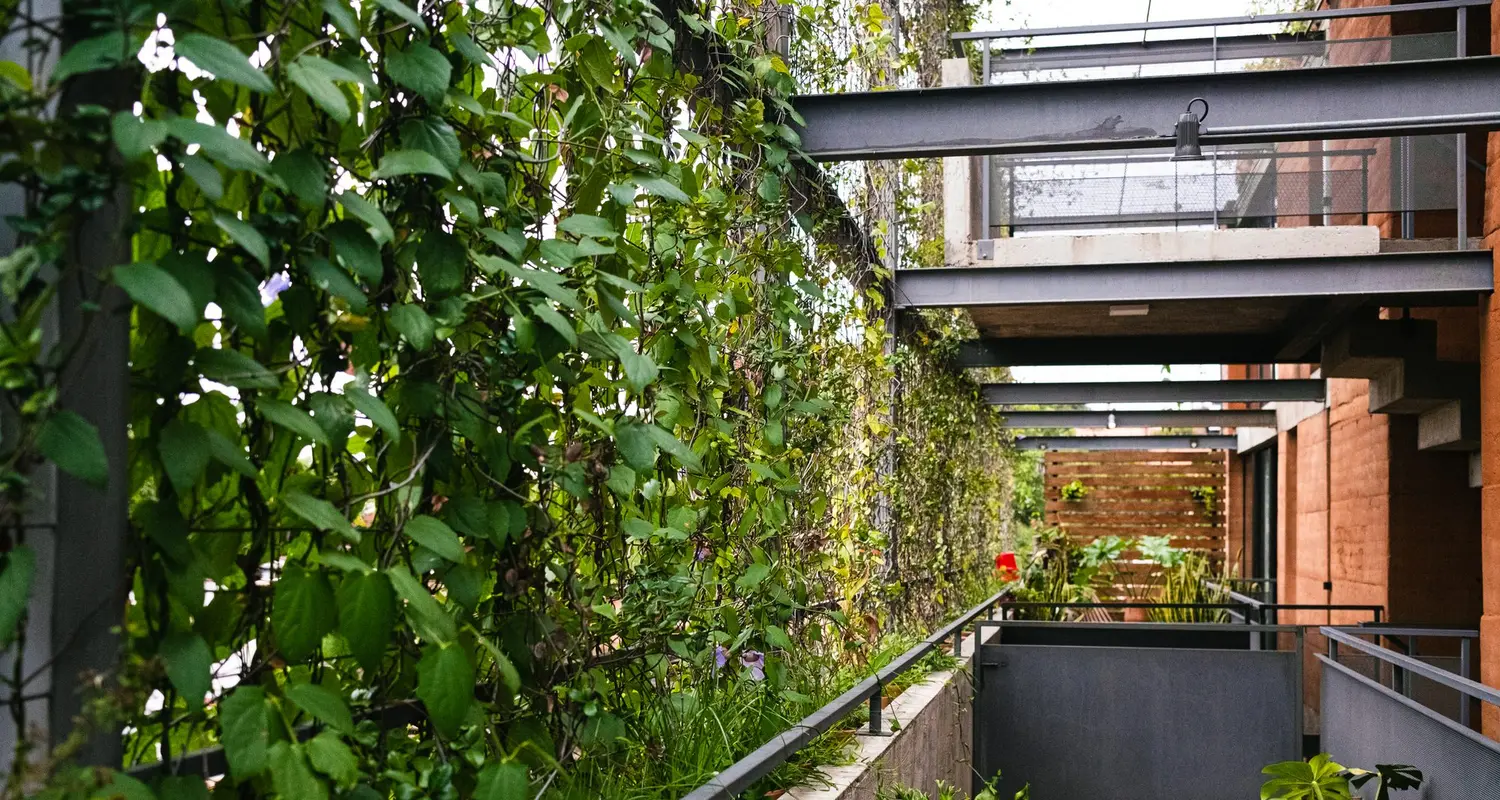
Vertical gardens
Here the wall decides, not the plant
Frame, waterproofing, irrigation and planting, in that order. First we look at where it’s going to hang.
- A frame set off the wall, with its own water collection
- Plants chosen after the aspect, not before
- Maintenance planned from day one
Send us a photo of the wall
With that, and which way it faces, we can already tell you a lot.
What’s included
Four layers, and you only see the last one
Of everything you’re paying for, the plants are the last part and the cheapest. What decides whether it’s still green in August is the three layers underneath.
The frame, set off the wall
A vertical garden isn’t stuck to the wall: it hangs from a frame with an air gap behind it. That gap is what stops the system’s moisture from ending up as damp in your wall.
Irrigation, and catching the run-off
Drip line or irrigation mat at the top, a collection channel at the bottom, and a controller that can’t miss a single day. Here water isn’t a running cost: it’s the only thing keeping the installation alive.
Growing medium and planting
Felt, panels or soil-filled modules, depending on the system. It’s chosen for how much water it holds in reserve and how much it weighs, and the plants are chosen afterwards, based on that and on which way the wall faces.
Maintenance, because there is some
Checking the irrigation, replacing plants that fail, cutting back whatever runs away, and keeping an eye on the feed that goes in through the irrigation. A vertical garden with no visits won’t last a summer.
What to look at first
The wall heats it from behind too
A plant in the ground gets the sun from above and has cool soil beneath it. A plant hanging on a west-facing wall gets the sun from the front and, on top of that, a wall that has been soaking up heat all afternoon right behind its roots. That doesn’t happen to any plant in a garden bed, and it’s the first reason a vertical garden works on one façade and fails on the one next to it.
The second is the growing medium. In a vertical garden each plant lives in a handful of substrate, which has to be light because it’s hanging, and that handful holds no reserve for anyone. Where a plant in the ground lasts days without water, this one lasts hours. It isn’t a more delicate plant: it just has no larder.
Put the two together and you get the consequence almost nobody raises when buying: a vertical garden has no margin for error. A stopped pump, a controller that resets after a power cut or a blocked line in the middle of August doesn’t give you a scare, it gives you a brown wall. And if the house is empty for part of the year, that has to be solved before it goes in, not after.
That’s why the first conversation isn’t about plants. It’s about which way the wall faces, how many hours of sun it gets, whether there’s a pale façade opposite bouncing more back at it, and what’s on the other side of the wall. With that, we already know whether what you want will work there or needs moving two metres.
Let’s talk about price
The square metres aren’t the expensive part
Two identical walls can cost very different amounts, and not because of their size. What moves the figure is what has to be sorted out around it for that green to keep going.
- Whether there’s water and power nearby. A vertical garden needs a water supply and electricity for its controller and, almost always, for a pump. If that wall doesn’t have them, they have to be brought to it, and that’s building work.
- Height and access. Up to where a ladder reaches is one job. Above that, the installation changes, and so does how it will be maintained afterwards, which is what usually gets forgotten.
- Where the excess water goes. Collecting and reusing it with recirculation costs more up front and less every month. Letting it drain away is cheaper to install and isn’t always the better deal.
- What kind of wall it is. A block boundary wall in a patio isn’t the same as the front of the house. The more delicate whatever is on the other side, the more protection goes behind.
We look at the wall, tell you whether it’s the right one and quote item by item, with the maintenance listed separately where you can see it. How each service is measured is explained in gardening prices.
If the wall isn’t right
There are other ways to cover a wall
Sometimes the honest answer is: not there. A climber planted in the ground, with its roots in real soil, does the same visual job without depending on a pump. It takes longer to cover, but then a power cut won’t bring it down.
That’s a garden design decision, and it’s best made before you order an installation.
Where we work
Mostly on patios and terraces
It’s a service for small, very visible spaces, which is where the ground runs out and the wall doesn’t. Each page describes its own area.
Understanding it
We explain it, we don’t hide it
Vertical garden with dead plants: where they die tells you why
By the end of summer almost every vertical garden has casualties, and they aren’t spread at random. The pattern they leave on the wall is the diagnosis, and it’s worth reading before you replace anything.
Read itBefore the vertical garden: whose wall it is and how much it weighs wet
Everyone starts with the plants. In a block of flats there are two things that come first, and both are settled with a phone call, not a catalogue.
Read it
Common questions
What people ask us most
Does it damage the wall?
A properly installed system doesn’t: it sits on a frame, with its protective membrane and its air gap, and the excess water is collected at the bottom instead of running down the wall. A badly installed one does, and the damage doesn’t show until it comes through on the inside. That’s why the first thing we ask isn’t which plants you want, but what’s on the other side of that wall.
How much water does it use?
We’re not going to give you a number we haven’t measured on your wall, because it depends on the system, which way it faces and the time of year. What does matter is how it behaves: it uses a little at a time, many times a day, and it doesn’t forgive a failure. Recirculating systems reuse the excess, and they’re the ones that make sense for a large installation.
I’m away for a month in summer. Will it survive?
Only if someone checks on it. In a vertical garden each plant lives in very little growing medium, so there’s no reserve to save it: a stopped pump or a clogged dripper in August isn’t settled in a few days, it’s settled in hours. If the house is left empty, this needs maintenance with visits and, if possible, a fault alert from the controller.
Will any wall do?
No, and it’s the part most people ignore. A west-facing wall on this coast heats up from behind and punishes the roots from the side nobody looks at. A north-facing one gives you a different garden, with other plants and fewer problems. Before quoting, we need to see which way it faces, how many hours of sun it gets and whether there’s glare from a white façade opposite, which counts too.
Is that the right wall?
Send us a photo and tell us which way it faces. We’ll tell you whether it will work there or is better moved, before we talk about plants. You can call or WhatsApp us in English.