Turf laying and natural lawns
A lawn is won in the week before the turf arrives
Ground preparation, turf, and the three weeks after, which are the ones that decide it. Written quote within 24 hours.
- Irrigation installed and tested before the turf arrives
- Ground fine-levelled and rolled, not just raked
- We’ll also tell you when a natural lawn isn’t right for you
Tell us how big the area is
We’ll send you a written price within 24 hours.
What’s included
Laying the rolls is the last step, and the shortest
Rolling out the turf on a medium-sized plot takes a morning. Everything that decides whether that lawn is still there in five years happens before, and none of it shows in the photo on handover day.
Clearing and levelling
Whatever is there comes out, the levels are fine-tuned and we check the water runs where it should. A dip two fingers deep is invisible on bare soil and perfectly obvious as soon as there’s grass on top.
The bed it will root into
Topsoil and soil improver, depending on what’s underneath, a fine rake and a pass with the roller. Turf roots into the top few centimetres: what’s below decides whether it lasts three years or fifteen.
Irrigation in before the turf
The system has to be tested and split into zones the day before. Laying first and watering with a hose afterwards is the most common way to lose an entire lawn.
Laying, and the first few weeks
Rolls laid with staggered joints, without walking on them, and rolled so the roots touch the soil. Then come three weeks that decide the result, and they’re the ones hardly anyone mentions when selling you turf.
What nobody tells you
Turf arrives alive, and with the clock ticking
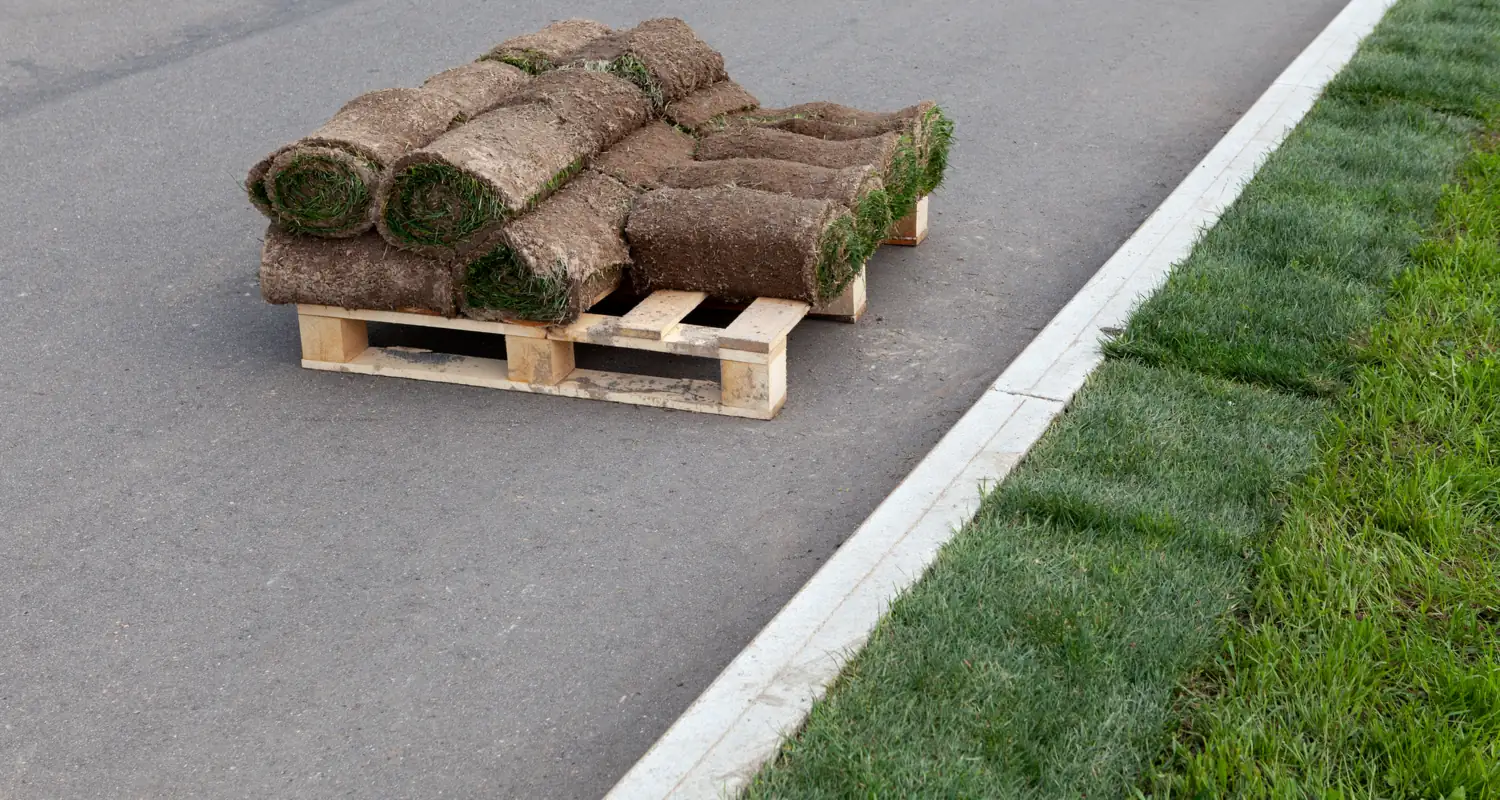
Turf isn’t a building material: it’s living grass with its soil, cut from the field and rolled up. It leaves the turf farm, travels stacked on a pallet, and from that moment it’s in the dark, squashed and unwatered.
And it does what any heap of cut grass does: it ferments and heats up inside. In a cool climate that leaves plenty of margin. Here, with the pallet sitting in the September sun, the clock runs much faster. Turf that arrives yellow inside the roll won’t recover, and it shows three weeks later, when it’s already laid and paid for.
That turns the natural order of the job around. The ground isn’t prepared “for” the turf: the ground has to be finished and the irrigation tested before anyone orders the turf. If there’s still half a day of levelling to do when the lorry turns up, the pallet waits, and waiting is exactly what it can’t do.
So when someone asks for a lawn for the day after tomorrow, the honest answer is usually no. It isn’t that we don’t want the job: the work is planned backwards from delivery day.
Let’s talk about price
The turf itself is the part that varies least
It’s almost the only thing with a market price. Everything else depends on what’s underneath, and you can’t see that until it’s opened up.
- What has to come out first. Clean soil isn’t the same as an old lawn, a buried concrete slab or builders’ rubble. Removal usually weighs more in the quote than the lawn itself.
- How much soil has to be brought in. If the ground doesn’t give the bed the turf needs, it has to be brought in. It’s measured in lorry loads, and it depends on access as much as on volume.
- Whether there’s irrigation or it needs putting in. A natural lawn without automatic irrigation won’t survive here. If there isn’t any, installing it goes into the quote, and it’s worth seeing it as part of the lawn, not as an extra.
- Access. A pallet of turf weighs a lot and doesn’t go up a staircase. If it has to be carried in by hand, the time multiplies and the turf has even less margin.
We come out, look at what’s underneath and send you a written price with preparation, materials and irrigation listed separately. Why that split matters is explained in gardening prices.
The other option
And sometimes the answer is: not here
There are spots where a natural lawn will never take: deep shade under trees, narrow strips that get walked on all the time, terraces with no soil. Insisting there costs you twice, because you pay for the installation and then for the repair. Artificial grass, with its drawbacks spelled out, is there for those particular square metres.
Where we work
The soil changes from one town to the next
A sandy plot by the sea and a clay one in the valley need different preparation for the same turf. Each page explains what changes in that area.
To do it yourself
We explain it, we don’t hide it
Should you sow a lawn or lay turf?
Yes, sowing is cheaper, in materials. What you buy with turf is the three weeks in which a sown lawn can be lost entirely through one slip.
Read itWhat’s under the lawn decides whether it lasts
Same lawn, same watering, same garden, and one strip that goes yellow every summer in the same place. The explanation isn’t in the grass: it’s thirty centimetres down.
Read itWhich grass to plant on the Costa del Sol: here you choose which season it’s green
The garden-centre bag promises green all year, and here that doesn’t exist. There’s a grass that looks good in summer and another in winter, and you choose by when you live in the house, the shade, the salt and the wear.
Read itWhen to sow grass seed on the Costa del Sol: October for winter grass, May for Bermuda grass
Guides say spring or autumn. Here, winter grass is sown in October: 269 mm of rain follow in three months. Seed sown in April gets 26 until July.
Read it
Common questions
What people ask us most
When can I walk on it?
At first, as little as possible. For the first few weeks the turf is resting on the soil, not rooted into it: walk on it and it shifts, leaving open joints that don’t close up properly afterwards. The home test is to pull at a corner by hand; when it won’t lift, it has rooted and can take normal use. We explain how to look after it afterwards separately.
What’s the best time of year here?
Autumn, by a long way, and then spring. In autumn the soil is still warm and the turf roots without having to cope with the heat of the day at the same time, so it reaches the following summer already established. It can be done in the middle of July or August, but watering becomes critical from the very first hour and the margin for error is minimal.
Natural or artificial?
It depends on the area, and almost every garden that works here has some of both. Natural needs water and mowing, and in return it stays cool and you can walk on it barefoot in August. Artificial needs none of that, and in full sun it gets too hot to bear. We cover it in full on its own page, with no axe to grind.
Which variety do you use?
Whichever will cope with the spot, which isn’t always the one that looks best in the catalogue. Here what decides it is tolerance to heat and to salt in the water, and how many hours of direct sun the area gets. A variety meant for a cool climate lays just as well and gives up in its first August.
Now is the right time
A lawn laid in autumn reaches the summer already rooted. One laid in May spends its first August struggling. You can call or WhatsApp us in English.