Blog · Natural lawns and turf
Which grass to plant on the Costa del Sol: here you choose which season it’s green
The garden-centre bag promises green all year, and here that doesn’t exist. There’s a grass that looks good in summer and another in winter, and you choose by when you live in the house, the shade, the salt and the wear.
 By Sergio Domínguez7 min read
At the garden centre the bags say “universal”, “hard-wearing” or “all purpose”, and promise green all year. Here that doesn’t exist. There are grasses that are at their best in July and others that are at their best in January, and none of them stays looking good for all twelve months.
So the useful question isn’t which grass is best, but when you want it green. And on this coast the answer varies a lot from one house to the next.
Two families, and each has its bad season
Summer grasses (Bermuda grass, kikuyu, St Augustine grass, zoysia, paspalum) grow with heat and get through the summer on much less water. In the coldest part of winter they stop and turn straw-coloured. They aren’t dead: they come back by themselves in spring.
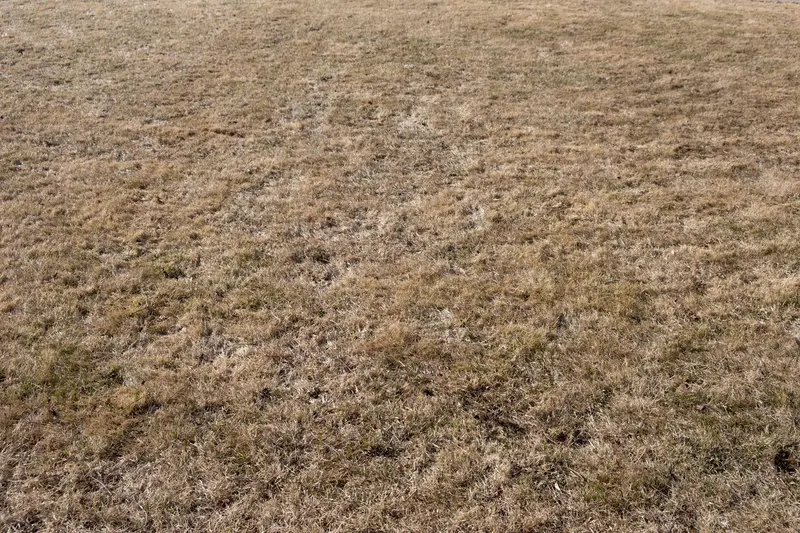
This is what a straw-coloured lawn looks like. It seems dead, but underneath, among the straw, there’s green. In a summer grass in the depths of winter that’s normal, and it comes back in spring. If what looks like this in August is a winter grass, that’s another story.
Winter grasses (tall fescue, ryegrass, meadow grass or poa, which is what nearly every bag contains) are the opposite: green from October to May and struggling from July to September, when they ask for a lot of water and still burn in patches. How to tell which one you already have is in reviving a lawn after summer.
The two kinds of lawn here, month by month
Neither is green all year. The summer grass turns straw-coloured in the coldest weeks; the winter grass struggles from July to September. Here you don’t choose the best lawn: you choose when you want it looking good.
If you live in the house in summer. In July and August the summer grass is at its best and the winter grass is struggling. For a summer holiday home, the summer grass.
If you live there from October to May. Those are exactly the winter grass’s good months and the summer grass’s worst. For a winter home, like so many on this coast, the winter grass, knowing that it will still need watering in summer.
This is what weighs most here and almost nowhere else: many houses on this coast aren’t lived in all year. A holiday home that fills up in July and August and a winter home lived in from October to May need opposite lawns.
A word of warning about the winter home. Even if nobody is there in summer, a winter grass needs its watering in July. Left without water it dies, and every autumn it has to be sown again.
The summer grasses, one by one
- Bermuda grass. The most common, and the one that wants the most sun: in shade it thins out until it disappears. It takes a lot of wear and recovers quickly. It’s sown or laid as turf.
- Kikuyu. The most vigorous. It covers fast and takes wear and drought, and for that very reason it creeps into the flower beds unless it’s given an edging. It almost always goes in as turf or as sprigs.
- St Augustine grass. Broad, thick leaf. It’s the summer grass that copes best with partial shade and salt, which is why it’s so common near the sea. It isn’t sown: only turf or sprigs.
- Zoysia. Dense, slow and low-effort: it grows slowly, needs mowing less and handles drought well. Its drawback is that same slowness: it takes a while to fill in.
- Paspalum. The one that best tolerates salt, even when watered with brackish water, which is why it’s used on golf courses by the sea. For a frontline garden, right by the sea, or one watered from a well that has turned salty, it’s the serious option.
The winter grasses, and the garden-centre bag
Tall fescue is the one in its group that handles heat best, and the base of almost every mix sold here. Ryegrass germinates very fast, which is why it’s in all of them, but it’s the one that gets through the summer worst.
They have two places where they really are the right choice: the house that’s lived in during winter, and real shade, under trees or on the north side of a high wall, where even St Augustine can’t manage. What isn’t a good idea is buying the bag without thinking, sowing it in full sun and expecting it to get through its first August like the picture on the packet.
Four questions to choose by
- When do you live in the house? In summer, a summer grass. From October to May, a winter grass. All year, almost always a summer grass: that’s when the garden gets used most and when it saves most water, and here its straw-coloured weeks are few.
- How much shade is there? In full sun, Bermuda, kikuyu or zoysia. In partial shade, St Augustine. In real shade, a winter grass, or consider something other than lawn.
- What water, and how much salt? On the frontline or with brackish well water, paspalum or St Augustine. If summer water is scarce, any summer grass before a winter one.
- How much is it walked on? With children, dogs or a ball, Bermuda or kikuyu, which recover by themselves. If it’s walked on little, zoysia or St Augustine.
When each one goes in
As turf, early autumn is a good time for almost all of them, with the soil still warm. Why, and what’s needed beforehand, is in natural lawn installation.
From seed it’s different. Winter grasses are sown now, in autumn. Summer grasses need warm soil and are sown in late spring. And several summer grasses can’t even be sown: they go in as turf or sprigs. If you’re torn between the two, it’s in seed or turf.
In short
Here no lawn is green all year. Summer grasses (Bermuda, kikuyu, St Augustine, zoysia, paspalum) handle the heat on less water and turn straw-coloured in the coldest weeks; winter grasses (tall fescue, ryegrass) are the opposite.
Choose the one that looks good when you’re there, and fine-tune for shade, salt and wear. And be wary of the bag that promises green for twelve months: here none of them delivers.