Blog · Natural lawns and turf
What’s under the lawn decides whether it lasts
Same lawn, same watering, same garden, and one strip that goes yellow every summer in the same place. The explanation isn’t in the grass: it’s thirty centimetres down.
 By Sergio Domínguez9 min read
There’s a symptom that turns up across half the Costa del Sol and that hardly anyone puts down to its real cause: a strip of lawn that goes yellow every summer, always in the same place, with a fairly straight edge. The rest of the garden holds up. It’s watered the same, it was sown the same day and it’s the same grass.
The usual reaction is to blame the grass or the watering. That area gets resown, a few minutes are added on the irrigation controller, a fertiliser gets tried. And the following summer the same strip appears in the same place.
The line wasn’t drawn by the grass
A good share of the houses on this coast are built on hillsides. To get a flat plot out of sloping ground you have to do two things at once: cut the high part down and fill the low part with that same material. It’s called cut and fill, and it’s done by machine before anything you see today exists.
The result is that your garden, although it’s one continuous surface from above, is two different grounds underneath. On the half that was cut down there’s subsoil: the material that used to be a metre and a half deep, compacted by the weight of the machine that drove over it. On the half that was filled there’s moved soil, loose and deep.
The same layer of topsoil was spread over both, and the lawn went on top of that layer. That’s why on handover day the garden is uniform, and why it takes years to stop being so.
The same garden, seen side-on
The day it was laid, the garden was all one. The same soil on top, the same lawn and the same watering. That’s why nobody suspects the ground: for months there’s nothing to suspect.
In summer both sides use water at the same rate. The sun doesn’t tell them apart, and nor does the irrigation controller: it gives both sides the same minutes because they’re on the same zone.
But one started with half a larder. Where the digger cut the slope down, the roots hit bottom two hand-spans down and there’s no reserve underneath. That strip dries out first every year, always in the same place: the line wasn’t drawn by the grass, it was drawn by the excavator.
Why you pay for it here and not so much elsewhere
A shallow profile isn’t a problem as long as it rains. If the soil is topped up every two or three weeks, having a small reserve hardly matters: it gets used and filled again. The defect is there, but it doesn’t show.
Here there’s none of that. Between June and September nothing falls that’s any use for recharging a soil, so the only thing going in is what the irrigation puts there, and irrigation wets from the top down as far as it reaches. Where the profile has depth, a reserve builds up below the root zone that acts as a cushion for weeks. Where the profile ends two hand-spans down, there’s nowhere to store anything: whatever the plant doesn’t drink that day is lost to evaporation or sits on top of the hard base.
That’s why the strip isn’t fixed by watering more. With the same zone and the same programme, lengthening the watering to save the bad part means waterlogging the good one. And with a compacted layer underneath, the extra water doesn’t go down: it sits there, and a lawn with wet feet and short roots has more problems, not fewer.
How to check without digging anything up
You don’t need to dig a test pit or order an analysis. Take an iron bar or a long screwdriver and push it into the lawn, without forcing it, at six or eight points spread across the whole garden. Do it the day after watering, with the soil damp, which is when it goes in best.
What you’re looking for isn’t a measurement, it’s a difference. If in one area the bar goes in easily and in another it hits something straight away, always at the same depth, you have your answer, and if you mark on a plan the points where it hits, you’ll get a line. Compare it with the strip that yellows. They’re usually the same.
The same screwdriver works for the other thing worth knowing, which is how far down the irrigation water is reaching; we cover that in how much to water the garden in summer.
What gets done before you sow or lay turf
If the lawn isn’t down yet, you’re at the only point where this is cheap to fix. Once there’s grass on top, any work means lifting it.
What has to be done, in order:
- Break up the compaction wherever there is any. It isn’t the same as running a rotavator over it: a rotavator turns the top few centimetres and can even leave a compacted pan just below where the blades reach. What’s needed is to decompact the area that hits bottom, at depth, and that’s sometimes a job for a machine.
- Even out the depth, not just the surface. If one half has depth and the other doesn’t, spreading a uniform layer of good soil on top leaves the problem just as uneven. Where the profile is shallow it needs more thickness, not the same.
- Sort out where the water drains to. A compacted layer is also a bathtub. If the garden has an area that takes a long time to dry after a long watering, that gets fixed now, not later.
- Have the irrigation tested before the material arrives. Once the turf is on the pallet, the clock is ticking.
And then there’s the decision everyone always talks about, which is seed or turf. It’s a real decision and it has its answer, but it comes after this one and matters less: we compare them in seed or turf.
And if the lawn is already down
Then the options are different, and it’s worth saying what each one is without selling any of them.
What does help, without lifting anything, is aerating that area with a hollow-tine machine (the kind that pulls out cores of soil, not the spiked kind, which compacts more) and filling the holes with sand or a top dressing. That doesn’t create depth where there isn’t any, but it improves how the water gets in and gives the roots a little more room. It has to be repeated; it isn’t a one-off.
What also works, and is usually the most sensible solution of all, is to stop asking that strip to be lawn. If underneath there are two hand-spans of soil over compacted material, that isn’t a bad place to plant: it’s a different place. A bed of plants that don’t need constant watering, a gravel area or a path will do a better job there than grass that’s going to look bad four months of the year. What you can put there is in drought-tolerant plants.
What fixes nothing is resowing that strip every autumn. The seed comes up just as well as in the rest of the garden, because the top few centimetres are more than enough for it to germinate. The problem comes in July, when it needs what’s underneath and it isn’t there.
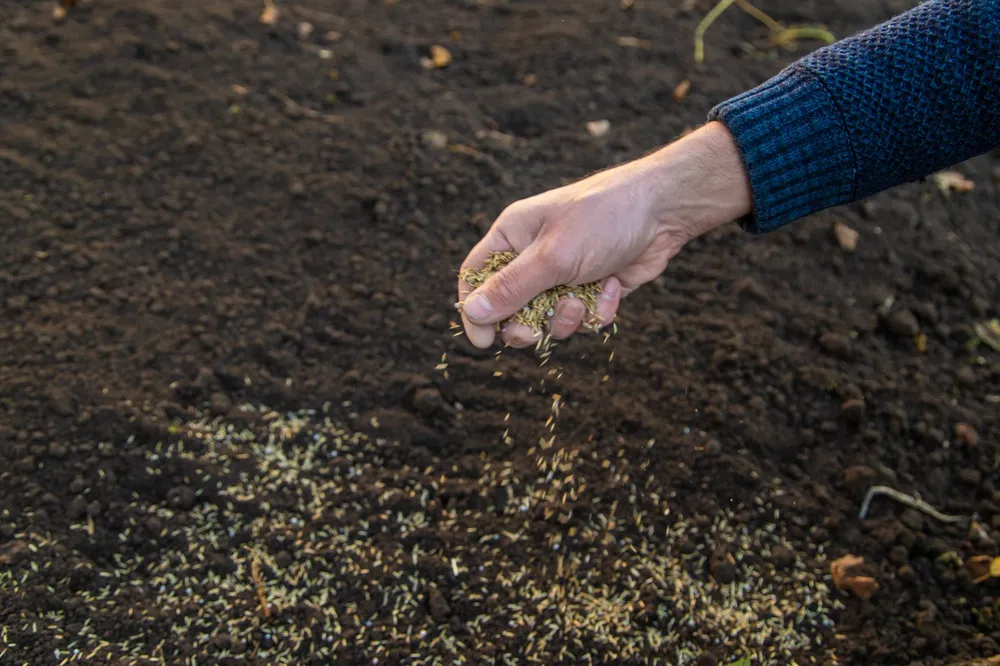
To germinate, this seed only needs what you see in the photo: the top few centimetres, damp and loose. That’s why an October resowing almost never fails, and why it proves nothing about what will happen in July.
Why this isn’t in anyone’s quote
Because it can’t be seen. A lawn quote that includes decompacting, adding uneven depths of soil and sorting out the drainage is dearer than one that doesn’t, and both end with a green garden on handover day. The difference shows up in the second or third summer, when nobody connects one thing with the other any more.
So if you’re comparing quotes, the useful question isn’t how much a square metre of turf costs. It’s what has been planned for the ground before it goes down, and what that plan is based on. What makes a gardening quote go up or down is about exactly this.
In short
A strip that always yellows in the same place isn’t a grass problem or a watering problem: it’s almost always the boundary between what the machine cut down and what it filled when the plot was made. You can check it in ten minutes with a screwdriver.
If the lawn isn’t down yet, now is the time to fix it and it’s cheap. If it is, it can be improved by aerating, but it’s worth asking whether that strip has to be lawn at all. What doesn’t work is resowing it every autumn and expecting a different result.