Blog · Mediterranean garden
What to plant here so you’re not watering all summer
August is ending, you look at the garden and the question asks itself. The answer has less to do with the list of plants than with where you put them and what you do in the first year.
 By Sergio Domínguez9 min read
August is ending, you go out into the garden and the balance sheet is there for all to see: some things have come through the summer without noticing and others have spent a month looking as if they’re just hanging on. The question asks itself — what can I plant that won’t give me all this work? — and it has an answer, but not quite the one you expect.
“Drought-tolerant” doesn’t mean what it seems
Before the list, the thing that kills more plants than anything else on this coast: a drought-tolerant plant isn’t drought-tolerant on the day you plant it. It becomes so once its roots are established, and that takes a good year.
The sequence is always the same. Someone buys rosemary and lavender because “they’re Mediterranean and don’t need watering”, plants them in May, follows the no-watering rule to the letter, and by August has two dried-up bushes. From that comes the conclusion that they don’t take here, when what actually happened is that they died before they got to be what was bought.
The first summer they need watering, even if they’re the toughest in the catalogue. From the second, less and less. And from the third on, almost nothing. That “almost nothing” is real, and it’s what makes it all worthwhile.
How to recognise them without knowing the list
There’s a shortcut that works in any nursery, and for plants that don’t appear on any list: the adapted ones look alike, and you can tell by the leaf.
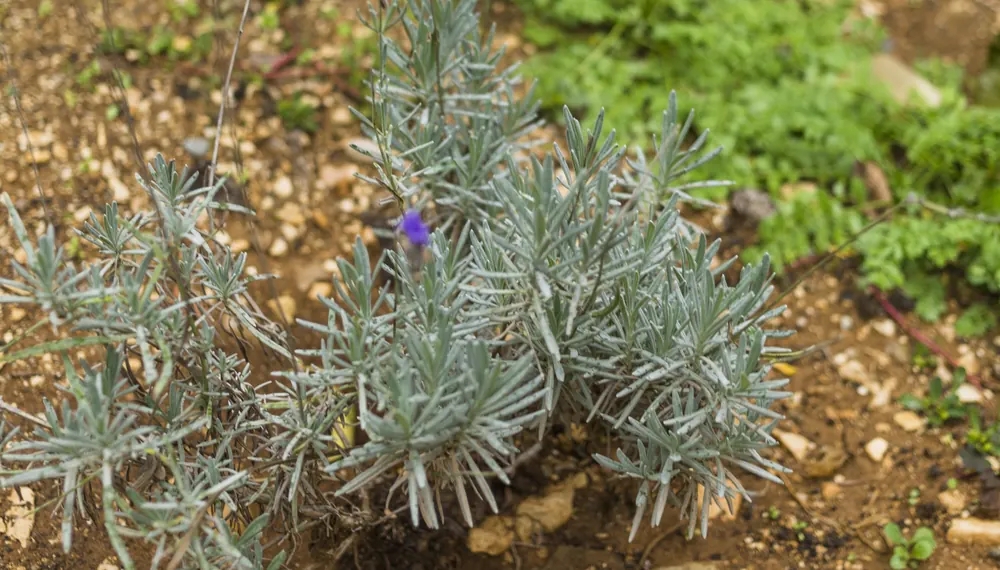
Look at four things and you’ll get it right almost every time. Small leaves, because the less surface, the less water evaporates. Hard or leathery leaves rather than soft ones. Grey or silver colour, which isn’t decorative: it’s a layer of fine hairs that reflects the light and slows down the dry air against the leaf. And often a scent when you rub it, because those oils also cut the loss.
A plant with big, soft, deep-green leaves is telling you it comes from somewhere it rains in summer. It can live here, but it will cost you water every year.
What does well here, no argument
For structure: rosemary, lavender, myrtle, teucrium, santolina, thyme. Shrubs that can be clipped, take full sun and ask for nothing once they’re settled.
For volume and height: oleander, pomegranate, olive, carob. Oleander is the plant in the motorway central reservations of half of Andalusia, and that’s exactly the reference you need: nobody waters it.
For summer colour: bougainvillea, lantana, plumbago. They flower precisely in the months when the rest of the garden is flagging. And if a bougainvillea won’t flower, it’s usually getting too much water, not too little: we explain it in why bougainvillea won’t flower.
For ground cover, so there’s no bare soil: gazania, aptenia, sedum. They spread, make do with little and save a lot of weeding.
For the impossible spot: agave, aloe, prickly pear. Where the hose doesn’t reach and the sun beats down all day.
And what doesn’t work, even if they sell it to you
It’s worth saying, because it’s still sold in the same nurseries with the same “suitable for outdoors” label. Hydrangeas, camellias, azaleas and Japanese maples aren’t plants for here, and not because of the heat: they want acid soil, and here the soil is chalky and the water hard. You can have them, but as a crop, with their own compost and corrections every season.
And then there’s the lawn, which isn’t a plant but a surface, and it’s the most expensive thing to maintain you can put in a garden on this coast. If you want one, have one; but have it where it gets walked on, not as filler for all the leftover space.
The mistake that takes out the good ones
With the list in hand, here’s the trap: planting them mixed in with the usual plants and running everything off the same watering. It’s what most people do, and it’s why the lavender lasts two years.
The bed seen from above
The same dose for everyone. You end up watering for the thirstiest plant, and the grey-leaved ones rot from below without giving any sign that they’re getting too much water.
Three zones, three doses. No building work needed: just plant together the ones that need the same, and cap the drippers you don’t need.
Waterlogged.Thirsty.
The underlying problem is that a watering schedule ends up set for the plant that asks for most, because it’s the one that complains first. The others put up with it quietly until they can’t any more. And a grey-leaved plant that’s rotting gives no hint that it’s getting too much water: it fades, goes dull and one day it’s dead, with every chance of the drought getting the blame.
The fix isn’t building work. It’s planting together the ones that need the same and, if the irrigation is already in, capping the drippers that fall where they aren’t needed.
And mulch isn’t optional
Covering the soil around it — with bark, gravel or whatever suits — does more for a newly planted plant than half an hour with the hose. It cuts evaporation right in the few centimetres where all its roots are in the first year, and it also keeps down the weeds that are stealing its water. How it works is in how much to water the garden in summer.
When to buy them
Not now. If you’ve got this far in August, the best thing you can do with this list is keep it until October: planting in autumn gives the roots the mild, damp months they need before their first July, and that’s exactly what decides whether “it hardly needs watering” ever comes true. The reasons, in detail, are in why here you plant in autumn.
A note on place: on big inland plots this stops being a preference and becomes the only viable option, because no well can keep two thousand square metres of thirsty planting watered. We cover it in gardeners in Alhaurín and Coín.
In short
Choose by the leaf before the name, group by thirst before colour, always mulch and water the first year as if they weren’t drought-tolerant. From the third year on, the garden practically looks after itself, which was the question at the start.