Blog · Mediterranean garden
Winter-flowering plants: here it’s the other flowering season
Here winter isn’t the garden’s dead season: a group of plants flowers just as the rest stops. Which they are, where they don’t work, and the light that keeps a poinsettia green.
 By Sergio Domínguez7 min read
Across most of Spain, winter is the garden’s dead season. Not here. Near the sea it barely freezes, and there’s a group of plants that flowers precisely from November to March, while the rest of the garden is at a standstill. Some of them are the very same plants sold as houseplants in the rest of the country.
Why they flower in winter here
There are two reasons. The first is where they come from. Several of the best winter performers here are from South Africa, where they also flower in the cool season. Here, with the cool weather and the little rain of the year, they do the same.
The second is what doesn’t happen: it doesn’t freeze. A frost burns the flowers and sometimes the whole plant, and right by the sea there are hardly any. That’s why here plants go into the ground, out in the open, that inland only get through the winter under cover.
What flowers here in winter
The one you see most is aloe. Not the aloe vera in creams, but Aloe arborescens: big clumps of leaves in rosettes, with teeth along the edges, which in the depths of winter send up spikes of orange-red flowers you can see from a distance. It wants sun, little water and soil that doesn’t get waterlogged, and with that it forms a clump you don’t have to touch.
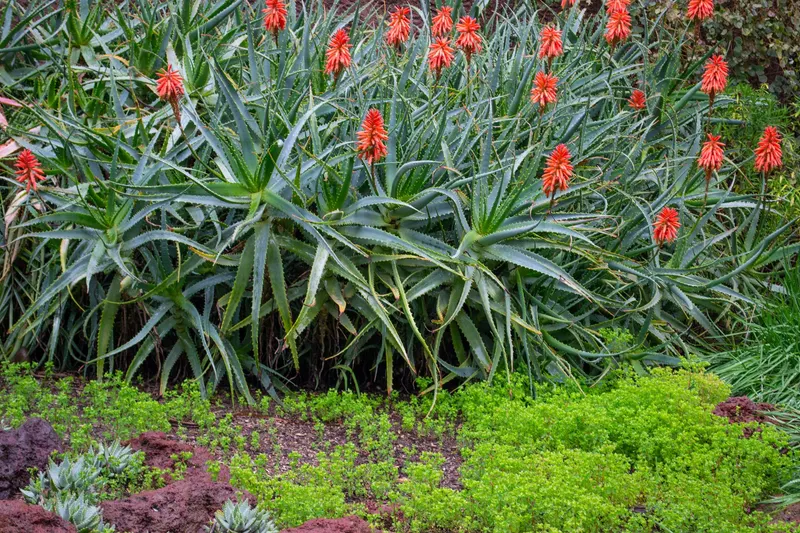
A clump of Aloe arborescens in flower. The rosettes are there all year; the red spikes are a winter thing. It’s a plant for a dry, sunny spot, and over the years it will cover a bank or a corner on its own.
After the aloe, the ones that give most in a coastal garden:
- Bird of paradise. Strelitzia flowers for a good part of the year, and above all in the cool season. In the sun and in a sheltered spot, because the wind shreds its leaves.
- Cape honeysuckle (Tecoma capensis). A shrub, or a climber if you give it support, with orange flowers from autumn into winter. It grows fast and takes clipping well, so it’s good for covering a fence.
- Polygala. A purple-flowered shrub that in a garden here is almost always in flower, and more so in winter and spring. Once established, it makes do with little water.
- Jade plant. In a pot indoors it hardly ever flowers. Outside, with the cool autumn nights, it fills up in winter with small white or pink flowers.
- Flame vine (Pyrostegia venusta). The climber that covers walls and pergolas in deep orange in the middle of winter. It needs sun and something to cling to, and it’s one of the first to suffer if there’s a frost.
Here, the poinsettia is a shrub
It’s the most striking case. In the rest of Spain the poinsettia is the pot you buy in December and throw out in January. Here, planted in the ground in a sheltered spot, it grows into a shrub taller than a person and turns red on its own every winter.
The red parts aren’t flowers, they’re leaves: the ones at the top of each stem, which change colour. The real flowers are the little buttons in the middle. And what triggers the change isn’t the cold but the length of the night. A poinsettia needs several weeks in a row of long, dark nights to colour up. That’s why it starts in autumn, when the nights draw in, and is at its best at Christmas.
That’s where the most common problem comes from, and the one fewest people believe: a light left on at night keeps it green. A street lamp, the porch light, a terrace light that stays on. A little light in the middle of the night is enough for the plant to count the night as short.
The same poinsettia, with and without light at night
The same plant, in the same garden. In September both are green. The nights are still short and the poinsettia hasn’t started to change.
The nights get longer. With long, dark nights, the top leaves of the one on the left start to colour. The one on the right has a street lamp beside it that comes on every night.
One is short of night. The one on the left reaches December red. The one by the lamp stays green: it isn’t short of feed or cold, it’s short of darkness.
If your poinsettia stays green while your neighbour’s turns red, before you feed it or move it, check what light reaches it at night. Sometimes it’s enough to switch off a spotlight or turn it away. If it’s a street lamp, that plant is in the wrong place to turn red, and you’re better off moving it or accepting that it will be green.
Two more things. It has a milky sap that irritates the skin and eyes, so wear gloves to prune it. And it’s pruned at the end of winter, once it has lost its colour, not in autumn: what you cut now are exactly the stems that were going to turn red. It isn’t the only plant that an autumn trim robs of its flowers: we cover it in what not to prune in autumn.
Where not
All this holds for the strip near the sea. A few kilometres inland, in the valleys and above a certain height, winter nights are quite a bit colder and the odd frost does come. There the list gets shorter. The poinsettia is one of the most delicate: in real cold it drops its leaves, and a frost burns it. How the garden changes in the valley is covered in gardeners in Alhaurín and Coín.
And within the garden itself the same thing happens on a small scale. The lowest corner, where the cold air settles at night, freezes before the south-facing wall does. Delicate plants go against a sunny wall and, if possible, under the eaves.
When to plant them
Now. Here you plant in autumn, with the heat gone and the whole winter ahead for the roots to settle before the first summer. Why the calendar here runs the other way round is in when to plant on the Costa del Sol.
A word of warning so you’re not disappointed: a plant you put in in October will spend this first winter making roots, and may not flower much. If you want it in flower now, buy it in flower at the nursery and plant it anyway. The good winter is the second one.
Watering in winter
They flower with the cool weather and the rain, but there are winters here when it hardly rains at all. If weeks go by without water, the odd watering helps them hold on to their flowers.
What you mustn’t do is leave the irrigation controller as it was in summer. With less sun and less heat, the same watering waterlogs the soil, and aloe and jade plant rot at the roots long before anything shows above ground. That’s why they’re better off not sharing an irrigation zone with the lawn: we explain it in grouping plants by how much they drink.
In short
Here winter is another flowering season. Aloe, bird of paradise, Cape honeysuckle, polygala, jade plant, flame vine and the poinsettia, which in the ground becomes a shrub. They work near the sea and in the sun, and they struggle inland and in the corners where the cold settles.
And if your poinsettia won’t turn red, don’t give it more feed. Check what light it gets at night. If you want a garden that flowers in winter too, that’s decided when it’s designed: we cover it in landscaping and garden design.