Blog · Mediterranean garden design
Group plants by what they drink, not by how they look together
If the same bed holds lavender and hydrangeas, there’s no right watering programme: whatever number you set leaves one of them out. It isn’t the watering, it’s where they were planted.
 By Sergio Domínguez9 min read
There’s a conversation that comes round every September. The client shows us a bed where half the plants are doing beautifully and the other half so-so, and asks what’s wrong with the watering. The awkward answer is that nothing’s wrong with the watering: there’s no programme that will keep both halves happy, because plants that drink different amounts were planted together in that bed.
And it isn’t a rare mistake, or an amateur one. It’s what you get by default if you choose plants by how they look together, which is how almost everyone chooses them, including quite a few schemes drawn up by professionals.
The controller can’t do two things at once
An irrigation zone is a group of plants connected to the same solenoid valve. When the controller opens that zone, they all get the same for the same length of time. There’s no way for one to get twice as much as its neighbour if they’re on the same zone, however different they are.
That turns choosing a spot into a watering decision, even if it doesn’t look like one. When you decide the lavender goes to the left of the hydrangea, you’re deciding that both will drink the same for the rest of their lives.
One zone, two different thirsts
You turn the watering down so the lavender doesn’t rot. It suits the lavender, and the hydrangea next to it spends August wilting. It’s the same zone, so they get the same.
You turn it up to save the hydrangea. Now it’s the lavender that’s in trouble, and it takes a while to show: dry-loving plants don’t complain the same day, they rot from below for weeks.
Between the two bands there’s nothing. There’s no in-between number that keeps both happy: a halfway point just makes both uncomfortable at once. What needs moving isn’t the controller, it’s one of the two plants.
Why the clash is bigger here
Grouping plants by what they drink is recommended in any climate. What happens on this coast is that the two things that make it painful come together.
The first is the palette. The mild winter lets you grow subtropical species here that inland wouldn’t make it past November, so the same nursery, the same aisle and the same trolley can hold a dry-loving lavender and a fern that wants constant moisture. Nobody warns you they’re incompatible in the same bed, because on their own both are perfectly suited to the place.
The second is that it doesn’t rain when it’s needed. In a climate with summer storms, the rain evens out the accounts every few weeks and hides a badly planned layout quite well. With four months in a row without useful rain, the only water that goes in is the water you decide on, and any mismatch builds up with nothing to correct it.
That’s why the same mistake that elsewhere gives you a mediocre garden, here gives you a garden with casualties.
The damage doesn’t show on both sides at the same time
This is what confuses people most, and what makes it take years to diagnose. The thirsty plant warns you straight away, and the over-watered one almost never does.
A hydrangea short of water droops its leaves that same afternoon and perks up again when you water. It’s a loud, immediate, reversible warning, and it pushes you to turn the watering up.
A lavender with too much water shows nothing for weeks. It works from below: the roots suffocate in soil that never gets to dry out, collar rot sets in, and what you see in the end is a bush that splits open in the middle or one day turns up completely dry, in the middle of summer, just when it was being watered most. It’s almost always read as a lack of water, and the conclusion is to water even more.
So the garden’s feedback always pushes in the same direction: up. That’s why most mixed beds end up watered for the most demanding plant, with the dry-loving ones slowly dying inside them.
How to divide it, in practice
You don’t need a plan or a botanical classification. Three piles sort out ninety per cent of it:
- The ones that want almost nothing once established. Rosemary, lavender, santolina, teucrium, shrubby salvias, and plants with grey, aromatic or fleshy leaves. These die more from too much than from too little.
- The middle ones. Most garden shrubs, which like a long watering at wide intervals and don’t cope well with either puddles or extreme drought.
- The ones that really ask for it. Hydrangeas, ferns, many plants with big glossy leaves, and practically anything of subtropical origin. The lawn too, which is the biggest drinker in the garden and always deserves its own zone.
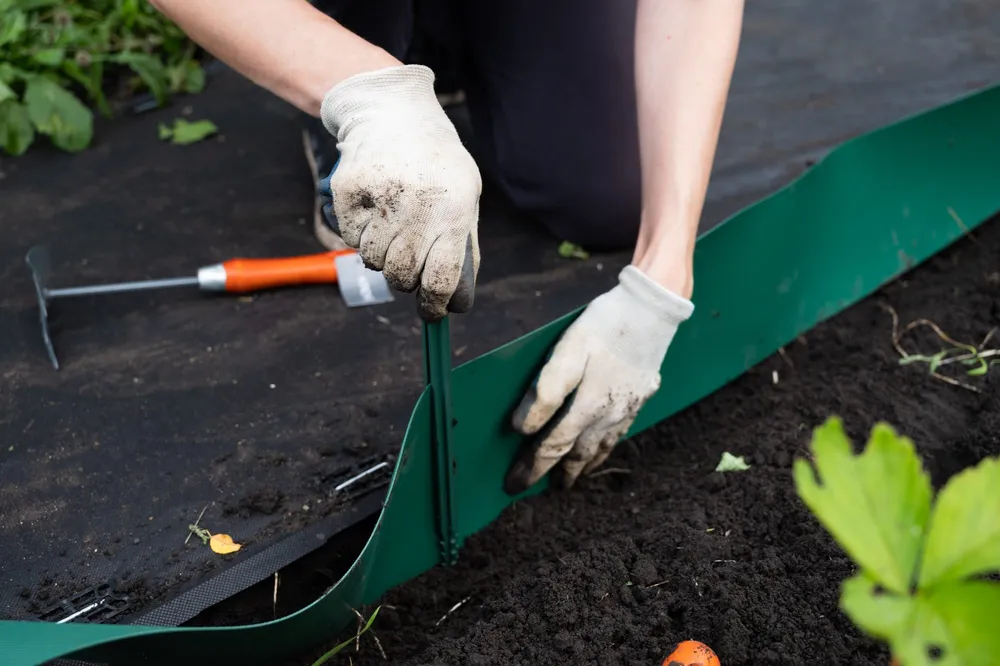
Separating two zones starts with deciding where the line goes. This one is physical and you can see it. The one that really decides the outcome — which plants share an irrigation zone — can’t be seen from anywhere, but it’s drawn at the same moment and with the same spade.
Each pile, one zone. And if the garden is already planted and there’s only one zone, the division still holds: what you do then is move plants, not change the programme. October is a good month for that, as it’s when everything else gets moved too. Why transplanting goes in autumn and not spring is in why here you plant in autumn.
Two details that spoil a correct division
Exposure counts as thirst. The same species in full afternoon sun and in the shade of a wall doesn’t drink the same, not by a long way. If your garden has a very exposed side and a sheltered one, that’s another division, on top of the one by species. A lavender on the north side of the house and another on the south side are two different cases.
And the soil rules beneath everything. Two identical plants, with the same watering and the same exposure, behave differently if one has half a metre of soil and the other a hand-span or two over compacted fill. That’s common on the hillside plots of this coast, and we cover it in what’s under the lawn, which is about lawns, but the mechanism is the same for any plant.
What this saves, and it isn’t just water
A garden divided by thirst gets watered less, yes, but what really changes is that it stops needing someone keeping an eye on it. When each zone has only one type of plant, the programme is set once a season and forgotten. When the bed is mixed, someone has to referee all summer between two plants that want opposite things, and that someone isn’t there if the house is a holiday home.
That’s why this division matters more in a holiday home than in a house lived in all year round. Not because the plants are different, but because there’s nobody there to correct the mistake by hand.
In short
If dry-loving plants and plants that want water share the same bed, the watering has no solution: any adjustment leaves one lot or the other out, and since thirst gives a warning and excess doesn’t, you end up watering for the demanding ones and losing the dry-loving ones without understanding why.
The decision isn’t the controller’s, it’s the plan’s. Three piles — little, medium and a lot — one zone for each, and the lawn on its own. If you’re planting this autumn, this is decided before you buy anything; and if the garden is already planted, it’s fixed by moving plants, which is October work too.