Blog · Mediterranean garden design
A garden without a lawn: what to put in its place and how it copes in August
Taking out the lawn is the change that saves the most work in a garden here, but you can swap it for something worse in July. Where to keep it, what to put in the rest, and what heats up, floods or grows back.
 By Sergio Domínguez7 min read
In this climate a lawn is the most expensive thing a garden can have to maintain: the plant that asks for the most water, needs the most mowing and is the first to complain. Taking it out is the change that saves the most work.
The risk is swapping it for something worse in July: an expanse of gravel that’s scorching, bare soil that fills with dust and weeds, or a lawn that comes back up between the stones. Whatever goes in its place is judged in August, not on the day the work is finished.
First, look at where people walk
Before deciding what comes out, you have to see what gets used. Over a normal week, notice where people walk, where they sit and where the children or the dog play. It’s almost always a few strips: from the terrace to the pool, from the house to the gate, a corner for playing. The rest gets looked at, but not walked on.
The same garden, seen from above
A garden that’s all lawn. All of it is watered and mown the same, even though a good part of it isn’t walked on all year.
What really gets walked on. From the terrace to the pool, from the terrace to the gate, and the corner where people play. The rest gets looked at, but not walked on.
Lawn only there. It stays where it’s used, and the rest becomes local plants with mulch, which don’t need mowing and drink much less.
The solution that works best here usually isn’t taking out all the lawn, but keeping it only where it’s used. What gets walked on needs something that stands up to feet and doesn’t burn bare soles, and for that a lawn is still one of the best things there is. What isn’t walked on doesn’t have to be lawn.
What to put in the rest
Local plants, with mulch. It’s what saves the most water and work. Shrubs and low plants that get through the summer on little watering, grouped by how much they drink, and between them a layer of bark or gravel that covers the soil, holds the moisture and keeps the weeds down. It isn’t mown, and once established it needs far less watering than a lawn. Which ones work is in what to plant so you’re not watering all summer.
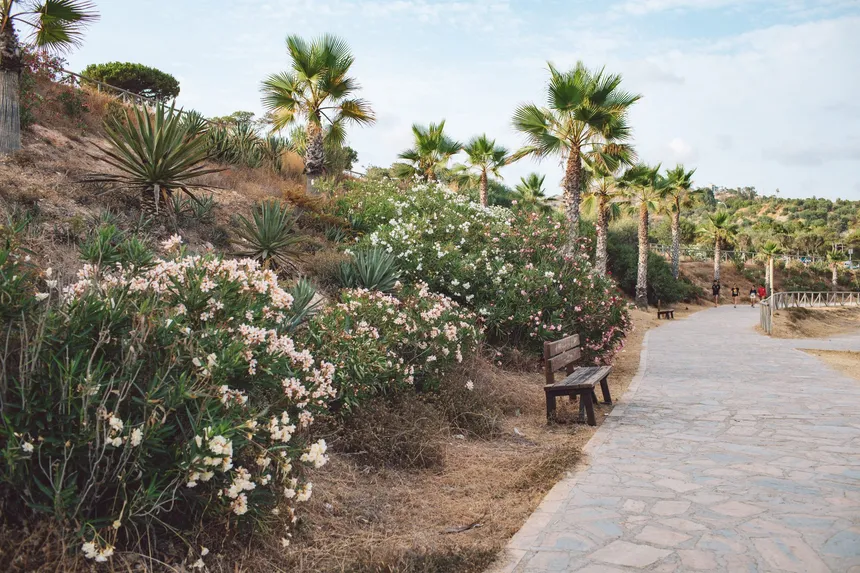
Beds without a single blade of grass next to a seafront promenade: oleanders in flower, agaves and palms on dry soil. It’s what holds up here on little water. In a garden, with mulch underneath, it looks more cared for and asks for even less.
Lippia, if something gets walked on now and then. Lippia (Phyla nodiflora) is a ground cover used a lot in the south instead of lawn, in areas with little foot traffic: it covers the ground, needs little watering and can be walked on without suffering. There are two things worth knowing beforehand. It flowers and attracts bees, so it isn’t for going barefoot in summer. And in the coldest part of winter it turns brown, like the summer grasses.
Gravel, used with sense. It doesn’t need watering and it’s cheap, but in the sun it builds up heat, and white gravel also dazzles and throws the heat back at the house. It works on paths and between plants that will gradually cover it, not as an expanse in full sun next to the house. And the weed membrane underneath isn’t for ever: over the years soil builds up on top of it and weeds grow on that.
Paving or decking where the table and chairs will go. It works, but the rain that used to fall on the lawn now has to go somewhere. We cover it in paving the garden and where the water goes.
Artificial grass. It gives you green without watering, but in the August sun it gets much hotter than natural grass, and it needs its own maintenance too. It’s in why artificial grass gets hot.
The usual thing is to combine them: lawn where people walk, plants with mulch along the edges and on the banks, gravel on the paths and decking where the table goes. Each part is watered on its own zone with what it really needs, which is where the saving is.
What not to do
- Taking out the lawn and leaving the soil bare. In summer it’s dust, with the first rain it’s mud, and within a month it’s full of weeds.
- Putting gravel on top of kikuyu or Bermuda grass. Both spread by creeping stems that keep resprouting for years, and they come up through the gravel and the membrane. They have to be dug out completely, roots and all, before anything goes down.
- Planting the new things on the lawn’s irrigation zone. Whatever replaces the lawn drinks much less, and if it shares the watering with it, either it drowns or the lawn that’s left dries out. Why, in grouping plants by how much they drink.
When to do it
Now. Autumn is when you plant here: whatever is new has the whole winter to root before its first summer, which is the one that decides whether it works. Why the calendar here runs the other way round is in when to plant on the Costa del Sol.
You don’t need any product to take the lawn out: it’s lifted with a spade or a turf cutter, taking the roots and leaving a margin round the area, and in spring it gets gone over in case a creeping stem left behind sprouts again. It’s more work on the first day and saves years of pulling weeds out from between the stones.
And if what you have is a shady corner where the lawn has never wanted to grow, there’s no need to keep fighting it: the sensible thing there is to plant something else. Which grass copes where is in which grass to plant on the Costa del Sol.
In short
Before taking out the lawn, look at where people walk and keep it only there. In the rest, local plants with mulch, Lippia where it’s walked on now and then, gravel on paths and between plants, and paving where the table goes.
What you don’t do is leave bare soil, put gravel over living kikuyu or water everything on the same zone. And it’s done in autumn, so the new planting reaches its first August already rooted.