Blog · Mediterranean garden
Why here you plant in autumn, not in spring
Spring is a good time to plant where the enemy is the cold. Here the enemy is July, and that turns the whole calendar upside down.
 By Sergio Domínguez7 min read
Almost everything you read about planting takes one thing for granted: that the enemy is winter. That you have to wait for the cold to pass, plant in spring and let the plant get established through the good weather.
It’s excellent advice. For somewhere else. Here winter doesn’t kill anything, and what does kill, every single year without fail, is July.
The calendar is upside down because the enemy is different
Where it really freezes, planting in November condemns the plant: in frozen soil the roots don’t grow, and a plant that doesn’t root in four months of winter reaches spring worse off than when you put it in. That’s why half of Spain plants in spring, and why every manual says so.
On this coast the soil doesn’t freeze. What there is, as regular as clockwork, is a four-month summer without any rain worth the name, and a newly planted plant stakes everything on it. So the useful question isn’t when the weather is best for planting. It’s how much time I’m giving this plant to make roots before its first July.
Put that way, the answer gives itself.
What grows before the heat arrives
Planted in November
8 months
Eight months of mild soil and rain to make roots. Nothing shows above ground, and that’s exactly what should be happening.
Planted in March
4 months
It joins halfway along, with the same exam date. It has half the time, and has to split it between sprouting and rooting at once.
And it isn’t four months against eight of the same quality. The spring plant’s four include May and June, when it’s already sprouting and spending, and they end just as the serious part begins. The autumn plant’s eight are quiet months in which it has nothing to do but take hold.
What the plant is doing all that time
On the face of it, nothing. That’s the part that disheartens anyone who plants in November: weeks go by, not a single new leaf appears, and it feels as if you’ve buried a stick.
Below ground, the only thing that matters is happening. With no new leaves to feed and no heat to evaporate the water, the plant can put everything it has into its roots, and it does so in soil that here stays mild and gets watered on its own. It’s the only time of year when rooting doesn’t compete with anything.
The difference shows in March. The autumn plant sprouts with its root system already in place and only has to get on with growing. The spring one sprouts and roots at the same time, from the same tank, with the clock against it.
The advantage that only exists in winter: bare root
There’s a second reason to plant in these months, and it’s purely practical. While plants are dormant, they’re sold bare-root: no pot and no soil, just as they come out of the nursery field. Roses, deciduous fruit trees, deciduous hedging. In May that option simply doesn’t exist.
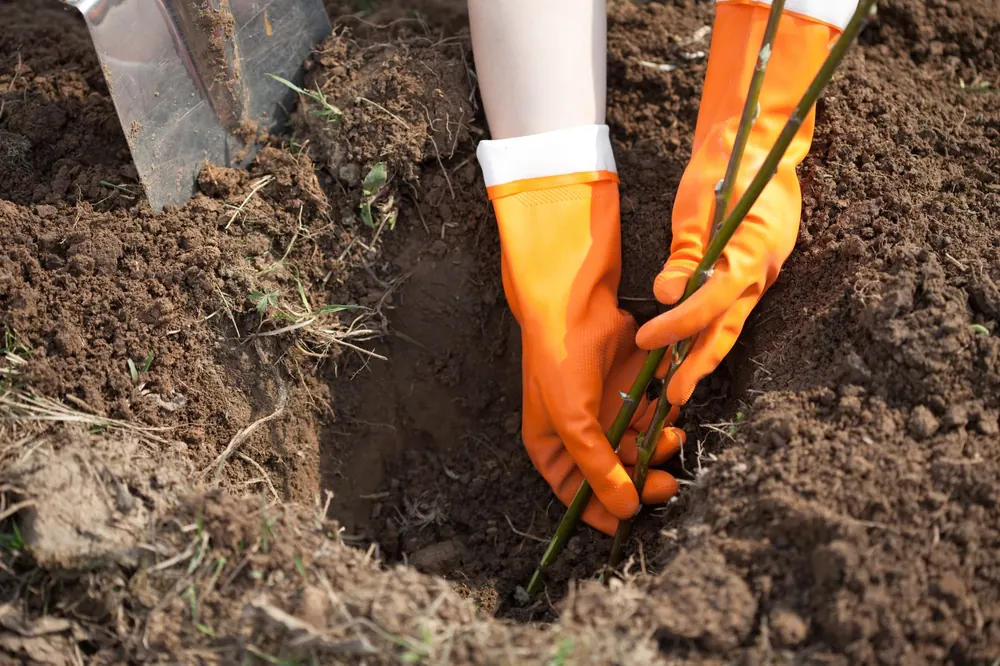
It’s worth it for three reasons. It’s quite a bit cheaper than the same plant in a container. You can see the roots you’re buying before you pay for them, a luxury you don’t get with a covered root ball. And it spares you the classic pot problem: the plant that has spent too long in a small pot and arrives with its roots circling round on themselves, which, unless you tease them apart by hand, go on circling underground for years.
If you buy in a container — which is normal for almost everything Mediterranean — take the plant out of its pot at the nursery and look at the roots before you decide. It’s free information.
When, exactly
October and November are the good window. The soil keeps the summer’s warmth, and the first rains settle the earth around the roots far better than a hose.
December and January are fine, especially for bare-root plants and anything deciduous, which is fully dormant. It roots more slowly, but it roots.
February is the last comfortable window. From then on, every week that goes by is a week less of margin. March is still possible, as long as you accept you’ll have to water more in the first summer. April is cutting it fine.
May to September, only if there’s no other choice. It can be done, and in fact it’s done all the time on new builds, but then that plant isn’t a garden plant: it’s a crop, and it has to be watered like one for months. Nobody warns you about that when they sell you the plant in June.
Planting in autumn doesn’t get you out of the first summer
It’s worth saying, because this is where the illusion breaks. A first-year plant has to be watered in its first summer, whether you put it in in November or in March. What changes is the margin: the autumn one has enough root to survive a few days’ lapse; the spring one doesn’t.
That first summer is exactly where it’s decided whether the money you spent on the plant was worth anything, so it pays to do it properly. We cover it in full in how much to water the garden in summer. The short version is that almost everyone waters little and every day when they should water a lot and with gaps in between.
The exceptions, which show where the rule comes from
The rule isn’t “autumn is magic”. It’s “give the plant as much time as possible before its worst season”. As soon as the worst season changes, the date changes with it.
Cold-sensitive subtropicals go the other way. A young avocado or cherimoya has more to fear from a frost than from an August, especially inland. Those are better planted in spring: the whole summer ahead, with watering, so they reach their first winter established.
So do palms. They root when the soil is warm, and moving them in the middle of winter is the surest way to have them sit still for half a year. That said, if you transplant a palm in the warm months, bear in mind that the red palm weevil flies precisely then and that any fresh wound is an invitation.
Anything going into a pot escapes most of this, because you control the compost. There, the date matters much less than the size of the pot and the watering.
A note on place: frost isn’t the same across the whole province. Right by the sea it practically never freezes, but in the valley, without the sea to soften it, winter nights get quite a bit colder and the list of what survives gets shorter. We cover it in gardeners in Alhaurín and Coín.
And if you already planted it in spring?
There’s no need to dig anything up. What you need to do is treat it for what it is during this first summer: a plant without enough root, and that means two specific things.
One, don’t rely on the garden’s general watering. A sprinkler set up for an established lawn or settled shrubs doesn’t reach where it needs to on a plant whose root ball is still the size of the pot it came in: you have to wet that root ball, not the square metre around it.
And two, mulch. A layer of organic material on the soil cuts evaporation a lot, right in the few centimetres where that plant has all its roots. It’s the cheapest thing you can do for it in August, and the one that shows most.
In short
If you’re reading this in summer, the short answer is wait for October. Not because planting now is impossible, but because waiting six weeks costs you nothing and saves you a whole summer of rescue watering.
And use the wait for what does need doing now: deciding what goes where, checking how many hours of sun each corner really gets and getting the winter pruning calendar ready, which falls on the same dates.