Blog · Efficient irrigation
How much to water the garden in summer on the Costa del Sol
“How many days between waterings?” is the wrong question. What decides it is how much water your soil holds and how much it’s losing, and you check that with a screwdriver.
 By Sergio Domínguez8 min read
The question always comes the same way: “how many days between waterings?”. And the honest answer is that it’s the wrong question. A garden isn’t watered by the calendar, it’s watered by what’s underneath: how much water your soil holds and how much it’s losing.
What can be said precisely is what goes wrong here, because it’s almost always the same thing.
The mistake almost everyone makes
Watering a little every day. Ten minutes every evening looks careful, and it’s exactly the opposite.
A short watering wets the top few centimetres of soil and stays there. The plant, which isn’t daft, puts its roots where the water is: near the top. And near the top, in July, the sun cooks the first few centimetres of soil every day. You’ve raised a plant with its roots in the most hostile place in the garden, and dependent on you into the bargain: the day you miss two days, it gives up.
The opposite works. Water less often and for longer. The water goes down, the roots follow it down, and thirty centimetres below the surface the temperature and moisture are much more stable. A plant with deep roots gets through a heatwave; one with shallow roots doesn’t.
What happens underground
The roots stay where the water is: near the top, right in the centimetres the sun cooks every day.
The water goes down and the roots follow it. At that depth, temperature and moisture hardly change from one day to the next.
How to tell whether you’re watering enough
You don’t need any gadget. Water as you normally do and, half an hour later, push a long screwdriver into the soil. It goes in easily while there’s moisture and stops dead when it reaches dry ground.
- If it stops after four or five finger-widths, you’re only watering the surface.
- If it goes in twenty or twenty-five centimetres without effort, you’re doing fine.
Repeat the test two days later. If it’s still damp at that depth, it isn’t time to water yet, however many days have gone by. That’s the real calendar.
The time of day matters more than it seems
Early morning, between 5:00 and 8:00. The soil is cool, there’s no wind and the water has time to soak in before it starts to evaporate. At midday, a good part of what comes out of the sprinkler goes into the air without reaching the roots.
And at night, when you go to bed? It’s worse than it looks on this coast. The humidity here is already high, and leaving the foliage wet for eight hours straight is an invitation to fungus. Same water, same money, more problems.
Each part of the garden needs something different
Watering the whole garden the same way is convenient and expensive. The needs are nothing alike:
Lawn
It’s by far the most demanding, and the first thing to look at if the water bill hurts. Raise the cutting height in summer: more leaf means more shade on the soil, and soil in shade loses a good deal less water than soil under a scalped lawn. It’s the cheapest adjustment there is.
Established shrubs and trees
They’ve spent years putting down roots and need much less than they’re given. One long watering every week or two is usually enough. Most of the Mediterranean shrubs you see here are overwatered, not short of water.
Pots and planters
The opposite extreme. A pot has nothing to draw on, and in August it may need water every day, especially on a terrace. Water until it runs out of the bottom: if you only wet the surface, the roots at the bottom stay dry without you noticing.
Newly planted
None of the above applies until it has rooted. It needs frequent water the first summer, without exception, and that’s why here you plant in autumn, not in spring: what’s planted in October reaches its first August with its root system established, and what’s planted in May spends it suffering. And if what you’re planting is a tree, where it goes then decides how much water the rest of the garden will ask of you: where to plant the tree that will give you shade.
Three things that really save water
In order of how much difference they make:
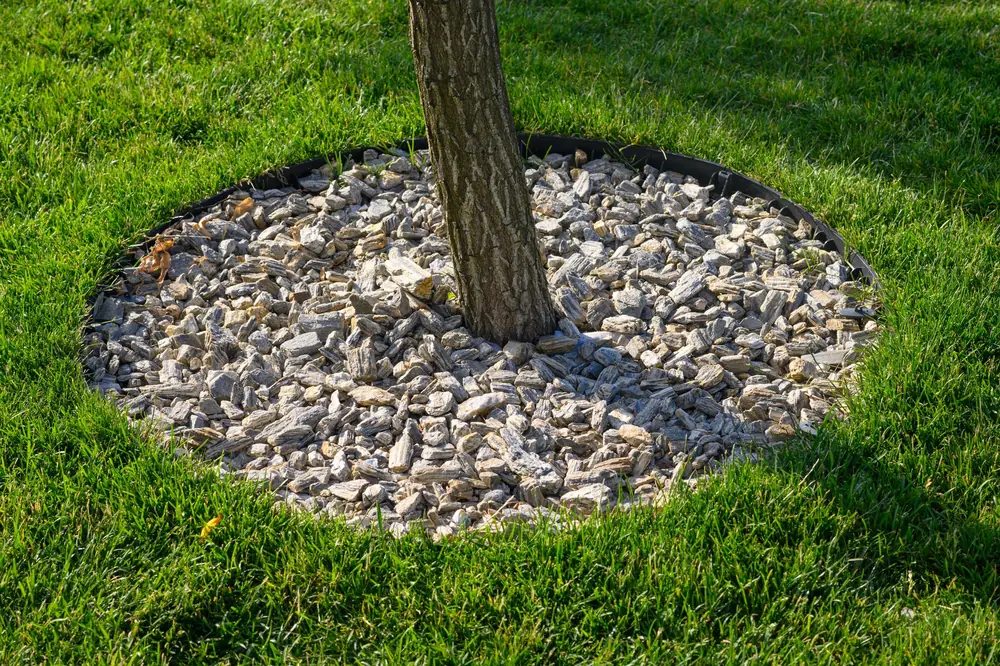
- Mulch. A layer of bark, gravel or shredded prunings over the soil. It slows evaporation, keeps the soil cooler and smothers weeds while it’s at it. It gives the best return for the effort, and hardly anyone puts it down.
- Drip irrigation where it makes sense. On shrubs, hedges and beds, drip puts the water exactly where it’s needed instead of spreading it through the air. On a lawn it doesn’t replace the sprinkler.
- Checking the system. A sprinkler turned towards the pavement or a dripper clogged with limescale has been working for months without you finding out. After a summer at full stretch there’s always one.
If you’re going to be away
The most useful thing you can do before going away for three weeks isn’t programming more watering: it’s mulching and checking that the irrigation controller really works. Let it run a full cycle in front of you before you lock the door. Flat batteries and seized solenoid valves are always discovered at the worst moment.
And in September, don’t switch it off all at once
When temperatures drop you have to cut back, not cut off. A dry September is perfectly normal here, and a plant that has got through the summer on just enough water won’t forgive two weeks of neglect when it already “seems” to have cooled down. With orange and lemon trees, that cut-off is also paid for in the fruit: the tree goes from fasting to feasting with the first storm, and that’s what splits the oranges on the tree.
With the first real rains, then yes: cut the watering right back and use the time to plan the winter pruning calendar, which is when the serious work comes.
A note on where: altitude changes needs quite a lot within the same municipality. Up in the higher part less water evaporates and less watering is needed than right by the sea. We cover it in gardeners in Mijas.