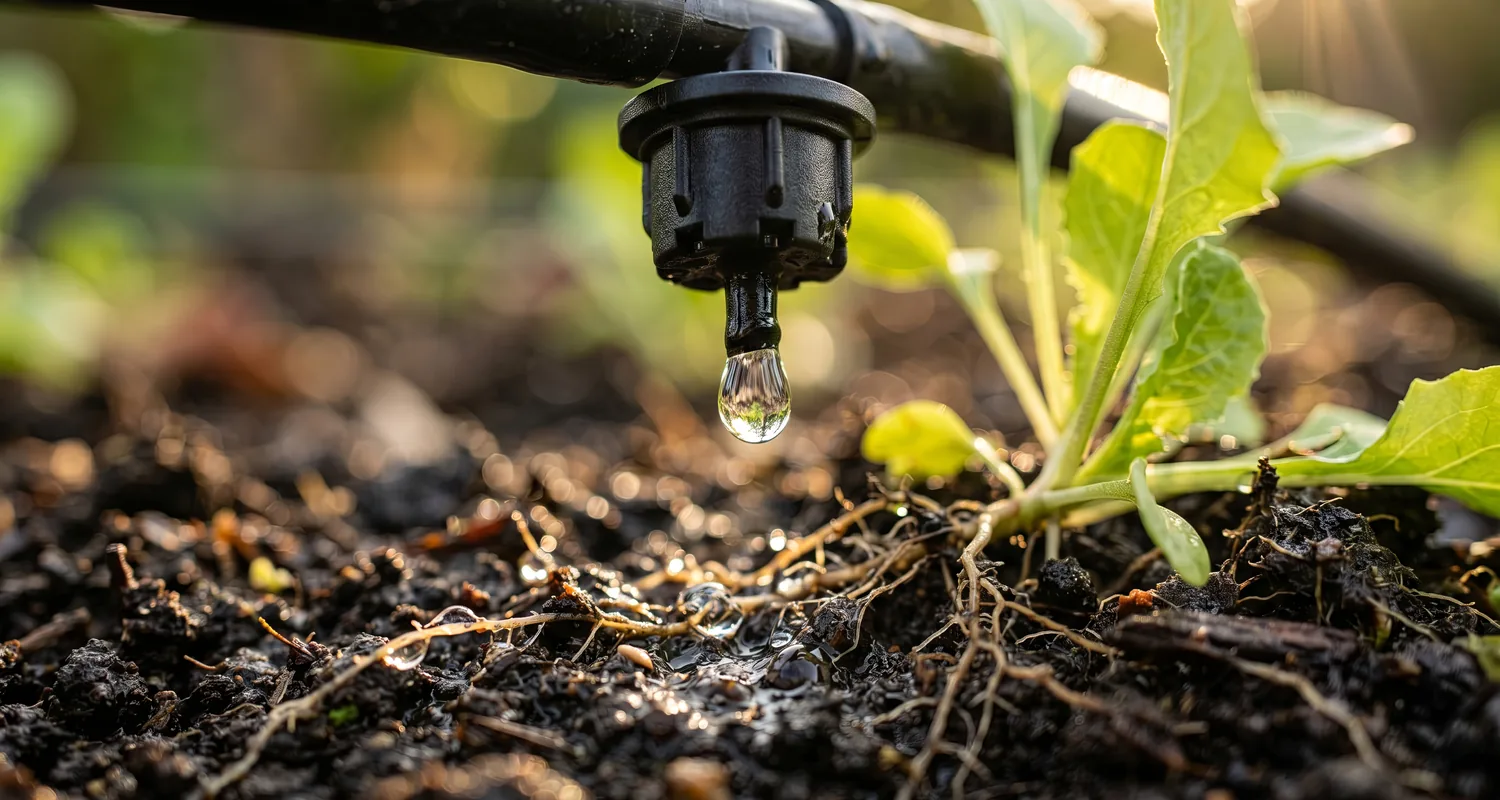
Automatic irrigation installation
The water gets there. Whether it gets where it’s needed is another matter
Drip, sprinklers and controller, designed for the water that comes out of the tap here. Written quote within 24 hours.
- Zones grouped by how much each plant drinks
- Filter and pressure regulator at the control head, and not just for show
- Reprogrammed every season, not set once and forgotten
Tell us what needs watering
We’ll send you a written price within 24 hours.
What’s included
An irrigation system is decided before the first metre of pipe is bought
The installation itself is the easy part. What makes it work or not is how it’s split into zones, and that’s worked out in the garden, with the plants in front of you.
Zones before pipes
What decides whether an irrigation system works is how it’s grouped: sun with sun, shade with shade, pots on their own and trees on their own. A zone that mixes lawn and shrubs waters both badly, and that can’t be fixed later by fiddling with the controller.
Drip, sprinklers or both
Drip for beds, hedges, trees and pots; sprinklers where there’s a proper lawn. Mixing them on the same zone is the most common mistake: a lawn wants a little and often, and a shrub just the opposite.
Control head and filtration
Filter, pressure regulator and valves so each zone can be shut off. It’s the part nobody looks at when comparing quotes, and the one that decides whether the system is still working three summers from now.
Seasonal programming
Four adjustments a year, not one. And a check of drippers and sprinklers at each: making sure the water comes out where it should costs less than finding out in August that it hasn’t been coming out for two months.
What stays behind
Here the water doesn’t entirely go away: it leaves something behind
The water on this coast is hard and carries dissolved salts. You don’t see that when you water, but the water evaporates and what it was carrying doesn’t. It stays in two places, and causes different problems in each.
The first is the dripper itself, which has an internal labyrinth less than a millimetre wide. Limescale builds up inside it and the flow drops little by little, with no warning. Nothing bursts and the ground doesn’t get wet: one particular plant simply starts doing worse than its neighbours and nobody knows why.
The second is the soil. In a climate where the rain is spread through the year, rainwater washes those salts down several times a year. Here, from May to October, that doesn’t happen: every watering leaves its share and no rain takes it away. Watering a little and very often, which is what nearly everyone does in July, makes exactly this worse, because it wets the top few centimetres and concentrates whatever is left behind right there.
That’s why the system is designed with a filter and with valves so each zone can be flushed, and why the schedule includes a long watering now and then, even if it looks wasteful: those are the ones that push the salt below the roots. When this is neglected, the sign shows up in the leaves: the edges scorch while the centre stays green.
Let’s talk about price
The pipe is the cheap part
An irrigation quote is driven almost entirely by things that aren’t materials. One garden can take twice the work of an identical one, depending on what’s underneath and where the water comes from.
- How many zones are needed. It isn’t an aesthetic decision. Each group of plants with a different thirst needs its own, and each zone means a solenoid valve, its wiring and its station on the controller.
- Whether there’s digging to do. Taking the main line under an established lawn, through paving or beneath a path doesn’t cost the same as running it through a newly planted bed.
- Where the water comes from. Mains, well or tank changes the whole control head: filtration, pressure and sometimes a pump. It’s the first thing we look at and what moves the figure most.
- What needs fixing first. With an existing system, a good part of the work is often sorting out what’s there: clogged drippers, sprinklers knocked out of line and joints leaking underground.
We come out, turn on the tap, check the pressure and send you a written price with the zones we propose and why. How to compare two quotes without being sold a pup is covered in gardening prices.
Where we work
Water pressure isn’t the same everywhere
In an urbanisation high up the hill, on an August afternoon, the mains gives what it gives, and a system designed without allowing for that leaves half the plot dry. Each page explains what changes in that area.
To do it yourself
Adjusting the controller gets you halfway there
And you don’t need to call anyone for that. We explain it all.
How much to water the garden in summer on the Costa del Sol
“How many days between waterings?” is the wrong question. What decides it is how much water your soil holds and how much it’s losing, and you check that with a screwdriver.
Read itThe leaves are burning at the edges, and watering more makes it worse
The edge dries out and the centre stays green. It isn’t thirst: it’s the salt each watering leaves behind, and since May it hasn’t rained enough to wash it away.
Read itPressure-compensating drippers: when you need them and when you don’t
On a slope, the same programme overwaters the bottom plant and underwaters the top one. What a pressure-compensating dripper fixes, what it doesn’t, and the cup test to tell.
Read it
Common questions
What people ask us most
Can it be installed in an established garden?
Yes, and that’s the usual case. Drip lines run on the surface or just below it, between the plants, and don’t mean digging up the garden. Where a trench does have to be dug is to take the main line to each zone and for the solenoid valve wiring, and that’s planned to cross where it’s least disruptive: along edges, paths and joints.
How often does it need checking?
Four times a year, at each change of programme, and one of those checks should come just before the summer. The typical fault isn’t a visible break: it’s a dripper that has gradually clogged up inside, and one particular plant drying out without anyone connecting the two. We explain how much to water in summer separately.
Is a Wi-Fi controller worth it?
It depends on whether anyone is going to use it. Being able to change the watering from your phone is handy if the house is only lived in for part of the year, and adds nothing if the controller is going to be left on automatic all year round. What really changes water use, with Wi-Fi or without, is having the zones done properly and adjusting the run times every season.
What if I have a well or a water tank?
It changes the control head, not the rest. A well usually brings more suspended particles, so it needs better filtration and more frequent cleaning; a tank may need a pump to give the drip system enough pressure. It’s one of the things we have to see on site before saying anything.
Shall we take a look at the one you have?
Often you don’t need a new system: sorting out the control head and redoing the zones fixes it. We’ll tell you in writing. You can call or WhatsApp us in English.