Blog · Efficient irrigation
The leaves are burning at the edges, and watering more makes it worse
The edge dries out and the centre stays green. It isn’t thirst: it’s the salt each watering leaves behind, and since May it hasn’t rained enough to wash it away.
 By Sergio Domínguez8 min read
The end of August. You step out onto the terrace and the plant that had been fine all summer has brown, brittle edges on its leaves. The rest is still green.
The conclusion is obvious: it needs water. And so is the reaction: add a couple of minutes to the watering, or go from every three days to every two.
Sometimes that’s it. On this coast, in August, it often isn’t, and watering more often makes exactly the problem you’re trying to fix worse.
A dead edge and a green centre
Before touching the irrigation controller, it’s worth looking at the leaf closely, because thirst and salt leave different marks and you can tell them apart without any instruments.
A thirsty plant droops all over. The leaves lose their firmness and hang, and if you water in the evening they’re stiff again the next morning. The damage can be undone as long as it doesn’t go past a certain point, and it affects the whole plant, not one part of each leaf.
The other one looks different: the edge and the tip dry out completely, the centre stays green, and between the dead and the living there’s a fairly sharp outline. Watering doesn’t bring it back. And it starts on the oldest leaves, which are the ones that have been transpiring for the most months.
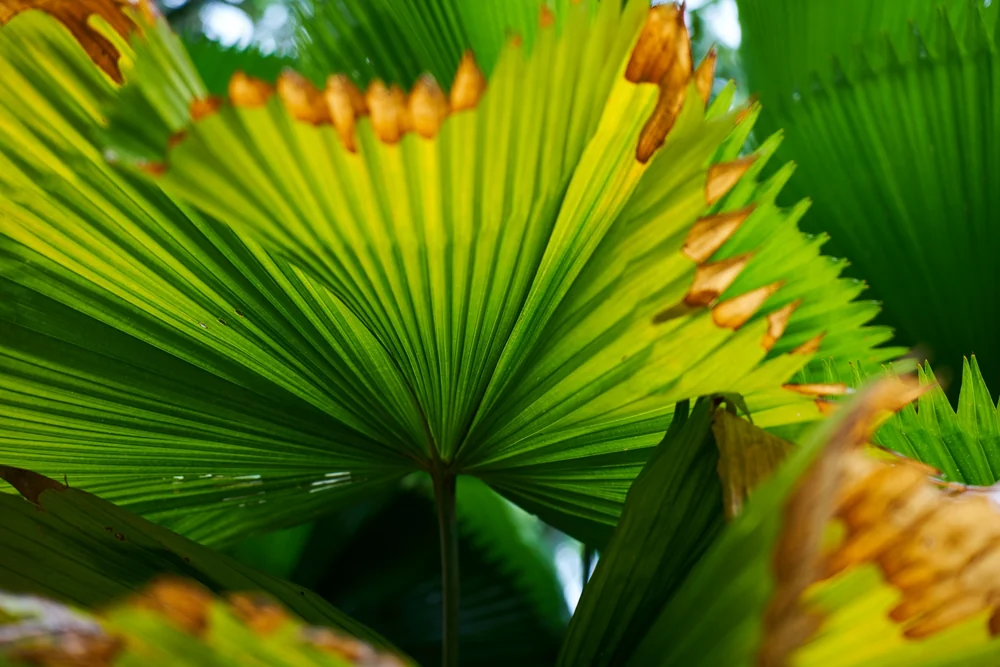
It’s the pattern, not the species: on a palm you see it at the tips of the leaflets, on a hedge along the edge of the leaf, and on a lawn at the end of the blade. Always in the part furthest from the stem, which is where the water’s journey ends and where whatever the water was carrying gets left.
Where the salt comes from
Here there are two sources, and they aren’t fixed the same way.
The irrigation water. All water carries dissolved salts, some more than others. Well water usually carries more than mains water, and near the sea a well can carry a lot more, because when the coastal aquifer is over-pumped, salt water moves in to fill the gap. That salt comes into the garden with every watering.
The sea. With the levante (the east wind), the air on the frontline carries salt spray and deposits it on the leaves. The waves don’t have to reach the plot.
You can tell them apart by where the damage appears. Damage from the sea burns the outside and the side that faces the sea: a hedge with its west-facing side perfect and its east-facing side toasted, or a row of plants where the first is much worse than the fourth. Damage from the watering doesn’t care about orientation: it shows up plant by plant, depending on how much each one drinks and how well its soil drains, and it’s worst in pots.
Why now and not in March
This is the local part, and it’s what explains the timing of the symptom.
Here it rains in autumn and winter and then stops. From May to September the water in the garden is what you put there, watering by watering, for four months. Each of those waterings adds salt. The plant drinks water and the sun evaporates water; neither of them takes the salt away. And there’s no rain to push it down.
A summer of watering, in cross-section
- water goes in with dissolved salt
- water leaves, the salt doesn’t
- salt build-up
Every watering leaves salt: the water evaporates or the plant drinks it, and whatever was dissolved in it stays behind. Since May it hasn’t rained enough to carry it away.
It only goes with water to spare: a long watering that gets right through the root zone, or the first good rain of autumn, pushes it on down.
That’s why a scorched edge is an end-of-summer symptom. It isn’t that the plant was coping and has suddenly stopped coping: the concentration in the root zone has been rising since May and is now at its highest point of the year.
And why watering more often makes it worse
Here’s the underlying problem, and it’s counter-intuitive. Salt only leaves if enough water passes to get through the root zone and keep going down. Water that stays near the top and evaporates takes nothing with it; it leaves behind whatever it was carrying.
A short, frequent watering does exactly that: it wets the top few centimetres, almost all of it evaporates and it adds another dose of salt. Repeated every other day through August, it doesn’t just fail to fix the problem, it builds it.
It’s the same reason short daily watering doesn’t grow deep roots either, which we explain in more detail in how much to water the garden in summer. Less often and for longer solves both at once.
What to do
- One long watering, the kind that drains through. In the ground, one that really soaks instead of three short ones. The aim isn’t to wet it: it’s for there to be water to spare that goes on down.
- In a pot, water until it runs out of the bottom, and wait until a fair amount comes out, not a few drops. And then empty the saucer: if it stays full, the pot drinks that water back up with all the salt concentrated in it.
- Don’t feed a plant that’s already scorched. Mineral fertilisers are salts. It’s adding more of the same just when there’s too much.
- After a strong levante, wet the leaves of whatever is on the frontline. With clean water and no sun on it, the deposit washes off before it does any harm.
- And wait for the first good rain, which is what really washes the soil through and costs nothing. One autumn rain does in an afternoon what a month of short waterings doesn’t.
A local case that hardly anyone connects: the pots on a covered terrace or a penthouse never get any rain. In a garden, winter washes the soil by itself; up there it never happens, so the salt from every watering keeps adding up year after year with nothing to remove it. It’s one of the reasons the plants on Fuengirola’s terraces and penthouses stall in their third or fourth summer even though they lack nothing. If that’s you, a flushing watering (generous, with the saucer emptied) a couple of times a year makes quite a difference.
What’s already scorched doesn’t come back
It’s worth saying so nobody waits in vain: dry tissue doesn’t rehydrate or turn green again. It stays brown until the leaf drops.
What you’re saving is the new growth. If you correct the watering now, whatever comes out from October onwards will come out clean, and in a few months the plant will have replaced the worst of it. You can trim the ugliest leaves if they bother you, but it does nothing for the plant, and taking off a lot of leaf at once does take something away.
If it happens every summer
When the problem comes back every August whatever you do, it’s no longer about watering: some plants just don’t suit the water or the spot.
Near the sea there are species that live with salt without batting an eyelid (oleander, tamarisk, pittosporum, mastic, rosemary) and others that never will; citrus, for example, is among the sensitive ones, and on a frontline plot with well water it will always struggle. It’s the same logic of grouping plants by their needs that we cover in what to plant so you’re not watering all summer, applied to salt instead of thirst.
And if what’s scorching is a whole hedge on the side facing the sea, the decision isn’t about watering but about species, which is exactly what needs thinking about before you buy: which hedge to plant here.
With a whole garden affected, or a lawn that dies off in patches always in the same places, it’s worth looking at the drainage and getting the water analysed. There, there is a number to be had, and it comes from a laboratory, not from a website.