Blog · Efficient irrigation
Pressure-compensating drippers: when you need them and when you don’t
On a slope, the same programme overwaters the bottom plant and underwaters the top one. What a pressure-compensating dripper fixes, what it doesn’t, and the cup test to tell.
 By Sergio Domínguez6 min read
A bank with drip irrigation, the same programme for every plant, and still the ones at the top go thirsty and the ones at the bottom turn yellow from too much water. Often it isn’t the plants or the controller: it’s the slope, sharing the water out in its own way. And that’s exactly what a pressure-compensating dripper fixes.
In a flat garden you don’t need them. On the coast, with so many developments on hillsides, and inland, where people water on terraces, you often do. Here’s how to tell which case is yours.
What a pressure-compensating dripper does
An ordinary dripper gives more water the more pressure reaches it. A pressure-compensating one has a membrane inside that opens or closes with the pressure and keeps the flow the same, with more pressure or less, within a range given on its data sheet.
Don’t confuse it with the flow rate. The 2, 4 or 8 litres per hour printed on the dripper tell you how much water it gives; being pressure-compensating tells you that they all give the same. They’re two separate decisions: the flow rate is chosen for the plant, and compensation for the ground.
Why it matters on a slope: ten metres, one bar
Water is heavy, and the further down it goes, the harder it pushes. Every ten metres of drop is roughly one more bar of pressure at the low point. On a drip line running down a bank, the drippers at the bottom work at a higher pressure than the ones at the top, and if they’re ordinary drippers, they give more water.
It doesn’t take a big drop to notice. Drip design manuals say that, with ordinary drippers, for the flow not to vary by more than ten per cent along a section, the pressure shouldn’t vary by more than twenty per cent. At the pressures a garden drip system runs at, a few metres of slope are enough to use up that margin. That’s why they recommend compensating drippers on uneven ground.
Over the years it shows in the plants: the ones at the top of the bank smaller, the ones at the bottom with yellow leaves, soil that’s always damp and, sometimes, rotten roots. And if you turn the watering time up so the top ones don’t suffer, the bottom ones get worse.
The same drip line on a slope
More pressure further down. With ordinary drippers, each one gives more water the more pressure reaches it, and on a slope the pressure rises as you go down: on the same programme, the plant at the bottom gets more than the one at the top.
And when it stops, the pipe drains at the bottom. When the controller cuts off, the water left in the pipe runs out through the lowest drippers. That’s extra water for the bottom plant every cycle, and next time the top drippers are slow to start.
Pressure-compensating and anti-drain: the same in all. A pressure-compensating dripper gives the same flow with more or less pressure, within the range on its data sheet. An anti-drain one closes when the water stops and keeps the pipe full. All three plants get the same.
And when the watering stops: anti-drain
There’s a second effect that happens when nobody is looking. When the controller cuts off, the water left in the pipe doesn’t stay put: it runs down and out through the lowest drippers. The plant at the foot of the bank gets an extra watering every cycle, and when the system comes on again, the drippers at the top are slow to start because the pipe has to fill up first.
A different part fixes that: the anti-drain dripper, which closes when the pressure falls below a certain point and keeps the pipe full. Some drippers are both at once, pressure-compensating and anti-drain, and on a slope those are the ones that make sense. If, after watering, you see the bottom drippers still dripping for a good while, yours aren’t.
When you don’t need them, and what they don’t fix
- A flat garden and short lines. If all the drippers are at the same height and close to the tap, an ordinary one gives the same as a pressure-compensating one, and costs less.
- Low pressure. The membrane needs a minimum pressure to regulate, given on the data sheet. Below it, the dripper gives less than it says. With a tank and no pump, or mains pressure that drops at watering time, check that before you buy.
- Limescale. A pressure-compensating dripper clogs just like an ordinary one. It doesn’t replace the filter or going over the drippers, which here, with hard water, needs doing several times a year.
- Plants that drink differently. If a rose and a lavender share a line, giving them the same is the problem, not the solution. That’s fixed with zones, not drippers. How it’s done is in grouping plants by water needs.
How to tell if your drip system shares water badly: the cup test
You don’t need a pressure gauge. Put out three identical cups: one under a dripper at the top of the line, one in the middle and one at the bottom, held so the dripper falls inside. Run the zone for a few minutes, turn it off and compare.
- If the bottom one clearly has more, it’s the slope, and pressure-compensating drippers fix it.
- If one has much less than the other two, not following the slope, that dripper is most likely clogged: clean it or replace it.
- If all three have the same, the sharing is fine, and what’s wrong is the programme. How to check whether the plant needs water is in how much to water the garden in summer.
And when you turn it off, watch the bottom dripper: if water keeps falling for a good while, it’s missing anti-drain.
If you’re planting on a bank this autumn
October is when you plant on the coast, and it’s the moment to set the drip system up properly from the start: changing drippers later, with the plants already in, is twice the work. Why now, in when to plant on the Costa del Sol.
- Run the lines across the bank, on the level, not up and down it: that way each one waters at a single height.
- Pressure-compensating, anti-drain drippers across the whole zone: even if each line runs level, the bottom one gets more pressure than the top one.
- If the bank is long, zones by height, each with its own valve: the top and the bottom don’t always need the same, because the rain that runs down the slope also collects at the bottom.
- And the programme, in short runs. On a slope, the water the soil can’t take moves down through it; two short waterings soak in better than one long one.
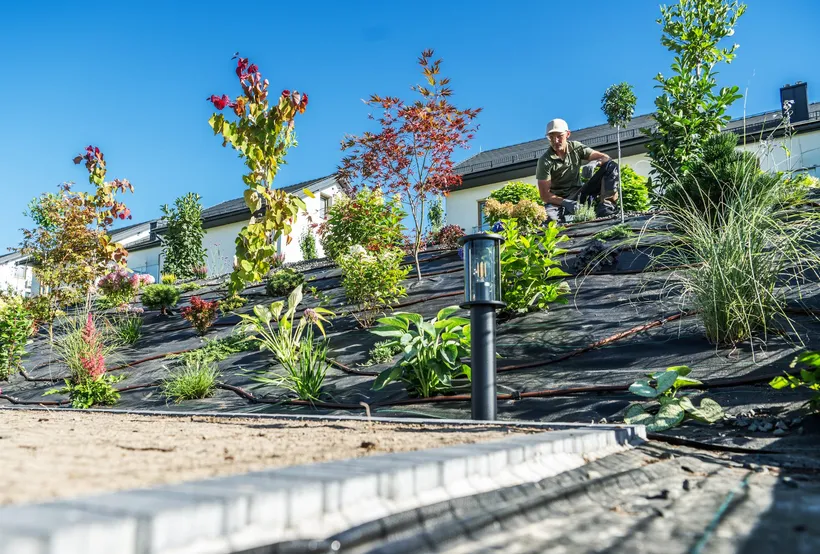
A newly planted bank with the drip lines on the level, one per height. Each line works at a different pressure: the lower it is, the more pressure.
In Benalmádena almost every garden is on a slope, and what that changes is in gardeners in Benalmádena. If you’d rather we installed or checked it, see irrigation installation.
In short
A pressure-compensating dripper gives the same with more pressure or less. In a flat garden you don’t need one; on a slope you do, because every ten metres of drop is one more bar at the bottom, and an ordinary dripper turns that into extra water for the plant at the foot.
On a bank, pressure-compensating and anti-drain, so the pipe doesn’t drain out at the bottom when it stops. And before changing anything, the cup test: in a short while it tells you whether the problem is the slope, a clogged dripper or the programme.