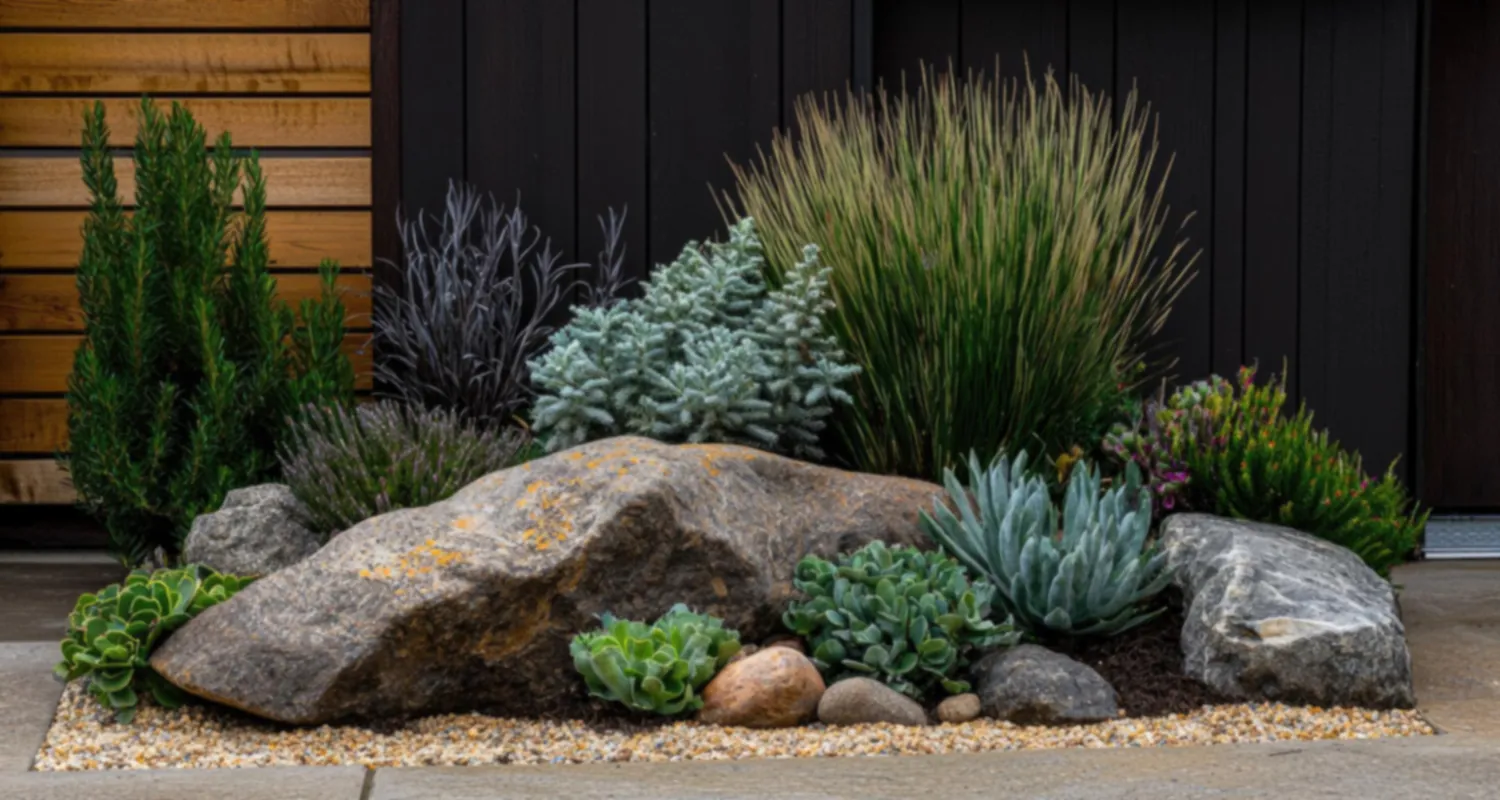
Landscaping and garden design on the Costa del Sol
The plan decides your bills for the next twenty years
We design for the August you won’t be here to see, not for the April render. Written quote within 24 hours.
- We group plants by thirst, not colour: that decides the watering for life
- We tell you how much upkeep each version needs before we draw it
- Plan, plants and installation, or just the part you’re missing
Tell us what space you have
With photos and a rough idea of the size, we can start talking.
How we work
Four decisions, and all four are made before planting
A garden isn’t ruined by the plant someone bought. It’s ruined by where it was put and what went in next to it, and that’s decided on paper.
See the site before drawing anything
Where the sun really falls in August and in January, what soil lies underneath, where the water runs when it rains hard and where the irrigation water is going to come from. A plan drawn without setting foot on the plot shows within two years.
Choose by final size and by thirst
Not by how the plant looks at the nursery. What matters is how big it gets, how much water it needs and whether that suits its neighbours in the bed. Nearly every regret comes from this decision.
Irrigation, from the plan onwards
Split into zones by plant group, not by wherever it was easiest to run the pipe. Adding the irrigation at the end is what forces you to water everything the same, and watering everything the same is what kills half of it.
Build it and get it going
Earthworks, drainage, planting and the first few months, which are what decide whether the plants take. A garden isn’t handed over the day it’s planted.
What the render doesn’t show
Everything that gets drawn, someone looks after every month
A garden project is sold with a pretty picture and paid for twice: once when it’s built, and again every month for the next twenty years. The plan writes that second bill, and hardly anyone mentions it while they’re drawing.
These are very specific decisions. A strip of grass the mower can’t get into is cut by hand for ever. A hedge planted where you can’t reach it from the ground needs a ladder every time it’s trimmed. A plant that grows taller than you can keep it forces you to cut it back twice a year for the rest of its life, and to spoil it a little each time.
And here there’s one more thing against you: there’s no winter to freeze the mistake. In a climate where plants go dormant, a badly planned garden gets four months off. On this coast it grows almost all year, so the extra work piles up without a break.
That’s why, before drawing anything, we ask how much upkeep you want. The same space can take a version that needs one visit a month and another that needs four. Both can look good; only one fits what you’re prepared to keep up.
The most local decision
Group by thirst, not by colour
The design mistake that kills more plants on this coast than any other has nothing to do with taste: it’s putting plants that need a lot of water and plants that need very little on the same irrigation zone.
From there, there’s no good way out. If you water for the thirstiest, the drought-tolerant one rots at the root and nobody understands why (a Mediterranean plant can take the summer, but it can’t take being wet in August). And if you water for the drought-tolerant one, the other dries out. The irrigation controller has only one setting per zone, and on that zone there are two plants that want opposite things.
Where it rains in summer this goes unnoticed, because the rain waters everything. Here, between May and September, you supply all the water, and only where you’ve laid pipe, so grouping by thirst stops being a landscaper’s preference and becomes the structure of the garden.
So it’s drawn the other way round from usual: first you decide which areas will need a lot of water, a moderate amount and very little; then the plants are shared out among those groups; and only at the end do you think about colour. We go through it with examples of plants in what to plant so you’re not watering all summer.
Let’s talk about price
Half the quote is what you’ll never see
And it’s the first part to be cut when the budget gets tight. It’s also the part that can’t be redone later without digging up the whole garden.
- What goes underneath. Drainage, earthworks, bringing in good soil and retaining walls. It doesn’t show in any photo, and it decides whether the garden thrives or ends up waterlogged.
- The size of the plants. The same design with small nursery plants or with large specimens means two very different quotes. It’s the biggest lever you have for adjusting the cost, and the choice is yours.
- Whether there’s water, and where it comes from. Whether there’s a supply connection, a meter and enough pressure changes the project. Sorting it out afterwards is the kind of surprise that throws a whole job off.
- How much upkeep you’ll want. This doesn’t make the build dearer: it makes the next twenty years dearer. We put it on the table before, not after.
We come out, take a look and set out the options with what each one costs, including what it will ask of you afterwards. If what’s needed is to wait until autumn to plant, we’ll tell you: here, you plant in autumn, not in spring.
Where we work
The site matters more than the style
A plot on a slope, a beachfront plot in the salt spray and one down in the valley with deep soil call for three different gardens.
Before you decide
What’s worth knowing before anything gets drawn
Group plants by what they drink, not by how they look together
If the same bed holds lavender and hydrangeas, there’s no right watering programme: whatever number you set leaves one of them out. It isn’t the watering, it’s where they were planted.
Read itA garden without a lawn: what to put in its place and how it copes in August
Taking out the lawn is the change that saves the most work in a garden here, but you can swap it for something worse in July. Where to keep it, what to put in the rest, and what heats up, floods or grows back.
Read itWhere to plant the tree that’s going to give you shade
Almost everyone picks the spot at midday, the one time when every position looks equally good. At five o’clock only one of them works.
Read itXeriscaping: a garden that loses little if one year you can’t water it
It isn’t a garden of stones and cacti: it’s one that lives almost on the rain alone and keeps watering for a small patch. Here it showed in 2023, when watering gardens with drinking water was banned.
Read it
Common questions
What people ask us most
Do you only do the design, or the building work too?
Both, or just one of them. Some people know exactly what they want and need someone to build it; others already have the garden and what they’re missing is the judgement. What we don’t recommend is a plan from someone who won’t set foot on the site: a garden’s problems turn up when you dig, not when you draw.
Can it be done in phases?
Yes, and often it’s the sensible thing to do. What shouldn’t be split up is what goes underneath: drainage, soil and irrigation are done in full, in one go, because opening it all up again once there are plants on top costs more than doing it properly the first time. The planting, on the other hand, can be spread over several seasons.
How long before it looks finished?
That depends on a decision of yours: the size of the plants that go in. With large plants the garden looks finished straight away and costs quite a lot more; with small ones the result takes a few seasons, but the plants root better and work out cheaper. There’s no right answer, only the one that fits what you want. We set out both versions for you, with their prices.
I already have a garden. Is it worth redoing?
Sometimes it’s enough to reorganise the irrigation and replace whatever is in the wrong place, which is much cheaper than starting from scratch. We’ll take a look and tell you whether it needs a renovation or just a pruning of past decisions. If changing a handful of things will sort it, we’ll tell you, even if it means less work for us.
When do you plant?
Here, from autumn to the end of winter. Planting in spring means borrowing the calendar of a climate that isn’t ours: the plant doesn’t have time to put down roots before July arrives, and July is the test. Autumn planting, with the dates and the exceptions.
Shall we start by looking at the site?
Tell us what you have and what you’d like, and we’ll tell you what can be done there and what it will need afterwards.