Blog · Natural lawns and turf
When to sow grass seed on the Costa del Sol: October for winter grass, May for Bermuda grass
Guides say spring or autumn. Here, winter grass is sown in October: 269 mm of rain follow in three months. Seed sown in April gets 26 until July.
 By Sergio Domínguez6 min read
Guides usually give two times of year to sow grass seed: spring and autumn. On this coast it depends on which grass it is, and for the one in almost every bag, only one of the two works.
The short answer: winter grass — tall fescue and ryegrass, what almost every mix contains — is sown in autumn, from mid-September to the end of October, and October is best. Bermuda grass, in late spring. And kikuyu and St Augustine grass aren’t sown at all: they go in as turf or as sprigs.
First, what’s in the bag
Two families of grass live here, on opposite calendars. Winter grasses are green from October to May and struggle in high summer. Summer grasses are the other way round: they grow with the heat and turn straw coloured in the coldest weeks. Which suits each house is in which grass to plant on the Costa del Sol.
Almost everything sold in a bag, whether it says “universal”, “hard wearing” or “all purpose”, is winter grass. And the rule works for both families: you sow at the start of the season in which that grass grows, so it has its good months ahead of it and not its bad ones.
Winter grass: in October
The University of California, which writes for a Mediterranean climate like this one, with dry summers and winter rain, puts it plainly: winter grasses are best sown in September and October, and the next best time is March and April.
But here September is still summer. At Málaga airport the average September maximum is over 28 degrees and the whole month gets 20 mm of rain on average, according to AEMET, the Spanish met office. And grass seed sits almost on the surface, in the top centimetre of soil, which in the September sun goes from soaked to dry in a few hours.
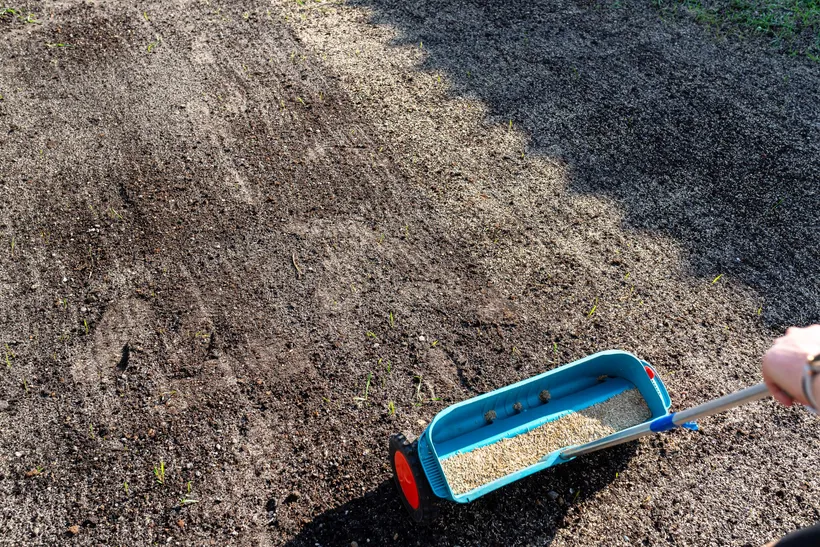
Sowing with a push spreader on soil that’s already been prepared. All the seed stays on top, in the top centimetre and in full sun.
October is where the two things meet: the soil still holds the summer’s warmth, which is what makes the seed come up, and the sun no longer dries the surface in an afternoon. Why that stretch, between coming up and putting down roots, is the delicate one is in should you sow a lawn or lay turf? And the rain comes after.
How much rain falls after sowing
Each month’s rain. Average rainfall each month at Málaga airport, according to AEMET, from September to August. The heaviest falls in November and December; from June to August, almost none.
Sown in October. November, December and January follow: 269 mm between them. The seed comes up while the soil is still warm and, once it has roots, the rain starts to help with the watering.
Sown in April. It’s the second time of year the guides give. May, June and July follow: 26 mm between them. Whatever comes up reaches its first summer with a few weeks of roots, and almost all the water comes from the sprinklers.
What comes up in October has November, December and January ahead of it, the three wettest months of the year here, and then the whole mild winter of the coast to fill in before its first summer.
If you’re reading this at the end of October, you’re just in time. After October the soil cools and whatever is sown takes longer to come up and fill in. If the window slips by, it’s better to lay turf or wait for next autumn than to sow in spring.
Spring doesn’t work here
The guides’ second time of year, March and April, works where summer arrives late and brings rain with it. Here, seed sown in April has May, June and July ahead of it: 26 mm between the three, on average. And a fescue or a ryegrass reaches its first July with a few weeks of roots, just as it enters its worst months.
It can be brought through, but only by watering a newly sprouted lawn all summer, in the season it copes with worst. It’s the same reason almost everything here is planted in autumn: why here you plant in autumn.
Summer grass: in late spring
With Bermuda grass, the most common summer grass, it’s the other way round. The same California guide gives mid-April to mid-May for the summer grasses that can be sown, and late spring or early summer for Bermuda grass. It needs warm soil to come up, and what lies ahead of it is its own season.
Here that means sowing between late April and early June, with the irrigation already in place: no rain follows, and the seed needs short, frequent watering until it comes up. Sowing it in autumn is arriving late: it has few weeks of growth left before the cold stops it, and whatever hasn’t filled in stays open until spring.
Kikuyu and St Augustine grass don’t even come into it: St Augustine isn’t sown, and kikuyu nearly always goes in as turf or sprigs.
What about sowing over the lawn you already have?
It’s the other October question: sowing ryegrass over Bermuda grass so it doesn’t turn straw coloured in winter. It’s done at this time of year, and on golf courses it makes sense. In a garden, what usually happens is that in May you have two lawns fighting, one starting up and the other dying off, with a good month of looking scruffy.
Reseeding the bare patches in an existing lawn follows the same rule. In a winter lawn, now. In a summer lawn, they usually close up on their own with water and a few weeks, and if not, in spring. How to tell which you have and what to do with each is in reviving a lawn after summer.
What the date can’t fix
Sowing in October doesn’t rescue badly prepared ground. What decides whether that lawn lasts is what’s underneath: the levelling, the soil and the drainage. How to check it is in what’s under the lawn. And until it comes up, the surface has to stay damp all the time: very short, frequent watering, even if it rains now and then.
If you’d rather we did it, see turf laying and natural lawns.
In short
Winter grass, the bagged kind, is sown in autumn, from mid-September to the end of October, and October is best: the wettest months of the year follow, and the whole winter to fill in. The spring the guides also give leaves it, here, newly sprouted in its first summer.
Bermuda grass is the other way round: in late spring, with the irrigation in place. And kikuyu and St Augustine grass go in as turf.