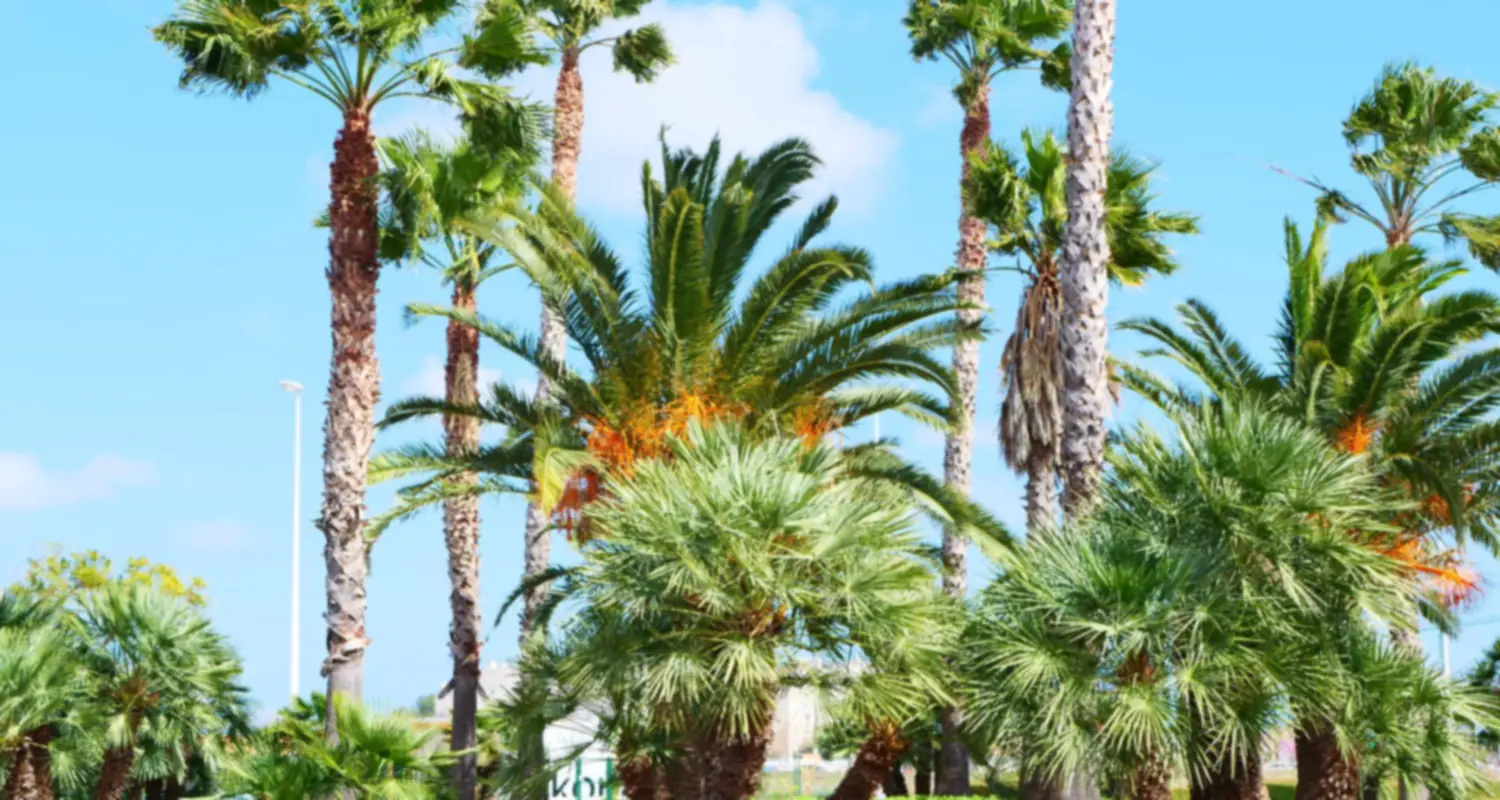
Palm tree pruning on the Costa del Sol
The month it’s pruned matters more than who prunes it
Here the calendar isn’t set by looks: it’s set by the red palm weevil. Written quote within 24 hours.
- We prune in the cool window, when the cut doesn’t give the palm away
- Never with climbing spikes: the trunk doesn’t heal
- Frond and green waste removal included
Tell us how many there are and how tall
A photo of the crown is all we need.
What’s included
Pruning a palm is mostly about taking off very little
A palm has no branches to thin and no crown to balance. It has a single growing heart, and anything extra you do to it, you do against it.
Dead fronds and fruit
Removing fronds that are already dead, the bunches and the fruit. On a heavily laden date palm, that’s what stains the ground, makes it slippery and blocks the drains every autumn.
Trunk cleaning
Old frond bases removed without wounding the trunk. The difference between a clean trunk and a stripped one is a few millimetres, and it only shows years later.
Crown check
Two minutes looking at the heart of the crown and the central fronds, which is where the weevil can be caught in time. By the time the damage reaches the outer fronds, the pest has been inside for months.
Height and removal
A cherry picker or ropes, depending on what the access allows, and the fronds brought down and taken away. A big Washingtonia produces a volume of waste that surprises everyone.
Why not now
Every cut in summer is a signpost
The red palm weevil doesn’t find palms at random. It follows the smell, and a fresh wound smells. That’s why the palm pruned in the middle of August is more likely to be hit than the one next to it that nobody has touched.
That gives you the only calendar rule that matters here: palms are pruned in the cool months, when the insect is barely flying, and in summer you do only what’s strictly necessary. It’s exactly the opposite of the usual reflex, which is to prune when the palm looks a mess, and the palm looks a mess in summer.
And it isn’t only a question of when: it’s also what with. The tools are disinfected between one palm and the next, because on an urbanisation with twenty palms the chainsaw is the shortest route from an affected one to the nineteen healthy ones.
What can’t be undone
A palm doesn’t heal
This explains almost everything else, and hardly anyone knows it. A palm trunk isn’t wood: it doesn’t thicken, it doesn’t replace tissue and it doesn’t close wounds. Whatever is done to it today will still be there in twenty years.
A tree responds to a cut by forming a ring of callus that ends up covering the wound. A palm has nothing to do that with. Every spike mark, every cut flush with the trunk and every knock from the cherry picker’s basket stays open, and each one is a place where something can get in.
That’s why we don’t climb with spikes or strip the trunk until it’s smooth, even though it looks smarter. The beautiful palm is the one that’s still there in ten years’ time.
If you suspect it
The first thing is not to prune it
If red palm weevil is suspected, pruning stops being maintenance and becomes a problem: it opens the palm up and contaminates the tools.
- Look at the centre, not the outer fronds. Lopsided central fronds, chewed in a zigzag or drooping to one side, are the early sign. By the time the whole crown turns yellow, the palm has been eaten for a long time.
- Don’t cut it or move it. Don’t prune it, don’t transplant it and don’t take the cuttings anywhere. Plant material from an affected palm is the main way the pest travels.
- It’s a declared pest, and that has consequences. Confirmed cases have an official protocol and have to be reported. It isn’t a gardening decision, it’s a formal procedure, and it’s worth getting information from the town hall or the regional government before you touch anything.
We do the pruning and the sanitation work, not the treatment. Applying a pesticide requires an applicator’s licence, so if the palm is affected, what it needs is an authorised applicator — and we’ll tell you what we’ve seen, so you don’t walk away without knowing what to ask.
The signs, in order from the earliest to the latest, are explained with photos in how to tell whether your palm is affected.
Let’s talk about price
With palms, what you pay for is the height
It’s the service where a price per palm is most misleading. Two identical palms can cost very different amounts depending on where they’re planted, and anyone giving a price over the phone is guessing.
- The height. It decides whether it can be reached with a pole from the ground, from a cherry picker or on ropes. Between the first and the last there’s a difference in hours and equipment, not in skill.
- How many there are. Bringing a cherry picker for a single palm is expensive by definition. For a community’s twelve, the travel is shared out and the price per palm drops on its own.
- The species. A tall Washingtonia and a date palm laden with fruit aren’t worked the same way, don’t bring down the same volume and don’t take the same time.
- Getting in and out. If the cherry picker won’t fit through the urbanisation’s entrance, we go up on ropes. And the fronds have to come out wherever they can, which is sometimes the same way the cherry picker couldn’t get in.
Send us one photo from below and another of the crown, and we’ll tell you what’s needed. If it’s the time of year to leave it alone, we’ll tell you that too.
Where we work
There are palms all along the coast
And red palm weevil too. Each page covers what we come across in that town.
To check it yourself
Two minutes every fortnight
You don’t need anyone to keep an eye on a palm. We cover it in full, with what to look for and the order it shows up in.
Red palm weevil: how to tell if your palm is affected
By the time the palm looks bad, the pest has been inside for months. The signs that do arrive in time are different ones, and you see them by looking at the crown for two minutes every fortnight.
Read itA sago palm isn’t a palm, and treating it like one is what ruins it
It’s sold as a little palm, watered like any other plant and stripped bare every spring. Those three things explain why yours hasn’t moved in years.
Read itPalm tree pruning: when it’s done here, and why not now
The good window is the cold months, and not because of the plant: because of the weevil. Every fresh cut in summer is a sign put up for it to come.
Read itThe processionary nest comes off in autumn, not when they come down
Almost everyone remembers the processionary caterpillar when they see the line on the ground. By then the easy part can no longer be done: the nest comes off in autumn, and here the caterpillars come down earlier than the inland calendar says.
Read itGeranium bronze butterfly: why it stays on the coast and what to do
A South African butterfly whose caterpillar eats geraniums from the inside. On the coast it can last the winter, and spraying the outside doesn’t reach it: it’s removed by cutting.
Read itThe palm borer moth: the palm pest that isn’t the red palm weevil
A large moth with orange hindwings whose larva bores into the palmito, the Chusan palm and the Canary palm. It leaves arcs of holes in the leaves and fibre plugging the trunk, and it isn’t the weevil.
Read it
Common questions
What people ask us most
When are palm trees pruned on the Costa del Sol?
In the cool months, and it isn’t because of the plant: it’s because of the red palm weevil. A fresh cut gives off a smell and the insect tracks it down; in the warm months it’s flying, and in the cold months its activity drops a lot. That’s why pruning in August “because it looked a mess” is exactly what you don’t want, even if the result looks good that same afternoon. We explain it in more detail here.
How many fronds can come off?
Not many more than are already dead. What you see a lot round here is the “feather duster” look, cutting well above the horizontal to space out the prunings and because some people like that silhouette. The palm is then left with fewer fronds than it needs to feed itself, draws on its heart to replace them and comes out of each pruning weaker.
Do you climb with spikes?
No. A palm trunk doesn’t heal, so every spike hole stays there for good and is a way in. We go up in a cherry picker when the access allows and on ropes when it doesn’t, which is slower, and that’s why some people resort to spikes.
What if I think it has red palm weevil?
The first thing is not to prune it: a cut on an affected palm speeds things up, and the tools can carry it to the palms next to it. The red palm weevil is an officially declared pest, and there is an official protocol for confirmed cases, which have to be reported. The treatment itself has to be applied by someone with a pesticide applicator’s licence.
Do you take the fronds away?
Yes, it’s included. And with palms it’s worth saying, because the volume is deceptive: what comes down from a single mature palm doesn’t fit in a small trailer, and if removal is billed separately, the surprise is considerable.
Shall we have a look at the crown?
Send us a photo and we’ll tell you what we see and whether it’s time to touch it or to wait.