Blog · Palms and plant health
The processionary nest comes off in autumn, not when they come down
Almost everyone remembers the processionary caterpillar when they see the line on the ground. By then the easy part can no longer be done: the nest comes off in autumn, and here the caterpillars come down earlier than the inland calendar says.
 By Sergio Domínguez7 min read
With the autumn, white silk bags start to appear on pines at the tips of the branches. These are the nests of the pine processionary, the caterpillar that in a few months will come down from the tree in single file.
Almost everyone remembers it when they see the line on the ground. By then the easy part can no longer be done. The nest comes off in autumn, while it’s small and sitting on a branch tip. And here the caterpillars come down earlier than the calendar going round says, which is the one for inland Spain.
How to recognise the nest
It’s a whitish silk bag, the size of a fist or smaller at first, tangled among the needles at the tip of a branch. Almost always on the outside of the crown and on the side facing the sun, which is where the caterpillars warm up. They spend the day inside; at night they come out to eat the needles and then go back.
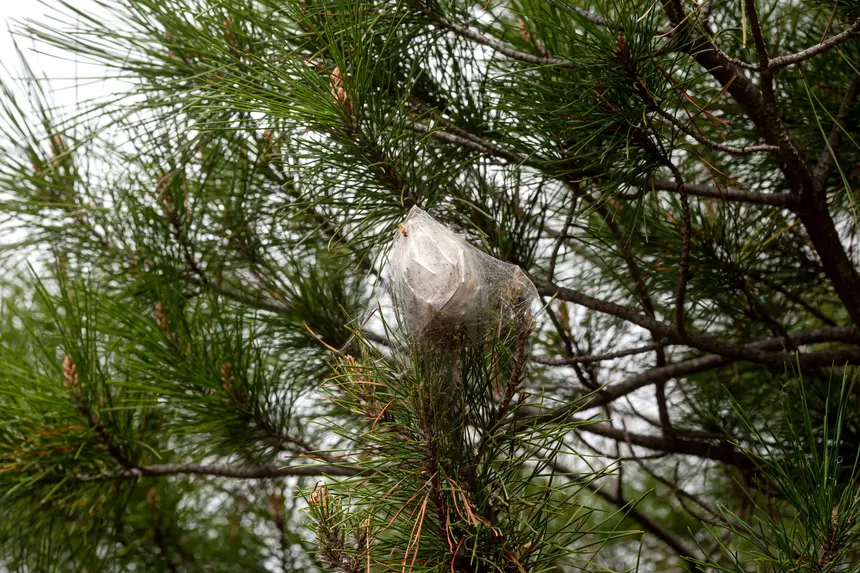
This is what it looks like from below: a white bag at the tip of a branch, among the needles. Over the winter it grows and becomes denser and dirtier. Old nests, grey and torn, count too: they still have hairs in them.
It likes pines above all, and sometimes cedars. And it prefers isolated trees and the edges of pinewoods, which are exactly the lone pine on a plot and the strip of pinewood bordering the houses of an urbanisation. In pinewood areas like Elviria, in East Marbella, it’s part of the work every autumn.
It stings before it comes down
The danger of the processionary is its stinging hairs: tiny, they come loose at the slightest touch and the air carries them. They cause skin and eye reactions, and in a dog that sniffs or licks a caterpillar they can do a lot of damage to the mouth and tongue. If that happens, go to the vet, without waiting to see how it develops.
What hardly anyone knows is that those hairs don’t appear in spring. The caterpillars have them as soon as they’ve grown a little, which is in autumn, and the nest holds on to them even when it’s empty. An old nest lying on the lawn is still a problem.
Why they come down earlier here
The cycle is simple. The moth lays its eggs on the needles in summer, the caterpillars hatch, and in autumn they spin the nest. They spend the winter growing and, once they’ve finished, they come down the trunk in single file and bury themselves to transform. In summer the moth emerges and it all starts again.
The key is that “once they’ve finished”. They grow faster the milder the weather, and here the autumn is mild and the winter barely slows them down. What inland is seen in spring can start here in the middle of winter.
The same pine, from autumn to late winter
Autumn. The caterpillars spin the nest at the tip of a branch, on the sunny side. It’s small, it can be seen from the ground and it comes off whole by cutting off the tip.
Winter. The nest grows with the caterpillars, which come out at night to feed and go back in. They already have their stinging hairs, and the nest keeps them even once it’s empty.
Late winter, earlier here than inland. They come down the trunk in single file and bury themselves. It’s when they’re most visible and when the dog finds them, and what was on a branch tip in autumn is now on the ground.
That’s why the advice to “deal with it in spring”, which is everywhere, comes too late here. By the time you see the first line on the ground, the caterpillars have already left the place where they were easy to catch.
What to do now
- Check the pines this autumn, and check them again every few weeks. They’re easy to see from the ground, and the more nests there are, the more urgent it is.
- Remove the nests you can reach. Cut off the branch tip with the whole nest on it, without breaking it, and put it in a bag that you seal. With gloves, long sleeves and goggles, on a day without wind. Never by hand, never shaking the branch and never with the nest above your face. If the pine also needs pruning, now is the time: pruning a pine tree here is done from mid-October to the end of winter, and the same pruning takes off the tips with nests.
- The high ones, with a pole pruner or by someone with the means to get up there. A high nest taken down from a ladder, above your head, is the quickest way to get the hairs in your eyes.
- A collar trap on the trunk before they come down. It’s a ring around the trunk that diverts the line into a bag of soil, where they bury themselves and stay. It uses no product of any kind, and here it has to go on earlier than the inland guides say: in autumn or early winter, not in spring.
There are treatments, but they aren’t for every case and they can’t be applied just anyhow: insecticides go on the small caterpillars, in early autumn, and they’re applied by someone with an applicator’s licence (carné de aplicador) and an authorised product. Pheromone traps, which catch the moths, are for summer and work for the following year. And in the longer term, nest boxes for great tits and bats help, as they eat a lot of them.
If the pines are in the communal gardens, it’s a matter for the community, and it’s worth having someone tasked with it before winter. Better still, have it written into the green-area maintenance contract, with its schedule.
What not to do
- Knock the nest down with a stick or a hose. It breaks and spreads the hairs over the lawn.
- Burn it in the tree. In a garden with pines, with dry needles on the ground, it’s the worst possible idea.
- Sweep up the line as it comes down. Better to keep children and dogs away and call someone to remove it with protection.
- Leave the removed nest in an open bin or on the garden waste heap.
In gardens here, pines and palms often share a plot, and each has its own pest and its own calendar. The palm’s is the red palm weevil, and that one too is won or lost by getting there in time: the symptoms of red palm weevil show once the damage is done. Checking the palm goes with its pruning, and that’s on the palm tree pruning page.
In short
The processionary nest appears in autumn, at the tips of the branches and on the sunny side. It stings before the caterpillars come down, and keeps stinging once the nests are empty.
Here, with a mild autumn and a gentle winter, the caterpillars come down earlier than inland. What works is done now: check the pines, remove the nests you can reach with protection, put the collar trap on before winter, and don’t wait until you see the line.