Blog · Palms and plant health
Red palm weevil: how to tell if your palm is affected
By the time the palm looks bad, the pest has been inside for months. The signs that do arrive in time are different ones, and you see them by looking at the crown for two minutes every fortnight.
 By Sergio Domínguez7 min read
With the red palm weevil there’s one thing worth understanding before anything else: by the time the palm “looks bad”, the pest has been inside for months. The damage happens inside the heart, out of sight, and only shows on the surface once it has eaten a good part of the tissue the plant grows from.
That’s why this article is about looking early, not reacting late. A palm caught early can often be saved. One caught after the heart has collapsed, almost never.
What exactly it does
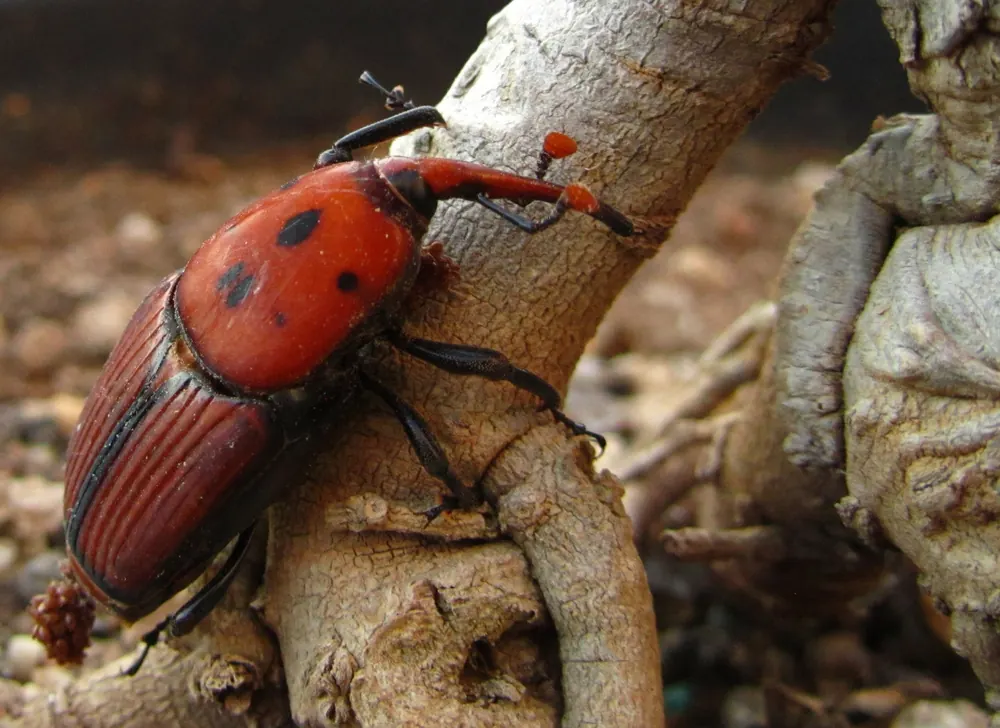
The adult is a reddish beetle two or three centimetres long, and it isn’t the one that does the damage. What destroys the palm is the larvae: the female lays her eggs in wounds or cracks in the crown, and the larvae dig tunnels inwards, eating the soft tissue of the heart.
That’s the key to everything else: if the heart (the point from which the palm puts out new leaves) is destroyed, the palm can’t regrow from anywhere else. It isn’t like a tree, which pushes out another branch. It’s over.
Which palms it attacks
It has a very clear preference for Phoenix canariensis, the thick-trunked Canary Island date palm found all along the coast. It also attacks the date palm. Washingtonia, the tall, thin-trunked palms you see lining avenues, interest it a good deal less, though they aren’t immune.
The signs, from earliest to latest
Check them in this order. The higher up the list, the better the chance of saving it.
1. Centre leaves cut or chewed
It’s the earliest sign and the easiest to miss. The new leaves in the centre come out notched, as if snipped with scissors, or with their tips eaten. That damage happened inside the heart weeks earlier, while the leaf was still folded. If you see this, act now.
2. The heart opens into an odd fan
The crown loses its symmetrical shape. The centre leaves spread out in a disorderly way or stay shorter than the outer ones, and the whole thing looks lopsided, as if ruffled on one side.
3. Centre leaves that bend or drop
They start to hang limply. The tissue that held them up is being eaten. The palm can keep its outer crown green and apparently healthy while the centre is dying, and that contrast is exactly what throws a lot of people.
4. Sawdust, cocoons and smell
Debris like damp sawdust at the base of the leaves or at the foot of the trunk. Fibrous cocoons the size of an egg. Sometimes a fermented smell. By this stage the colony is large.
5. The heart collapses
The whole crown falls to one side or slumps. At this point there’s nothing left to do for the palm, and the urgent thing becomes something else: removing it properly so it doesn’t become the source that infects the palms around it.
The window closes
- 1Centre leaves chewedmargin: High
- 2The heart opens oddlymargin: High
- 3Centre leaves bent overmargin: Medium
- 4Sawdust and cocoonsmargin: Low
- 5The heart collapsesmargin: None
Margin to save it
The first two stages are the only comfortable ones, and they’re exactly the ones you can’t see from below. By the time the symptom is obvious to the naked eye, the bar is nearly at the end.
What you can do to keep it away
Don’t prune it in the warm months
It’s the most important preventive measure and the most ignored. The weevil finds fresh cuts by the smell they give off, and a palm freshly pruned in June is exactly the lure it was looking for. If it has to be pruned, do it in midwinter, when the insect is far less active. We explain it with the rest of the calendar in when to prune on the Costa del Sol.
And if you have to cut, seal
Any cut, even taking off one dead leaf, is a way in. A wound sealant greatly reduces the smell that draws the adult.
Look at them closely every few weeks
From below, with the palm against the light, you see nothing. You have to look at the crown carefully, and if it’s tall, with binoculars or from a high window. Two minutes every fortnight is all the watching it takes.
Watch out for palms brought in from elsewhere
A good part of this pest’s spread has come on the back of transplanted palms. If you buy a mature palm, look at the heart before planting it and ask where it comes from.
If you suspect yours is affected
Two things, in this order.
First, don’t prune it. The natural impulse is to cut off the ugly leaves, and it’s the worst thing you can do: it multiplies the smell that draws more adults and can spread larvae.
Second, get someone to look at it as soon as possible. The treatment depends on how far the infestation has gone, and it isn’t the same for a palm with chewed centre leaves as for one whose heart has been taken over. The sooner it’s caught, the cheaper it is and the more likely it is to be saved.
And a warning about the end of the process: if the palm can’t be saved, removing it isn’t just any job either. A badly handled infested palm releases adults that head straight for the neighbour’s palms. There are regional regulations on this and it’s worth complying with them, and not only because of the fine: it’s the difference between losing one palm and losing every palm in the street.
If you have doubts about yours, send us a few photos of the crown taken from above or from the side (from below you can’t see a thing) and we’ll tell you what we see.