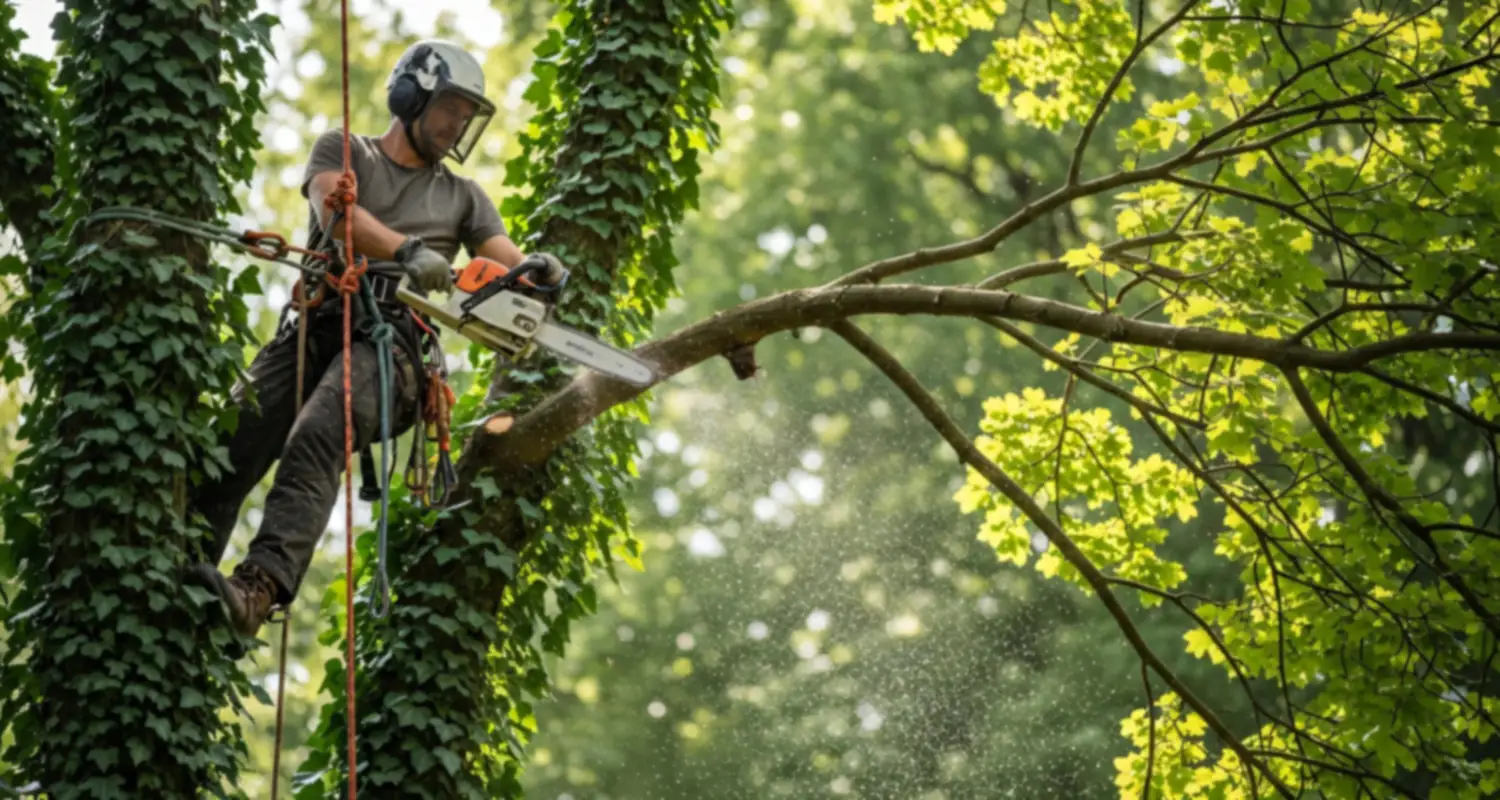
Tree pruning on the Costa del Sol
A topped tree grows back taller and less secure
We prune so the tree holds up, not so you can see it’s been cut. Written quote within 24 hours.
- No topping: we reduce by cutting back to a side branch
- Lowered on ropes over a pool, car or glazing
- Green waste and wood removal included
Tell us which tree, and what’s underneath it
One photo of the whole tree, from a distance, is worth more than any description.
What’s included
Good pruning barely shows
It’s the counter-intuitive part of the trade. When you can clearly see from the ground where they’ve cut, they’ve usually cut too much.
Formative pruning
The first few years decide the tree’s structure for the rest of its life. Five minutes with the secateurs on a young tree saves you a cherry picker twenty years from now.
Crown clean
Dead wood, crossing branches that rub against each other, and water shoots. It’s the pruning that does a tree the most good and shows the least from the ground, which is exactly the sign it’s been done well.
Problem branches
Anything hanging over the pool, the car, the glazing or the power lines. It’s lowered piece by piece on a rope instead of being dropped, because dropping it is where the scares come from.
Height and removal
Climbing on ropes when the cherry picker can’t get in, and the cuttings taken away. On a plot with mature trees, the volume that comes down isn’t a detail of the quote: it’s half the quote.
What we don’t do
Topping doesn’t lower the risk. It puts it off and makes it bigger
It’s the most common request in communal gardens: the tree has got big, someone has had a fright, and the decision is to cut it in half. It looks like the cautious thing to do. And it’s exactly what makes it dangerous.
When a thick branch is cut in the wrong place, the tree responds with lots of very fast shoots around the wound. And those shoots are attached to the surface of the cut, not to the heart of the branch, which is where the old one grew from. In a few years you have the same height again, with longer branches held on by much less.
On top of that, the tree can’t close a large wound: it stays open and rots inwards while, from the outside, the tree looks lush. That’s why a ficus or a mulberry topped eight years ago drops a branch one day when there isn’t a breath of wind.
If the tree is too big for its spot, the answer isn’t topping it: it’s reducing the crown by cutting back to a side branch that can take over, or accepting that it was the wrong tree for the place and needs replacing. Both are better said up front than in five years’ time.
Timing
Being able to prune all year doesn’t mean any time will do
On this coast it hardly ever freezes, and that removes the barrier that sets the calendar on its own in other places. Here the window is so long that people end up pruning when it suits them, which almost never coincides with when it suits the tree.
There’s no single good date: there’s one per species, and some of them clash badly. A citrus and a stone fruit tree aren’t pruned in the same month, and a palm is in a league of its own, because its calendar is set by a pest.
The month-by-month calendar, with what’s due in each month and for which species, is written up in when to prune on the Costa del Sol.
Let’s talk about price
What makes pruning expensive is under the tree
It’s what surprises people most about a pruning quote. The same tree in the middle of a plot and over a glazed terrace don’t cost anywhere near the same, and the difference isn’t in the crown.
- What’s underneath. Over a lawn, the branch can be dropped. Over a pool, a car or a glazed terrace it has to be lowered piece by piece on a rope, and that multiplies the time.
- The condition of the tree. A healthy tree can be worked with confidence. One with dead wood or rot means checking every anchor point as you go, and that’s paid for in hours.
- How close the power lines are. Near an electricity line the method and the precautions change, and sometimes the right people have to be contacted first.
- Where the cuttings end up. The crown of a mature tree fills several trailers. If the lorry can park at the gate, that’s one thing; if it all has to be carried out by hand along a side passage a metre and a half wide, that’s another.
We come, take a look and send you the price in writing, with what’s included and what isn’t. And if what needs doing is waiting three months, we’ll tell you that too.
Where we work
Every town has its own trees
And its own problems: slopes in some, mature street trees in others. Each page goes into it.
For you to decide
Before you pick up the secateurs
A good part of the pruning in a garden gets done without calling anyone. What you don’t want is to do it in the wrong month.
When to prune on the Costa del Sol: a month-by-month calendar
The pruning calendars going round the internet are made for a climate that isn’t ours. Here it almost never freezes and summer lasts from June to September, and that changes the dates of almost everything.
Read itWhat not to prune in autumn if you want flowers in spring
You come back in September, the garden has run wild and you cut everything back. The wisteria, the mock orange and the hydrangea already have March’s flowers made, and they go in the bag with the rest.
Read itWhen to prune oleander, and how to rejuvenate one that’s grown huge
Here oleander never stops growing and ends up as a wall that’s bare at the bottom with the flowers on top. When it’s pruned, how to renew it without going a year without a hedge, and why its cuttings aren’t burnt.
Read itPruning a pine tree: when it’s done here, and why it’s never topped
The pine is the tree of half this coast and the one that takes a bad cut worst: it won’t regrow from wood without needles. What it’s pruned for, what you can’t ask of it and when to do it here.
Read itOpening up a tree all at once here scorches its bark
A tree’s crown is also its sunshade. When it’s opened up all at once, the sun reaches bark that hasn’t been exposed in thirty years, and here that isn’t a metaphor.
Read itHow to prune lavender: when, depending on which you have, and where to cut
Fringed, Spanish and English lavender flower at different times and are pruned in their own. The cut always goes in the leafy part: from bare wood it barely regrows.
Read itWhen to prune a fig tree, and how not to lose the brebas
In winter and bare, yes. But on a breba fig, next summer’s breba is already on last year’s branches, and tipping them, as is often done, loses it.
Read itWhen to prune roses on the Costa del Sol: in January, not March
Guides say February or March because you have to wait for the frosts to pass. Granada gets 48 days of frost a year; Málaga, 0.2. Here roses are pruned in January.
Read it
Common questions
What people ask us most
Can you top it so it stops growing so much?
We can, but we’ll advise you not to, and we’ll explain why before we touch anything. A topped tree responds with very fast, poorly anchored shoots, so within a few years you’re back at the same height, with branches less securely attached than the ones you took off. What does work is thinning the crown and reducing it by cutting back to a side branch, which takes volume off without opening large wounds.
When are trees pruned here?
There isn’t one date for everything: there’s one for each species. And here it gets complicated because it hardly ever freezes, so the window is long and gives the false impression that you can prune at any time. Stone fruit trees, citrus, deciduous ornamentals and palms all have different moments, and some of them clash quite badly with each other.
Do I need a permit?
Sometimes, yes. In quite a few municipalities, street trees and trees above a certain size are protected, and pruning is not the same as felling. It varies from one municipality to another, so the right thing to do is ask at the town hall first and, in an owners’ community, also agree it at a general meeting. If you hire us, we’ll tell you which case we think it is, but the paperwork is the owner’s responsibility.
Do you look after trees in owners’ communities?
Yes. In communal gardens, decisions about trees are made differently: what is done and why has to be put in writing, because the committee changes and the decision doesn’t. And it usually comes late, when there’s already a root lifting a pavement or a branch over a car. We explain the problem with roots here.
Do you take away the wood and the cuttings?
Yes, it’s included. If you’d like to keep the firewood, we leave it cut and stacked wherever you say, which works out cheaper for everyone.
Shall we take a look before you decide anything?
Tell us which tree it is and what’s worrying you, and we’ll tell you what we would and wouldn’t do, in writing.