Blog · Pruning calendar
What not to prune in autumn if you want flowers in spring
You come back in September, the garden has run wild and you cut everything back. The wisteria, the mock orange and the hydrangea already have March’s flowers made, and they go in the bag with the rest.
 By Sergio Domínguez8 min read
You come back to the garden in September and it’s run wild. Two months of irrigation, heat and nobody watching. You get the hedge trimmer out, go over everything, and in one afternoon the place is presentable again.
In March, the wisteria doesn’t flower. Nor does the mock orange. And nobody connects the two, because six months have passed between the cut and the missing flowers.
The question that decides when to prune
It isn’t what month it is. It’s this: does your plant flower on the wood it made last year, or on the wood it’s going to make next year?
Plants that flower on old wood prepare their flowers well in advance: at the end of summer they form the buds, keep them through the winter and open them in spring. By the time March comes, the work was done months before.
Those that flower on new wood do the opposite: they shoot in spring and flower on that new growth, so cutting them in winter takes nothing away. In fact it does them good.
A garden’s whole pruning calendar comes from that distinction. The rest is detail.
March’s flowers are already made
This is the part that’s hard to believe, because you can’t see it. A freshly formed flower bud is a small oval bump stuck to the wood, the size of a grain of rice and the same brown as the branch. From a metre away you can’t tell it from a knot.
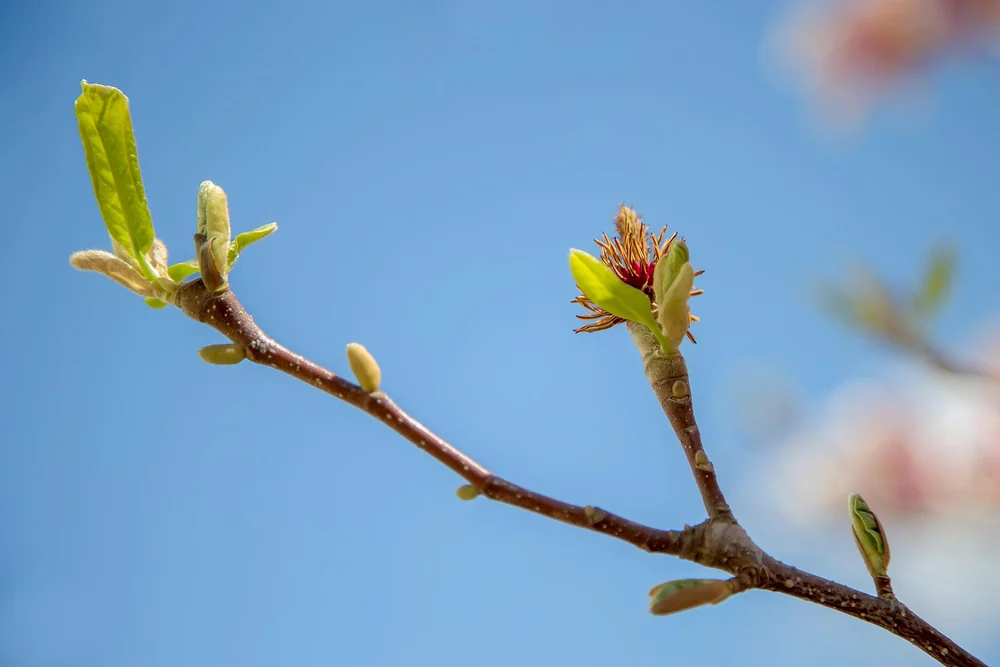
And that’s the problem with the autumn tidy-up: those buds are on the outer layer, which is exactly the layer a hedge trimmer takes off. It isn’t that a few get lost. They all do, and the plant is left perfectly healthy and perfectly unable to flower.
The same branch, one decision apart
October: March’s flowers are already formed and waiting in the wood. From the outside you can’t tell them from a knot.
The trim: the hedge trimmer takes off the outer layer, which is exactly where they all were.
March: the one nobody touched flowers. The other is healthy and green, and has nothing to flower with until next year.
The trimmed plant isn’t sick and isn’t short of anything. In spring it shoots strongly and puts out new leaves, which is all it can do. It flowers again the following year, as long as nobody goes over it again in autumn.
Which ones to leave alone now
The old-wood ones. If they’re in your garden, put the shears away until they’ve flowered:
- Wisteria, which also flowers on short spurs of wood several years old: a rough trim costs it seasons.
- Mock orange, lilac and forsythia. The three spring-flowering classics, and all three are spoilt the same way.
- Hydrangea. The most famous case and the one people get wrong most often, because the dry winter stems are crying out to be cut.
- Camellia and azalea, which form their buds in summer.
- Laurustinus, much used here as a hedge, which flowers in winter with what it prepared in autumn.
- Almond and stone fruit trees, and in general anything that flowers before it comes into leaf.
- Jasmine depends on which one it is. The winter-flowering one flowers on old wood; the summer one, on new wood. Check when yours flowers and you’ll know which group it’s in.
Which ones you can cut back
The new-wood ones. These flower on whatever grows afterwards, so the late-winter cut doesn’t just leave their flowers alone: it multiplies them.
- Oleander, which flowers all summer on the year’s growth and takes hard pruning.
- Bougainvillea, the same, and it’s grateful for having old wood taken out from the middle.
- Plumbago, lantana and lady of the night.
- Syrian hibiscus and buddleia.
- Repeat-flowering roses, the ones that keep flowering all season.
And if you don’t know which group yours is in
There’s a rule that never fails and that you can apply without knowing the plant’s name: prune it just after it finishes flowering.
It works for both groups for the same reason. If it flowers on old wood, after flowering it has the whole summer ahead to prepare next year’s flowers. If it flowers on new wood, it has already done its job and the cut leaves it plenty of time to regrow. You don’t need botany: you need to notice when it flowers.
Why it goes wrong more often here than elsewhere
In a cold climate the plant sets the calendar on its own: it drops its leaves, it’s left bare, and that’s the signal that the year is over. Pruning is done in midwinter because that’s when it can be done.
Here there’s no such signal. Many plants stay green, most never fully stop, and the garden is still in use, so it isn’t the plant that decides when the tidy-up happens: the calendar of use does. And that calendar points to September and October, which is exactly when the buds have just formed.
There’s a case very typical of this coast that makes it worse: the rental home. A villa garden is smartened up between lets, not between seasons, and that leads to going over everything in October to leave it presentable for the rest of the year. It’s a reasonable business decision that lands on the plant in the worst month, and it’s one of the things we see most in the Mijas urbanisations.
The full calendar, month by month and by species, is covered separately in when to prune on the Costa del Sol.
What does need doing now
Not being the month for a general prune doesn’t mean there’s nothing to do. September gives you plenty:
- Remove the dry, the dead and the broken, which can be done any day of the year and doesn’t cost any plant its flowers.
- Tip back whatever is blocking a path or covering a window. One specific cut isn’t a general trim.
- Cut back whatever has already flowered this summer, which is exactly the right moment according to the rule above.
- Plant, because here planting time is now and not spring, for reasons we explain in why you plant in autumn here.
And if what you have is a clipped hedge, that’s a separate matter: it’s trimmed for shape rather than flowers, and it has its own rules, covered in why a hedge goes bare at the bottom.
Everything else can wait. A garden copes with a few months of looking unkempt better than it copes with a spring without flowers.