Blog · Hedges and topiary
Your hedge has gone bare at the bottom: why it happens and what can be done
A hedge that loses its base isn’t fixed by cutting it harder. And if it’s cypress or thuja, which is half the hedges on this coast, it can’t be fixed at all.
 By Sergio Domínguez8 min read
It’s one of those things that happen so slowly that one day they’re just there and nobody remembers when they started: the hedge is dense and green at the top, and at the bottom it’s down to bare stems, with the neighbour’s fence showing between the trunks.
The usual reaction is to cut it back harder “so it thickens up”. Depending on what your hedge is, that’s either the cure or the final blow, and it’s worth knowing which before you switch the machine on.
Why it goes bare at the bottom
It isn’t thirst, it isn’t the soil and it’s hardly ever a pest. It’s light.
A hedge is a plant competing with itself. The top shades the bottom, and a leaf that gets no light doesn’t pay its way: the plant drops it and puts its growth where the light is. If the face of the hedge is vertical (or worse, wider at the top than at the bottom, which is how any hedge trimmed without a plan ends up), the base is left in the dark and disappears.
And here the effect is stronger than further north, for a geometric reason: the higher the sun at midday, the less light a vertical surface gets. In July, at midday, the face of a straight hedge is practically in its own shade.
One sunny day, two profiles
At midday the vertical face gets almost no direct light: the sun passes over it. The base lives on the low-angle hours and ends up bare.
Sloping the face turns it towards the sky. It gets less than the top, but it gets it all day, and that keeps it in leaf right to the bottom.
The shape that prevents it
Wider at the bottom than at the top. There’s no need to overdo it: if the faces slope slightly, the base gets light all day instead of only first and last thing.
It’s hard to do because instinct says the opposite. When you trim standing up, the easy thing is to follow the vertical, and since each pass takes a little less off the top than the bottom, where you reach more easily, a hedge trimmed without thinking about its profile gets wider at the top year after year. The base fades on its own, without anyone having done anything strange.
If yours already overhangs at the top, the correction is made at the top, not the bottom: you get the slope back by taking width off the upper part, which is where there’s too much.
And now the important part: what your hedge is
Everything above applies to any hedge. What comes next splits the world in two, and it’s the difference between being able to fix it and not.
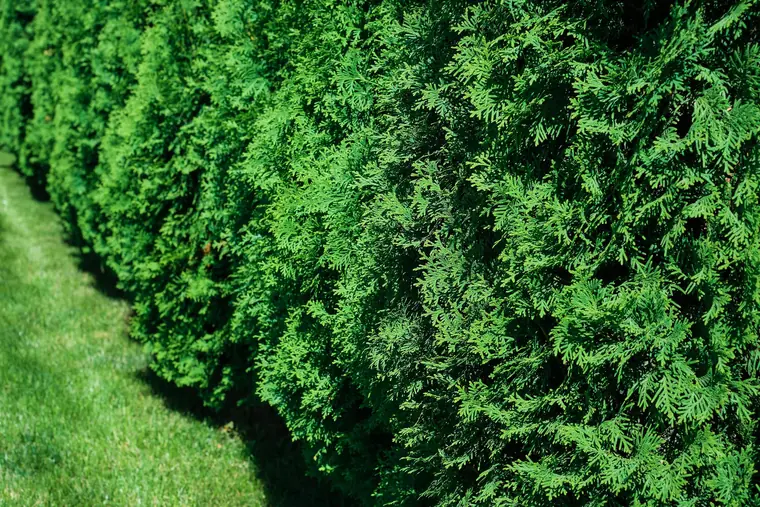
Conifers don’t regrow from old wood. Cypress, thuja, leylandii, juniper: anything with scale-like leaves works the same way. The green is an outer layer a few centimetres deep, and behind it there’s woody growth without a single dormant bud. If you cut beyond that layer, the gap stays brown for good. It isn’t slow to regrow: it has nothing to regrow from.
Broadleaf hedges do regrow. Pittosporum, laurustinus, laurel, privet, euonymus, myrtle, jasmine: these keep buds in the old wood and respond to a hard prune by pushing out new shoots from inside. A proper renovation brings them back.
Checking takes two seconds. Part the foliage with your hand and look at what’s behind it. If you see bare brown twigs and no buds, and the leaf is scale-like, don’t cut there. If you see small shoots coming from the inside, you have room to work.
What can be done if it’s already bare
If it’s broadleaf, it gets renovated. That’s done as winter ends, in stages: one face one year, the other face the next, and the top in a third round. Cutting all three sides at once leaves the plant with nothing to feed itself with, and with two seasons of patience the result is a new hedge. Water and feed afterwards, because it has rebuilding to do.
If it’s a conifer, the honest answer is that it can’t be fixed. It can be hidden (a band of low shrubs in front conceals the bare base and gives you something to look at), you can live with it, or it can be replaced. What can’t be done is to prune it until it comes back. If someone tells you it can, what you’ll be left with is a brown hedge.
If it has to be replaced, don’t rush out to buy now. Planting time here isn’t just any time, and the reasons to wait for autumn weigh even more with a hedge, which is a lot of plants together, all with the same first summer ahead of them.
The trimming calendar here
On this coast a hedge grows almost all year, so the northern pattern (one hard cut and then wait) doesn’t fit. Trimming lightly and often works better: three or four light passes spread through the year keep the shape without ever having to go into old wood, which is exactly the cut that doesn’t forgive. It’s the rhythm we work to in hedge and shrub trimming.
In the height of the heat, better not. A trim leaves thousands of fresh cuts on the exposed face, and under the August sun that surface scorches and stays brown for a few weeks. Late summer is a good time as soon as the heat eases, and from then until the start of winter the work is comfortable. In spring, take a look before you bring the machine in: dense hedges are where birds nest.
Three mistakes that cost you dearly
Letting it grow taller than you can trim. A hedge you can no longer reach gets trimmed well on top and badly on the sides, and that’s exactly the recipe for a bare base. The right height is the one you can keep up yourself, not the one that hides the neighbour completely.
Using a hedge trimmer on large leaves. On laurel or aucuba the machine cuts the leaves in half, and those cuts go brown and stay visible for weeks. That calls for hand secateurs, stem by stem. It’s slower, and you can see the difference a fortnight later.
Planting the hedge against the wall. A hedge planted up against a wall gets no light on that side and goes hollow inside. It needs air and some light on both sides, even if it’s not much.
A local note: owners’ communities are where you see the most bare hedges, and almost always for the same reason (they’re trimmed quickly, vertically and once a year). How maintenance is planned when the decisions are made at an owners’ AGM is covered in gardeners in Fuengirola.
In short
Look at your hedge’s profile end-on. If it’s a rectangle or a mushroom, you know why it’s losing its base. And before you decide anything, part the foliage with your hand: what’s behind the green layer tells you whether this can be fixed or whether you’ll have to learn to live with it.
If yours is doing well and you just want it to stay that way, the rest is a matter of calendar. When each job is due is in the pruning calendar for the Costa del Sol.