Blog · Hedges and topiary
A hedge gone brown after the summer: the pattern tells you what happened
At the end of summer many hedges come out with brown patches and the first thought is a pest. It hardly ever is: where it has dried out tells you what happened, and each pattern has a different fix, or none.
 By Sergio Domínguez7 min read
At the end of summer many hedges come out with brown patches. The first thought is almost always a pest, and the second, to look for a product to stop it.
It’s hardly ever that. Where the hedge has dried out tells you what happened to it, and each pattern has a different fix, or none. Before you buy anything, it’s worth taking a calm look.
First, what’s normal
If your hedge is cypress or thuja and, when you part it with your hand, you see it’s brown inside but the outer layer is still green, nothing is wrong. Conifers shed their old inner foliage every year, the part that no longer gets any light, and they do it right now, between the end of summer and autumn.
That isn’t fixed by watering more or by cutting. You leave it. What you need to look at is the outer layer.
One dry plant in the middle of the row
It’s the most common case and the hardest to read. One plant entirely brown, with green ones on both sides. It looks as if something has got into that plant and is going to move on to its neighbours.
Here it’s almost always water. From May to September it hardly rains (Málaga airport gets 52 mm on average across those five months, according to AEMET, the Spanish met office), and the hedge lives on drip irrigation: each plant has a dripper at its foot and drinks only from that. If one clogs (lime, soil, a root that works its way in, someone who trod on it), that plant goes without water all summer, while the one next to it, a hand’s width away, still has its own. Where it rains in summer, the rain would cover up the fault. Here there’s nothing to cover it.
The same hedge, from spring to the end of summer
Spring. The hedge sits on a drip line, with a dripper at the foot of each plant. Each one drinks from its own, and the soil underneath is moist.
Summer. One dripper clogs. Its damp patch dries out and, since here it doesn’t rain all summer, that plant gets no water from anywhere else. The ones next to it still have theirs.
End of summer. One dry plant between two green ones. It looks as if it will spread to its neighbours, and it won’t: a hand’s width away, they have water. The dripper is what to check.
Checking is easy. Turn that irrigation zone on and walk the line looking at each dripper: the one at the dry plant doesn’t drip, or barely does, and the soil under it is dry while the soil next to it is damp. Look at the end of the line too: in a long row, the last plants are the ones that get least.
The dripper is cleaned or replaced and the whole line checked, because if one has clogged, the others are going the same way. A check of the automatic irrigation at the end of summer is what prevents next year’s dead plant.
A whole stretch, or several in a row
If it’s several plants in a row, usually the water isn’t reaching that stretch: a break or a leak in the line before it gets there, or a zone that doesn’t open. Again, you see it by turning the irrigation on.
The opposite case exists too, and it’s misleading because the plant looks just as dry. Put your hand or a spade into the soil. If it’s soaking and the plant is dry, there’s too much water: a leak underneath, a low spot where water collects, or watering that runs too long. The roots have drowned, and the plant gets no water even with water all around it.
Odd dry branches scattered through the hedge
If, instead of whole plants, what you have is odd branches that have suddenly dried out, scattered here and there, it’s a different matter. On cypress, a branch that dries out completely, with resin on the bark, points to a fungus that causes cankers in the wood.
What you do is done by hand: cut the branch below the dry part, clean the tool between one cut and the next, and take the cuttings out of the garden. If the problem keeps advancing on one plant, that plant eventually has to come out, so it doesn’t keep spreading it.
Brown on the outside, or at the bottom
If the brown is on one face only, the one facing the afternoon sun, the wind or the sea, it’s scorch: heat, the terral (Málaga’s hot, dry wind from inland) or salt. On the beachfront the face looking out to sea suffers it every year. If only the tips have burned, it greens up again with the next flush of growth.
And if the brown appeared right after a trim in midsummer, that’s the cause: the trim leaves thousands of fresh cuts in the sun. That’s why here trimming is left until the heat eases.
If the brown is at the bottom, on the pavement side, at dog height, and above all at corners and next to entrances, it’s urine. That’s not a joke: on a hedge that borders the street it’s extremely common, and the plant that gets it every day ends up drying out from the base.
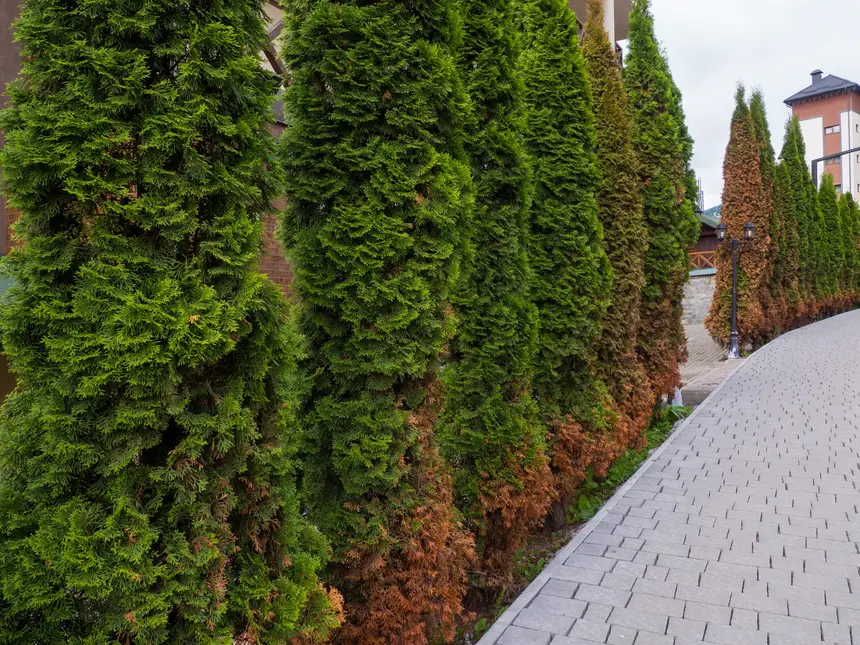
Two patterns in the same row. Brown at the bottom and on the walkway side, with the top and the back still green: that points to something coming from the walkway at ground level, not to a disease. And further along, one plant completely dry between green ones, which is the first thing to check in the irrigation.
What can be fixed and what can’t
It all depends on what your hedge is. Cypress, thuja and other conifers don’t regrow from the dry part: whatever has gone brown all the way through stays that way. If it’s a whole plant, it gets replaced. If it’s the tips, they come back.
Broadleaf hedges do regrow: pittosporum, elaeagnus, laurustinus, laurel. The dry part is cut out and, once the cause is fixed, the plant closes the gap again. How to tell them apart by hand, opening up the hedge, is in why a hedge goes bare at the bottom.
If something has to be replaced, now is the time: autumn is when planting is done here, with the whole winter ahead for the new plant to root before its first summer. And if several need replacing, it may be a good moment to rethink the species. We cover that in which hedge to plant on the Costa del Sol.
The rest of the work on a hedge (trimming, reducing it, and what to do with one that has swallowed the path) is on the hedge trimming page.
In short
A hedge that’s dry after the summer hardly ever has a pest. Brown inside and green outside, on a conifer, is normal. One dry plant between two green ones, here, is almost always its dripper. A whole stretch: water that isn’t arriving, or too much of it. One face: sun, terral or salt. At the bottom, on the pavement side: dogs.
Before you buy a product, turn on the irrigation and look at the drippers. It’s the cheapest thing to do, and the one that explains it most often.