Blog · Hedges and topiary
Which hedge to plant here, and why cypress is hardly ever the answer
Garden centres sell the fastest grower, because it screens in the first year. The trouble comes when it passes the height you can keep up with and doesn’t stop.
 By Sergio Domínguez8 min read
You want to block out the neighbours, or the noise from the street, or both. You go to the garden centre, ask for a hedge and out comes the usual: a fast-growing conifer, cheap, and on offer if you take twenty.
Two years later the decision looks spot on. The problem arrives around year eight, and by then there’s no cheap fix.
Fast growth gets paid for, just not at the garden centre
Choosing by growth rate is the most natural thing in the world, and it’s exactly what not to do. A hedge that grows fast doesn’t grow fast up to the height you wanted and then stop: it grows fast for ever.
The same years, two hedges
It takes longer to screen, and in return it stays where you can trim all of it: the sides and the base are within your reach every year.
It screens in year one and doesn’t stop. What grows above the line only gets cut on top, so it ends up wide at the top and bare at the bottom.
As soon as it passes what you can comfortably reach from the ground, it only gets trimmed on top, because that’s what can be done. And that’s where the decline begins: the top widens, shades the base and the base fades. That process starts the day the species is chosen. We describe it step by step in why a hedge goes bare at the bottom.
And with cypress there’s an added problem
Conifers (cypress, thuja, leylandii) don’t regrow from old wood. The green is an outer layer a few centimetres deep, and behind it there are no buds. That means there’s no second chance with them: if the hedge goes bare or outgrows its space, it can’t be recovered by pruning, and the only way out is to rip it out and start again.
On a twenty-metre hedge, that difference between “it can be renovated” and “it has to be replaced” is the most expensive decision in the garden, and it gets made without a second thought on the day you buy.
Broadleaf hedges come with a safety net
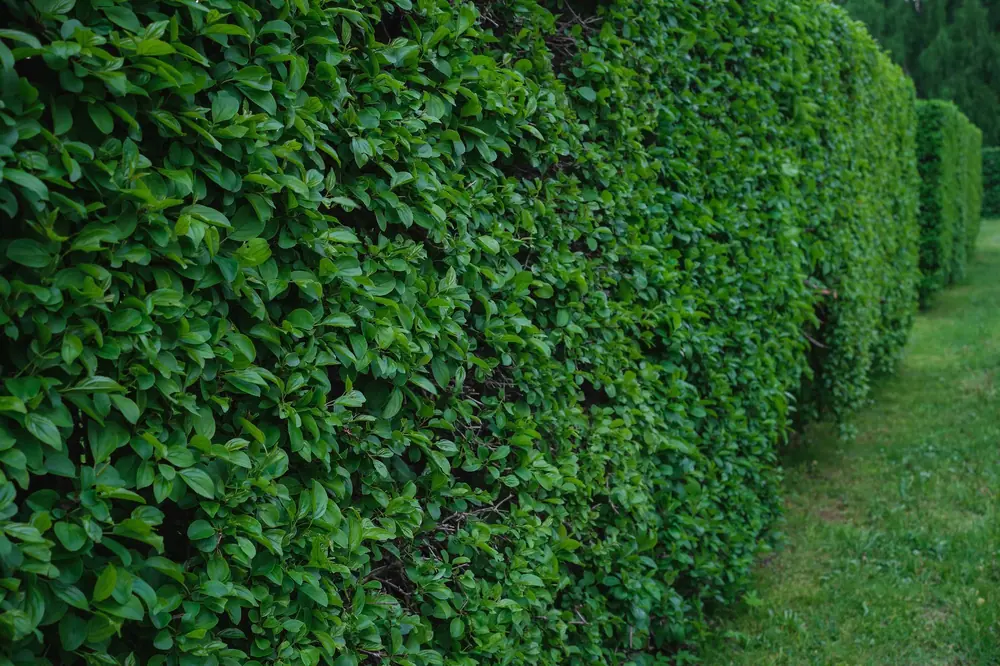
The alternative is broadleaf hedges, and their advantage isn’t how they look: it’s that they keep buds in the old wood. A hedge like that can be cut back hard, face by face over a couple of seasons, and it comes back.
The list that works here
Pittosporum. It’s the workhorse of this coast, and for good reason: it copes with salt, makes a dense mass, trims well and regrows. If you have to pick one without thinking about it too much, this is the one.
Myrtle. Native, small-leaved, takes fine trimming and needs very little water once established. For medium-height hedges it’s hard to beat.
Laurustinus. The one that copes best with shade, which here is a real problem on the north side of a building. It also flowers in winter, when there’s nothing else.
Privet. If you really need speed, this is the fast one you can forgive: it grows quickly and regrows, so a mistake can be put right.
Oleander. For an informal screen, with no square trimming and flowers all summer, nothing is more rewarding or needs less water. A warning: it’s toxic if eaten, so think twice with small children or a dog that likes to chew.
Teucrium or rosemary, for low dividing hedges (path edges, divisions within the garden), where a conifer is out of proportion.
What to decide before you buy
The final height, and make it one you’ll keep up. Not the one that hides the neighbour completely: the one you can trim all of, sides included, without hiring anything. Everything above that becomes a yearly cost.
Formal or informal. A hedge clipped square needs several passes a year, because here plants grow almost all year round. An informal one (oleander, unclipped myrtle) needs a tidy-up and little else. The difference in work between the two is huge, and it’s decided now.
Sun or shade, and whether salt spray reaches you. On the seafront some species scorch and others don’t even notice; pittosporum is one of the latter.
Spacing. Two classic mistakes: planting it right up against the wall, where it gets no light on one side and goes hollow inside, and planting the shrubs too close together to screen sooner. The second works for two years, and then they compete with each other for the same water. And as for the distance from the boundary, better to check it beforehand than argue about it afterwards.
And an alternative hardly anyone suggests
Sometimes what you want isn’t a hedge: it’s to stop seeing something. A fence or mesh with a climber on it screens sooner, takes up a quarter of the space and doesn’t need trimming on three faces. Bougainvillea if it gets the sun, jasmine if you want scent, ivy or Virginia creeper for an ugly wall.
It has its drawbacks, and you should know them: it doesn’t block noise like a dense mass of plants, and a vigorous climber gets in wherever it can if it isn’t kept in check. But for a twenty-metre boundary wall it’s cheaper to install and to maintain, and on this coast any of the three gets by with hardly any watering once it has taken.
When to plant it
In autumn, and with a hedge that matters more than with any other planting: it’s a lot of plants together, all with the same first summer ahead of them. If they reach July with their roots still not established, you don’t lose one: you lose three, and a hedge with gaps is no longer a hedge. The reasons are in why we plant in autumn here.
A local note: on sloping plots the hedge also holds the soil and breaks the wind, and there the choice changes (you want more root and less height). We cover it in gardeners in Benalmádena.
In short
Choose by how much you’ll have to trim it and by whether it forgives a mistake, not by how fast it screens. That almost always rules out the cheap conifer from the garden centre and leaves pittosporum, myrtle or laurustinus, which take a year longer to do their job and then do it for twenty.