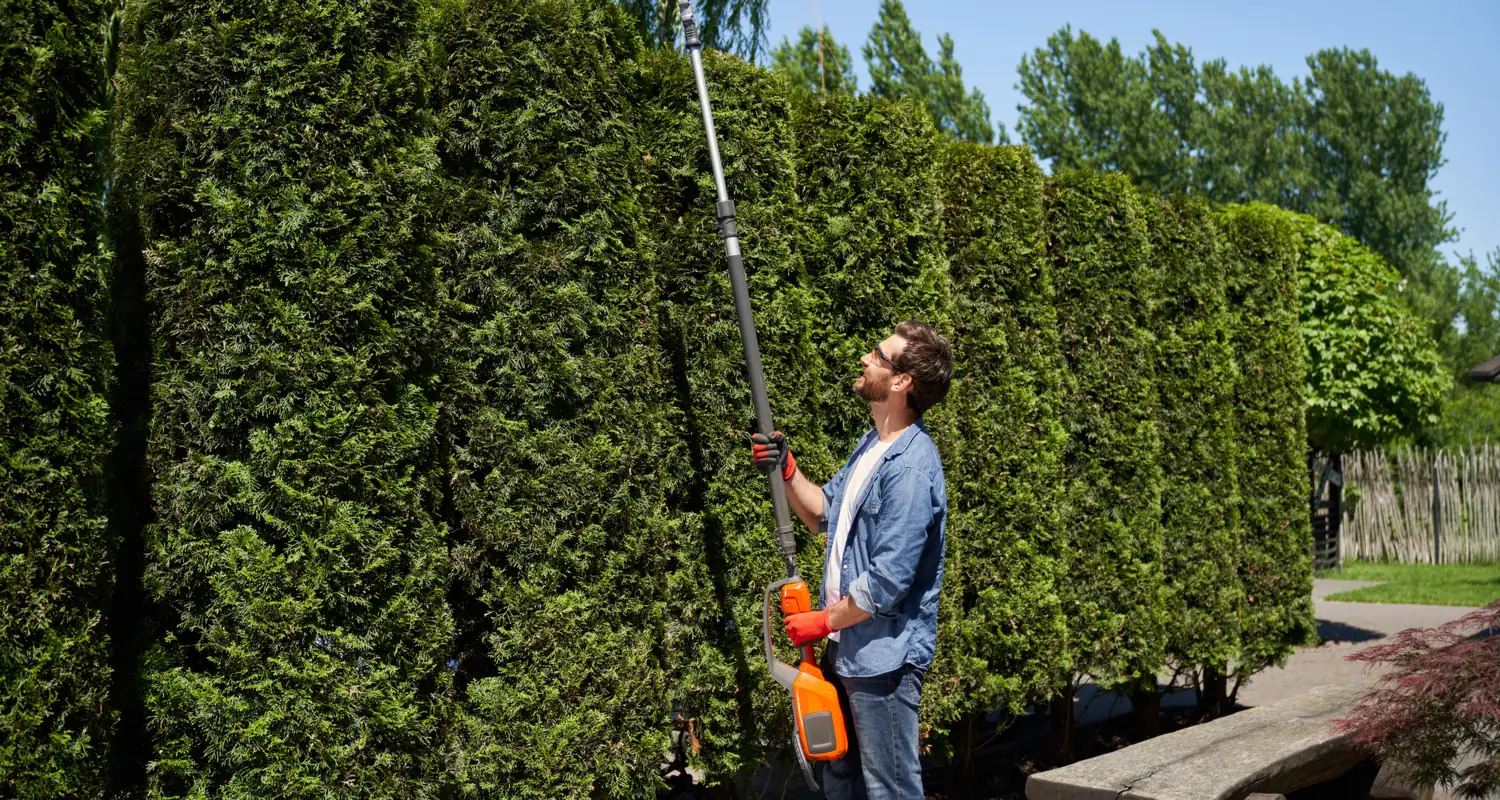
Hedge and shrub trimming
Straight, dense to the bottom and no falling out with the neighbour
Trimming for hedges and shrubs, recovery for neglected ones and reduction for those that have outgrown their space. Written quote within 24 hours.
- Light passes each season, not two hard cuts a year
- Before cutting it back, we check what species it is
- Green waste removal included
Send us a photo of the hedge
One from the front and one from the side show us the height, the length and what it’s like at the bottom.
What’s included
Four different situations with the same name
“Cutting the hedge” means very different things depending on the state it’s in. The one people ask for most is the third, and it’s the one that goes worst if it’s done without first checking what plant it is.
Maintenance trimming
Light passes spread through the season instead of two hard cuts a year. It’s more visits, yes, and it’s what keeps the hedge dense right to the bottom instead of slowly turning into a bare stick with leaves on top.
Bringing neglected hedges back
When it hasn’t been touched for years, one visit won’t fix it. It’s planned in stages, over more than one season, because cutting a conifer hedge back hard in one go can’t be undone.
Reducing height and width
A hedge that has swallowed the path or blocks the view can be brought back to size, but you need to know the species first: some regrow from old wood and others don’t.
Cuttings taken away, always
Trimming a hedge produces a surprising volume, especially if it’s been left to grow for a while. It’s included and stated in writing, which is where the surprises usually turn up.
Where the job changes
Above a certain height, it’s no longer just cutting the hedge
A chest-high hedge is trimmed on foot, watching what you’re doing and correcting as you go. One that’s taller than your head is something else with the same name: you’re working blind over the cutting line, with the machine above you and no view of the face you’re cutting. That’s where wavy hedges come from.
And on this coast that height is reached in far more places than usual, because the boundary hedge between plots is the default privacy solution on almost every urbanisation. It’s planted to screen, and nobody ever decides what its final height should be, so it keeps going up until one day it gets in the way.
That brings the second complication, which is the one that really holds jobs up: a boundary hedge has two faces, and each one is on a different property. Trimming it only on your side leaves the other side growing, and within two years the whole hedge has shifted towards the neighbour. The conversation about access needs to happen before anyone climbs onto anything, not with the machine in hand.
That’s why, with a tall hedge, the first thing we look at isn’t the plant: it’s how to reach it from both sides and what’s underneath. If the work can’t be done properly, we say so before quoting.
Let’s talk about price
Linear metres tell you almost nothing
It’s the figure everyone gives over the phone, and of two hedges the same length, one can cost three times as much as the other.
- The height. It counts for more than anything, length included. It changes the equipment, changes the pace and means the cuttings have to be brought down instead of swept up.
- How long since it was last cut. A hedge on regular maintenance is gone over quickly. One that has been growing for three years is a recovery in stages, and that means several visits spread out over time.
- How many sides you can get to. Two accessible faces with room to work aren’t the same as a hedge right up against a wall or wedged against the neighbour’s fence.
- What’s at the foot. A planted bed, gravel, a pool or parked cars. It decides how much time goes on protecting and clearing up, which is often more than the cutting itself.
We come, look at it and send you the price in writing, and if it makes more sense to set it up as seasonal maintenance than as a one-off cut, we’ll tell you, with the figures for both options.
Where we work
Every urbanisation has its own hedge
In some areas the boundary cypress rules, and in others nearly everything is broadleaf. They aren’t trimmed the same way and they don’t put up with the same things.
To do it yourself
Before you pick up the hedge trimmer
Everything you need to know is written up in full, and with that plenty of people sort it out without calling us.
Your hedge has gone bare at the bottom: why it happens and what can be done
A hedge that loses its base isn’t fixed by cutting it harder. And if it’s cypress or thuja, which is half the hedges on this coast, it can’t be fixed at all.
Read itWhich hedge to plant here, and why cypress is hardly ever the answer
Garden centres sell the fastest grower, because it screens in the first year. The trouble comes when it passes the height you can keep up with and doesn’t stop.
Read itA hedge gone brown after the summer: the pattern tells you what happened
At the end of summer many hedges come out with brown patches and the first thought is a pest. It hardly ever is: where it has dried out tells you what happened, and each pattern has a different fix, or none.
Read it
Common questions
What people ask us most
How many times a year does it need cutting?
More than the two the manuals say, and not so we can sell you visits. Here hedges grow practically all year round, with a pause in high summer because of the heat and two strong spurts in spring and autumn. Frequent light passes keep the shape with cuts the plant barely notices; two hard cuts force you into old wood, which is where it doesn’t regrow from.
Can you cut the neighbour’s side?
Only if the neighbour agrees, and it’s best to have that sorted before we come. A hedge planted on the boundary has two faces, and each one is on a different property. We work with whoever hires us and on the land we’re given access to; what can be cut on the other side, and how far from the boundary you’re allowed to plant, depend on each municipality’s rules and on private agreements between neighbours, so that’s something to check, not improvise.
My hedge is very tall. Is that a problem?
It’s the question we get most. It isn’t a problem, but it is a different job: the equipment changes, the time changes and the price changes. What decides whether it can be done, and how, is access — whether suitable equipment can get to the foot of the hedge on both sides — and what’s underneath. That’s checked on site before we say anything.
What if I want to get rid of it altogether?
That can be done, and sometimes it’s the sensible decision: a very old conifer hedge that’s bare at the bottom won’t recover, and it works out better to pull it out and replant than to keep it going for another five years. Pulling out the line of root balls and leaving the ground ready is a separate job, with its own quote. What to plant instead is covered here.
Has it got out of hand?
Hardly any are as bad as they look. Send us two photos and we’ll tell you whether it can be brought back or not, before we talk about price.