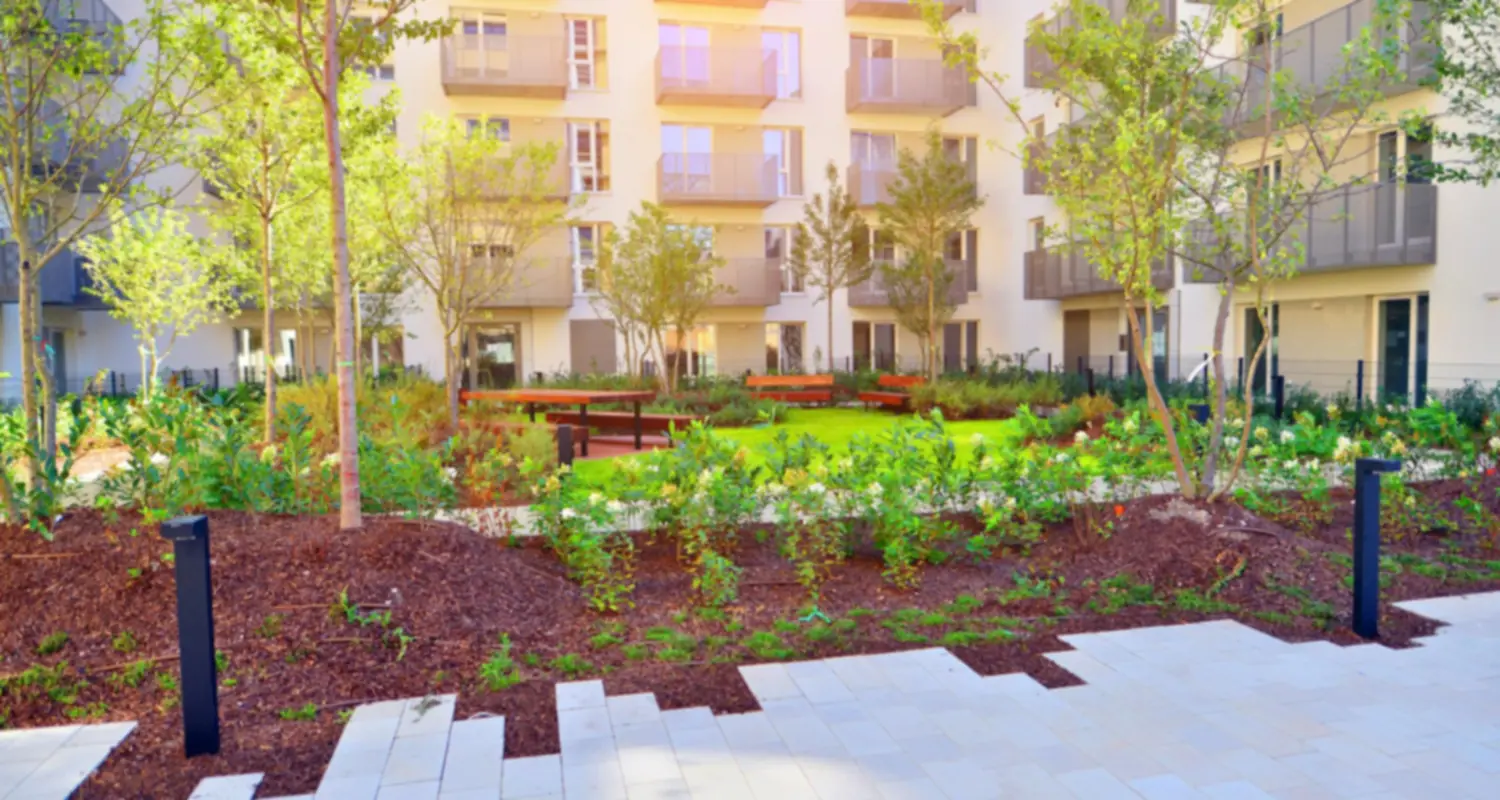
Garden maintenance for communities and urbanisations
The committee changes. The garden stays
An annual contract, a single point of contact and a written report of every visit, so that what was agreed survives a change of committee. Written quote within 24 hours.
- A monthly report: what was done, what was seen and what to plan for
- One point of contact, not a phone line open to the whole community
- In writing: where routine work ends and extra work begins
Tell us about the urbanisation
How many blocks, the green areas, and whether there are trees or palms.
What’s included
Three fronts and a logbook
In a private garden the client sees the work every day. In a community nobody sees all of it, so the fourth pillar is keeping a record.
Green areas and walkways
Mowing, edging and cleaning the flowerbeds, with the visits spread by season. In communal gardens what people notice isn’t the mowing: it’s the unedged border and the leaves piled up at the entrance.
Trees and palms
Checking the trees, pruning them at the right time of year and keeping watch on the palms. It’s the item that gets looked at last, and the one that costs most when it’s looked at too late.
Communal irrigation
Checking the zones, drippers and controller, and flagging it when the water use doesn’t add up. A buried leak in a communal area can go months without anyone seeing it.
A report of every visit
What was done, what was seen and what should be planned for, in writing and dated. It isn’t red tape: it’s the only thing that survives a change of committee.
What nobody tells you
A community has no memory
It’s the fundamental difference from a private garden, and it explains almost everything that goes wrong. The committee changes, the administrator may change and residents come and go, but the garden has been there for twenty years and it isn’t going anywhere.
In practice, what isn’t written down doesn’t exist. Something gets proposed, it isn’t approved, and three years later the problem turns up again as if it were new. Or a frequency is agreed and nobody remembers what it was. Or something is planted where it didn’t fit, and whoever decided on it no longer lives there.
That’s why the monthly report isn’t paperwork. It’s the only thread that links one committee to the next, and it’s what turns “the gardener says something needs doing about that tree” into a dated warning that can go on the agenda.
About the price
Square metres tell you less than you’d think
It’s always the first figure people ask for, and the one that tells you least. Of two urbanisations with the same green area, one can take twice the hours of the other.
- How many pieces, not how many metres. Two thousand square metres of open lawn get mown in one pass. The same two thousand split into twenty flowerbeds between blocks means twenty set-ups, twenty edges and far more time.
- What trees there are, and what state they’re in. Mature trees decide how much work at height there is: the part that’s quoted separately, and the one that causes most upset when nobody planned for it.
- The state of the irrigation. A communal system that works is maintained in one visit. One with broken zones turns the contract into repairs dressed up as maintenance, and meanwhile the water meter keeps running.
- The calendar of use. In a holiday-let urbanisation, noise in August brings complaints. Concentrating the heavy work outside the season doesn’t make it dearer: it means planning, which is a different thing.
We come, walk round it with whoever the community nominates, and send the quote in writing, with what’s included and what isn’t. If there’s something worth fixing before anyone signs anything, we say so too.
Where we work
Each town has its own kind of community
An urbanisation of villas with their own plots is nothing like a block with two flowerbeds and a pool. Each page covers its own area.
Before the owners’ meeting
So you arrive with your homework done
Two things worth being clear about before you compare quotes or make decisions about the trees.
Your community’s gardening contract: what to check before you sign
Three quotes on the table and they all seem to say the same. What separates a good one from a cheap one isn’t the price: it’s what happens when something goes off script.
Read itTree roots are lifting the paving: what can be done and what can’t
The first reaction at the AGM is always the same: cut that root. It’s the one that causes most trouble, and it comes from believing roots grow straight down.
Read itThe urbanisation’s drains, before the first storm
The water that doesn’t go in through the grate doesn’t wait: it runs down until it finds the next low point, and on a terraced urbanisation that point usually has a door.
Read it
Common questions
What property administrators ask us most
Who do you deal with, the property administrator or the president?
Whoever the community decides, but only one person. What doesn’t work is a phone line open to every resident: it ends in contradictory instructions, jobs requested twice and nobody knowing who authorised what. One contact and one channel, and everything else in writing.
What happens when the committee changes?
The memory gets lost, and that’s exactly what the monthly report is for. The written history is what stops every new committee rediscovering the same problem from scratch, and what lets you justify why something was proposed two years ago. Without it, the community repeats decisions and pays twice for the same thing.
Is everything included, or are some things billed separately?
Routine maintenance is included: mowing, trimming, irrigation, cleaning and green waste removal. What’s quoted separately is the extraordinary work (work at height, felling, renovations, replacing plants), and the contract should state in writing where that line falls. If a quote doesn’t define it, it isn’t cheaper: it’s just less specific. What to check in the contract, point by point.
Can you work during the high season?
We can, but it’s planned differently. In urbanisations with holiday lets there are months when clearing work at 9:00 in the morning causes more complaints than an untidy garden, so the noisy jobs are concentrated outside those months, and in summer we start early and do only what’s needed.
Do we need an annual contract?
We set it up that way because a garden runs by seasons and skipping one costs you in the next, but that’s an argument, not a tie. What does make sense for a community is to have the agreement settled before the busy season, not in April, with everything growing flat out and three quotes to compare.
Shall we look at it before the next owners’ meeting?
We walk round the urbanisation and send the quote in writing, with what’s included and what isn’t, so it can be properly compared.