Blog · Community green spaces
The urbanisation’s drains, before the first storm
The water that doesn’t go in through the grate doesn’t wait: it runs down until it finds the next low point, and on a terraced urbanisation that point usually has a door.
 By Sergio Domínguez8 min read
In an urbanisation, the drain is the last thing anyone talks about. You can’t see it, it gives no shade, no owner brings it up at the community meeting, and it hasn’t had to do a single thing since May.
And that’s exactly the trap. A drain only shows it’s blocked on the day it needs not to be, and that day always comes with very little warning.
Here the first rain gives no warning
Somewhere the rain is spread through the year, a half-blocked drain shows itself little by little: an odd puddle in October, the grate swallowing slowly, and by the time the big one comes someone has already looked at it.
It doesn’t work like that here. We go from May to September without useful rain, and then the season opens with a cloudburst — a gota fría — that dumps in two hours what elsewhere falls in a month. There’s no trial period: the system goes from nothing to everything at once, and it happens at night.
And what’s inside the grate after the summer isn’t what it seems either. It isn’t just last week’s dry leaves: it’s four months of dust, sand, soil from the flower beds and grass clippings, which, with no rain to wash them away, have been packing down at the bottom. A grate can look clean on top and have its trap turned into a plug of mud.
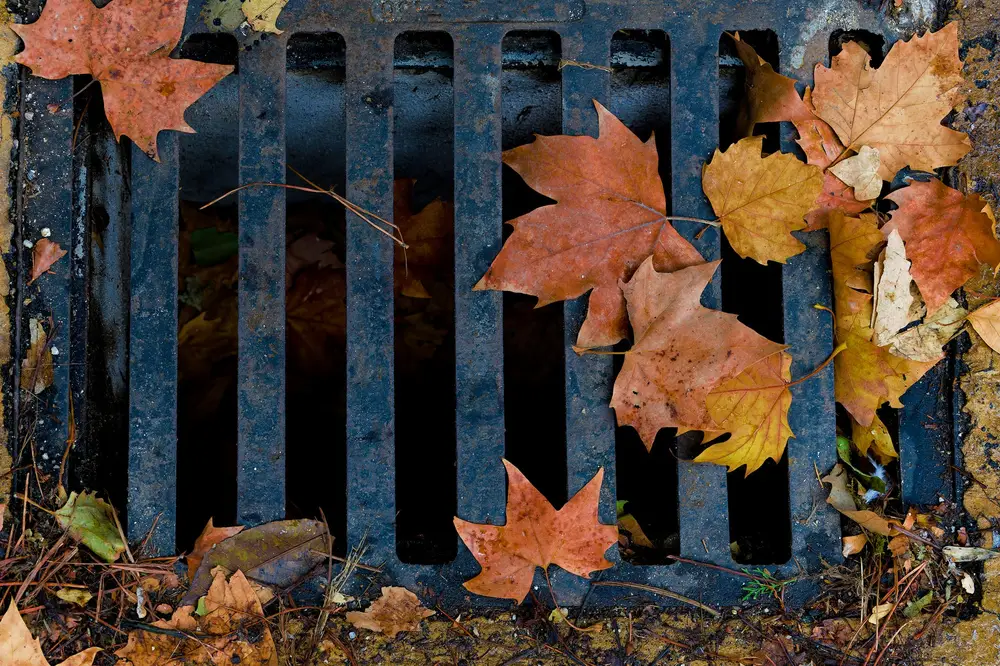
On top, this grate is clear and anyone would say it drains. What decides whether it does is what’s down the gap on the left, and you can’t see that without crouching down to look.
What a blocked drain doesn’t do
Here’s the misunderstanding that sorts out the rest of the article. The word “blocked” suggests a sink: it fills up, the water stays there, and when you unblock it, it goes. And on a sloping street nothing stays.
The same drain, before and after the leaves
A drain that works goes unseen. It swallows whatever falls on it and that’s the end of the story. That’s why nobody looks at them: they’ve spent the whole summer doing nothing, because it hasn’t rained.
With the grate covered, the water doesn’t wait. It runs over the top and carries on downhill. Nothing has got stuck here: it has been diverted, which is different and a lot worse.
The water stops at the lowest point it finds. And on a terraced urbanisation that point usually has a door: the garage ramp, the ground floor of the last block.
The water that doesn’t go in through the grate doesn’t wait. It runs over the top and keeps looking for the next low point, and on a terraced urbanisation — which is half this coast — the next low point is a few metres further down, on another property, in another block or on a garage ramp.
That’s why the damage almost never shows up where the problem is. A storeroom floods and nobody connects that storeroom with a grate fifty metres away and two terraces higher up. A blocked drain doesn’t hold the water back: it spreads it around, and it spreads it downhill.
The four places to look
The road grates and the ones on ramps. The ones on garage ramps are the most urgent: they’re the lowest point of the plot and there’s nothing behind them to stop the water. Lift the grate and look at the bottom; don’t just give it a once-over with the broom.
The gullies in the planted areas. They have the worst of it, because they have soil and plants around them all year and nobody sees them. A flower bed that has crept up over the years may have left the grate below soil level.
The gutters and downpipes that discharge into communal areas. A downpipe blocked at the top doesn’t flood the top: it overflows and dumps the whole roof onto the garden, which not only waterlogs it but washes the soil away.
The channels on the hillside. Many hillside urbanisations have ditches or channels that catch what comes down from the hills before it gets into the plot. If they get blocked, the water gets in wherever it likes. It’s usually the same job as clearing the plot, which is why it’s worth asking for both together.
The wall underneath all this
Emptying the drains isn’t just about avoiding a puddle. On a terraced hillside, water that isn’t carried away soaks into the ground, and soaked ground is what pushes on the low walls holding up the terraces.
Before you order the work, two things
Check which stretch is yours. In many urbanisations part of the drainage belongs to the town hall and part is private, and the line isn’t where you’d imagine. It changes who cleans it and who is liable if something floods, and it’s one of those things you only find out once it has happened. Asking in September costs one phone call.
Check whether it’s in the contract. Clearing gullies falls into that band of jobs everyone takes for granted and almost no gardening quote mentions. If it isn’t written down, it isn’t contracted — it’s exactly what to check before signing, and we cover it in what to look for in the community’s gardening contract.
And make the most of the visit. The same week the drains are checked is the time to look at the trees, because the first storm on the levante (east wind) is also what brings down the branches that have been dry all summer: the signs that a tree is dangerous are easier to see before than after.
In short
A community’s drains are cleared in September, because in October having thought about it is no use any more. It’s half a morning’s work, and what it prevents isn’t a puddle: it’s the water of the whole urbanisation choosing its own way down.