Blog · Community green spaces
Your community’s gardening contract: what to check before you sign
Three quotes on the table and they all seem to say the same. What separates a good one from a cheap one isn’t the price: it’s what happens when something goes off script.
 By Sergio Domínguez9 min read
September comes, the AGM is called and there are three gardening quotes on the table. All three say roughly the same thing (“full maintenance of the communal gardens”) and one is cheaper.
What separates a good contract from a cheap one is hardly ever the price. It’s in what the contract doesn’t say, which is exactly what ends up arriving as one-off invoices through the year.
Here the garden doesn’t stop in winter
Many contracts come from a template designed for a climate where plants stop growing from November to March: visits from spring to autumn, one hard prune in winter and little else. On this coast that doesn’t match reality.
Here things grow almost all year round, with a slowdown in high summer because of the heat (not the cold) and a strong push in spring and autumn. A contract with a flat number of visits a month leaves you overpaying in the quiet months and short exactly when everything takes off.
What you need to look at isn’t how many visits a month, but how many visits in each season. If the quote doesn’t make that distinction, it hasn’t been thought through.
Palms go separately, and that isn’t an unfair extra
Almost every community on this coast has palms, and palms aren’t routine maintenance, for two reasons.
The first is the calendar: a palm isn’t pruned in the warm months, because every fresh cut is an invitation to the red palm weevil. That narrows the good window to the cold months and makes it a job with a date, not something done whenever there’s a visit. Why it’s so serious is covered in how to tell if your palm is affected.
The second is resources: preventive treatments require a qualification to apply plant protection products, and the height requires equipment. If a quote puts the palms inside “general maintenance” at no extra cost, either it isn’t touching them or it’s touching them badly.
Work at height is another matter
Tall hedges, trees and palms aren’t done with the same tools or the same insurance cover as mowing the lawn. They need a pole, a platform or climbing, and they need insurance that specifically covers work at height.
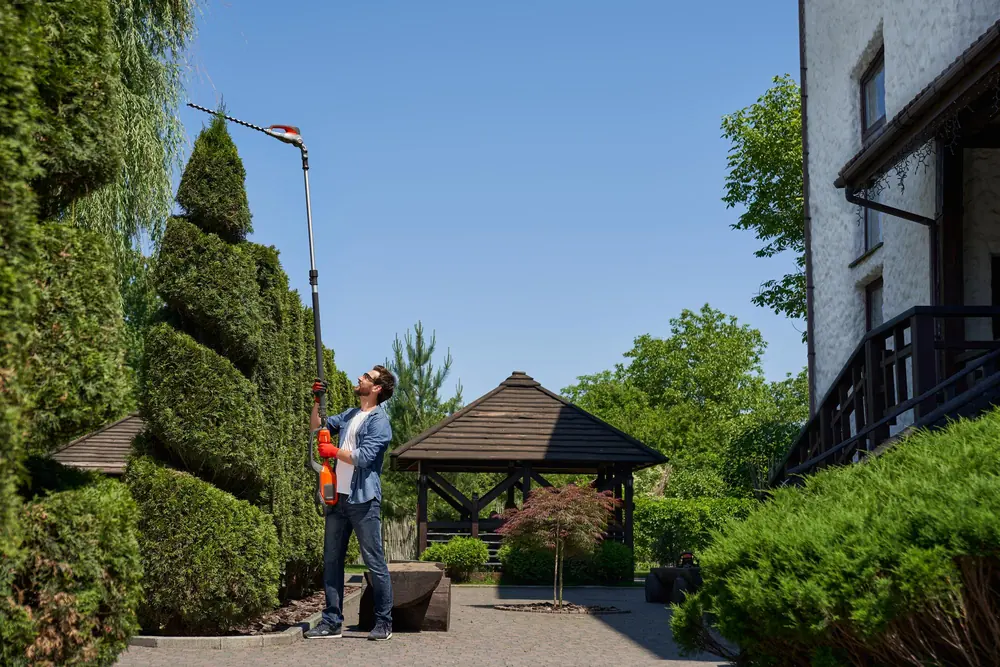
This is where the cheap quote hides: it covers everything that can be reached from the ground and the rest turns up during the year as extra jobs. Ask who does the work at height, with what equipment and whether it’s covered. And get it in writing, because if there’s an accident in a communal area, the community’s insurer is the one who’ll be asking.
Water is the item nobody looks at
In a community with green areas on this coast, the water bill rivals the gardening bill itself in size, and the contract hardly ever says who looks after the irrigation beyond “checking the system”.
It’s worth pinning down three things: who adjusts the irrigation controller and how often, who finds and repairs leaks, and what happens when a sprinkler has been watering the pavement for weeks. A gardener who reprograms the irrigation four times a year pays for themselves on the water bill, and one who never touches it costs a fortune even if their quote is the lowest. What lies behind those adjustments is in how much to water the garden in summer.
“Just tell us when it starts looking bad”
It’s the arrangement that looks cheapest and the one that costs most. Not because the hours are charged at a higher rate, but because of what you end up buying.
One year of a communal garden
- With a plan. It holds all year, and the ups and downs are the seasons, not scares.
- Only when called out. Every dip ends in an emergency job, and those are the expensive ones: hard pruning, a deep clean and replacing what has been lost. And the starting point is never fully recovered.
When work is only done once someone calls, what gets hired is always the emergency job: the hard prune of whatever has got out of hand, the deep clean, and replacing the plants that couldn’t cope with the neglect. They’re the three most expensive things a garden can ask for, and on top of that the starting point is never fully recovered, because a lost plant takes seasons to be properly replaced.
What to ask for in writing
A short list you can take to the AGM and check against any quote:
Frequency by season, not a flat number a month. What’s included and what’s billed separately, spelled out item by item: palms, height, clearance, treatments, replacing plants. Green waste removal, included or not (it’s the classic surprise, and in a community the volume isn’t small).
Who adjusts the irrigation, and how often. A written report of every visit, with the date and the tasks: in a community whose president changes every year, the report is the only trace of what has been done. One point of contact, not a general phone number. And the public liability insurance, with cover for work at height included.
And about the price
You won’t find a figure per square metre here, and be wary of anyone who gives you one without having seen the property. One community can take twice the work of another with the same area depending on its trees, whether there’s a slope, whether the irrigation works and whether machinery can get in or everything has to be carried up by hand.
What you can compare between three quotes is what each one includes, with the list above in front of you. Almost always, once they’re set out in that column, the cheap one stops being cheap.
A local note: the strip from Fuengirola to Benalmádena is where there are the most communities with green areas per square metre, and it’s also where the difference shows most between a property administrator who asks for all this in writing and one who signs the cheapest. We cover it in gardeners in Fuengirola.