Blog · Mediterranean garden
Strelitzia nicolai in the garden: what the houseplant guides don’t tell you
Guides treat it as a living-room plant. In a coastal garden, with 0.2 days of frost a year, it becomes a clump of trunks 6 to 8 metres tall.
 By Sergio Domínguez6 min read
Almost everything you read about Strelitzia nicolai, the giant bird of paradise, is written for a pot in a living room: indirect light, no draughts, mist the leaves. In a Costa del Sol garden it’s a different plant, and most of that advice doesn’t apply.
The short answer: sun or part shade, plenty of room, water in summer and a clean-up of dry leaves and spent flowers every so often, always cutting from the base. What it doesn’t need here is protecting from the cold.
The living-room plant and the garden plant aren’t the same
The Royal Horticultural Society treats it as a glasshouse plant: it says not to let it drop below 10 or 12 °C and warns that it eventually reaches 10 metres, too big for almost any home. Singapore’s National Parks Board, where it grows outdoors, gives it 6 to 8 metres. And the University of Florida describes it as a clump of tall stalks to be planted only where there’s room for it when it’s mature.
Planted in the ground and with no frost, it sends up new stems from the base and, over the years, becomes a clump of several trunks, each with its fan of leaves at the top. The leaves, according to the RHS, reach a metre and a half, on a two-metre stalk.
Strelitzia nicolai, over the years
When planted. A fan of leaves, like the one sold for the living room. The figure next to it is a person, for scale.
Years later. It sends up new stems from the base and becomes a clump of several trunks: 6 to 8 metres according to Singapore’s National Parks Board, and up to 10 according to the RHS. Old leaves dry out until they drop, and the stalk of each spent flower stays where it was.
The clean-up. Out with the dry leaves and the whole stalk of each spent flower, cut at the base. If the clump is taking over, a sucker or two as well. The new flowers carry on up top, among the leaves.
The RHS reckons 10 to 20 years to reach full size, so the change isn’t noticeable from one season to the next. You notice it the day the clump covers the window.
Here it can stay outside all year
The University of Florida considers it cold sensitive, and it isn’t a plant for frost. But at Málaga airport the average is 0.2 days of frost a year, and January, the coldest month, averages 12.1 °C, according to AEMET, the Spanish met office. Near the sea it’s right at home.
Inland, in the Valle del Guadalhorce, where the odd winter night gets close to zero, it’s better in a sheltered corner facing south, east or west, the aspects the RHS gives it.
Where to put it
What causes the most trouble isn’t the care, it’s the spot. The RHS gives it 4 to 8 metres across when mature; the University of Florida, about 3. Planted a metre from the house or the edge of the pool, in a few years it won’t fit, and what it drops, dry leaves and spent flowers, ends up in the water.
Sun or part shade: all three sources agree on that. And out of the wind. The RHS warns that in a windy spot the leaves, being so large, soon get shredded. They tear between the veins, which run crosswise from the central one, and a torn leaf that’s still green isn’t a sick leaf: it’s a leaf the wind has been through.
Watering: in summer, yes
Houseplant guides insist on not overdoing the water, and in a pot they’re right. In the ground in a garden here the problem is the opposite: from June to August, 12 mm of rain falls at Málaga airport. Singapore’s parks board classes it as a plant that needs lots of water, and the RHS asks for generous watering while it’s growing and little in winter.
Here that means regular watering from spring to autumn, in soil that drains well, and hardly any from November to February, when the rain does it: 100 mm in November and as much again in December. That’s why it doesn’t go on the same drip line as the rosemary: more in grouping plants by water needs.
The clean-up, which is most of the work
Old leaves dry out and eventually drop, leaving the trunks bare at the bottom, which is what gives it that banana-plant look. Until they drop, they hang brown inside the clump. And each flower, once it’s over, leaves its stalk behind.
- Dry leaves, and torn ones that have already gone brown, are cut at the base, with sharp secateurs, as the RHS advises. At the base, not halfway up.
- The whole stalk of each spent flower, not just the flower.
- A sucker or two, if the clump is taking over. The University of Florida advises removing excess growth from the base of the stalks.
- And nothing else. It doesn’t need pruning, the RHS says so in as many words: the leaves aren’t trimmed and the trunks aren’t cut back from the top.
While you’re at it, check the base of the leaves, where scale insects and red spider mite hide, the pests the RHS lists. On a young clump all of this is done from the ground. Once the trunks are past three or four metres, the dry leaves at the top call for a ladder. If you’d rather we did it, it’s in gardener by the hour.
If it doesn’t flower
It may be flowering and you can’t see it. The University of Florida notes that the flowers appear inside the canopy, among the leaves, and on a tall clump they’re up high, where the leaf stalks start.
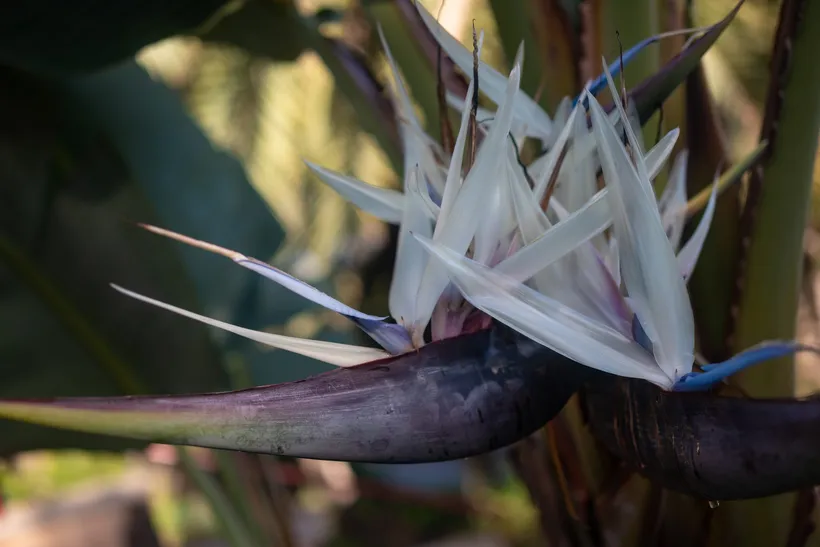
The nicolai flower: white and blue, on a purple, boat-shaped bract. An older one shows behind it.
And it may simply be young: according to the RHS, a strelitzia needs to be five to ten years old before it flowers.
Nicolai or reginae?
Both are called bird of paradise. The reginae, the one with the orange and blue flower, is the small one: 1 to 1.5 metres according to the RHS, with no trunk. The nicolai is the big one, with the white and blue flower, and the one that becomes a clump of trunks. Everything in this article is about the nicolai. The reginae is among the plants that flower in winter.
And dividing it?
You can, and it’s the easiest way to get another one, according to the University of Florida. The RHS advises doing it in spring, separating suckers that already have roots from the clump.
In short
The Strelitzia nicolai in the guides lives in a pot. In a garden on the coast, where it hardly ever freezes, it becomes a clump of trunks 6 metres tall or more.
Plenty of room, away from the house and the pool, out of the wind; water in summer; and a clean-up every so often, with the dry leaves and the stalks of spent flowers always cut from the base. Pruning, none.