Blog · Tree felling and work at height
Removing a palm with red palm weevil: what the Junta requires and why
Once the weevil eats the growing point, the palm won’t regrow. In Andalusia it has to be removed as Decree 77/2010 sets out, and the owner pays the costs.
 By Sergio Domínguez6 min read
A palm with red palm weevil doesn’t always have to be felled. But once the pest has eaten the growing point, it won’t regrow, and then removing it isn’t just any felling job: in Andalusia there’s a written procedure, and the owner is required to follow it.
The short answer: if the weevil has killed the palm, it’s removed as set out in annex V of the Junta de Andalucía’s Decree 77/2010: a plastic sheet on the ground, the fronds and crown treated and wrapped, and all the waste covered on its way to landfill or to a plant that destroys it. The owner pays.
When it can’t be saved
The decree puts it like this: when the weevil damage makes it impossible for the palm to regenerate and it poses a serious risk of spreading the pest. In practice, when the growing point, the bud the new fronds come from, has been lost or has collapsed. How to recognise each stage is in red palm weevil symptoms.
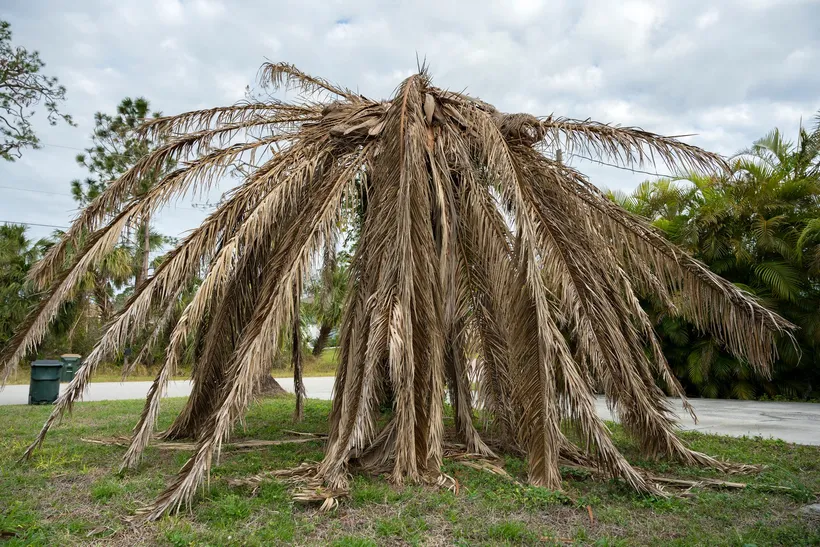
A dead palm, with its dry fronds hanging down to the ground. It isn’t from here and we don’t know what killed it, but this is how a palm that can’t be saved ends up.
While it’s being decided, the palm isn’t pruned: cutting off the ugly fronds attracts more adults. And the most susceptible, according to the decree itself, are the Phoenix palms, such as the Canary Island date palm and the date palm. On the Canary Island palm the damage is mainly in the crown.
Why it isn’t just any felling job
What’s in the crown and fronds of an infested palm is larvae, cocoons and adults. A felled palm left in a pile, or taken away on an open trailer, is exactly what the decree wants to avoid: the pest jumping to the palms along the street.
That’s why in 2015 the Junta declared the whole of Andalusia a demarcated zone, and since then the decree’s compulsory measures apply here just as anywhere else. For the owner of a palm, they are these:
- Report the symptoms to the Junta, to the plant health service of the provincial agriculture office, and let its inspectors in to see it.
- Treat it, if it can be saved, with a treatment programme that can only be applied by authorised companies and staff holding the relevant licence.
- Remove it as set out in annex V, if it can’t be saved.
- Pay for it. The costs of all these measures fall to the owner, says article 9.
Not doing so is listed as an offence in the same decree.
How it’s done, step by step
How a palm with red palm weevil is removed
First, the ground and the fronds. A plastic sheet or mesh is laid around the palm to catch whatever falls, and all the fronds come off. The fronds and the rest of the waste are treated and bagged.
Then the crown. It’s treated, it can be wrapped in plastic thicker than 200 gauge, and it’s cut off the trunk with a chainsaw. On a Canary Island date palm, the damage is mainly in the crown.
Finally, everything covered. The trunk is cut as close to the ground as possible and cut into pieces, or left, sealed, if it isn’t affected. The stump is sealed. The waste goes, covered with a tarpaulin, to landfill or to a plant that shreds or composts it.
Annex V sets it out like this:
- Isolate the area. A plastic sheet or mesh on the ground, around the palm, to catch everything that falls.
- Remove all the fronds. The fronds and the rest of the waste are treated and bagged in plastic, or covered.
- The crown. It’s treated once the fronds are off, it can be wrapped in plastic thicker than 200 gauge, and it’s cut off the trunk with a chainsaw.
- Clean up and load. All the waste onto the vehicle, a final treatment, the ground raked or swept, and the load covered with a tarpaulin or mesh.
- Destroy it. To landfill, or to a plant that shreds it or makes use of it, for example by composting, as long as nothing is left that could shelter the pest.
If the landfill site is too far away, the decree allows the waste to be buried in a trench at least two metres deep, treated and compacted. Taking down a tall palm with a collapsed crown is also work at height: the crown is heavy and no longer firmly held.
The trunk can stay
This is the least known part. If the trunk isn’t affected, annex V allows it to be left standing, with the cut sealed. If it’s removed, it’s cut as close to the ground as possible and cut into pieces depending on its height and where it is. Either way, the cut that’s left is sealed.
And if it can still be saved
Then what’s needed is the treatment programme, and pruning has its own rules too, in annex IV: dry fronds only, no shaving the trunk, clean cuts and the waste covered all the way to the landfill. On Phoenix palms, such as the Canary Island date palm, pruning is done only from November to February, so the window opens now. The reason is in when to prune palm trees.
The waste from that pruning, and from palms that are removed, is handled by the town halls at their own or contracted landfill sites. Each town says where. If you’d rather we took care of it, what we do with palms is in palm tree pruning.
What to ask whoever is removing it
- Where the waste goes. To landfill or to a plant that shreds or composts it. If they can’t tell you where, they won’t be doing it the way the decree requires.
- How it travels. The fronds bagged and the load covered with a tarpaulin or mesh, not on an open trailer.
- Who treats it. Treatments are applied by an authorised company, by licensed staff.
- What happens to the trunk: whether it stays, sealed, or is cut at ground level and cut into pieces.
- Who reports it to the Junta. The duty to report the symptoms is the owner’s, even if the company helps you do it.
In short
A palm that has lost its growing point to the red palm weevil doesn’t recover, and in Andalusia its removal has rules: Decree 77/2010 requires the owner to report it, to remove it as set out in annex V and to pay for it.
Plastic on the ground, fronds and crown treated and wrapped, the trunk removed or sealed, and everything covered on its way to landfill or the shredder. What can’t happen is it ending up in a pile on the plot.