Blog · Tree felling and work at height
The stump: remove it, leave it, and why palms are different
Felling is only half the job. What’s left in the ground decides whether that bit of garden is any use again, and with a palm the rules are turned upside down.
 By Sergio Domínguez9 min read
When you ask for a quote to fell a tree, the conversation usually ends with a question that catches people off guard: and the stump, shall we take it out? It sounds like an extra, one more line on the quote. And sometimes it is. But other times it’s exactly the part that decides whether that bit of garden is any use again.
The honest answer is that it depends on what you’re going to do with that square metre, and on what was planted there. And there’s one case, very common on this coast, where everything you’re about to read is turned on its head: the palm.
Felling doesn’t kill the tree
This comes first, and it’s hard to believe because there’s nothing left standing. A tree cut down to the base keeps its whole root system, with the reserves it had built up, and it keeps the living layer just under the bark. The wood at the centre of the stump is dead (it was already dead before the cut), but the outer ring isn’t.
With that, the natural thing is for it to sprout. It isn’t that the tree “doesn’t notice”: from its point of view it has suffered major damage, and it responds exactly as it responds to major damage, by pushing out shoots from whatever it has left.
The same stump, cut to three depths
What’s left after felling is still alive. The wood at the centre is dead, but the outer layer isn’t, and the roots hold years of reserves. That’s why the first thing a healthy stump does is sprout.
Cutting it flush with the ground doesn’t kill it. The garden is left level and it looks sorted, but the buds aren’t in the trunk: they’re in the collar, which is still down there, intact. Normally it sprouts again around the edge.
What finishes it is going below the collar. That’s where the buds run out in almost every species. That leaves the ones that resprout from roots further away, which the machine can’t fix because the problem is no longer in the stump.
Why it lasts longer here
In a climate with a real winter, regrowth is a spring episode: it comes out, and the cold and the leafless months use up what the roots had in store. The strategy of cutting back the shoots until the roots are exhausted works within a reasonable number of seasons.
Here there’s no such brake. With mild winters, the roots have good months almost all year round, and what elsewhere is a two- or three-season war goes on a good deal longer here. That doesn’t change the biology, it changes the sums: cutting back shoots is cheaper in materials and far more expensive in time than people reckon.
When it needs removing and when it doesn’t
It isn’t always necessary. Stump removal is worth paying for when:
- You’re going to replant there or nearby. A stump and its roots take up the space, compete for water and make digging the hole harder. If the idea was to use the autumn to plant something else, this isn’t optional.
- It’s going under lawn, paving or irrigation. Anything that has to end up level or buried doesn’t get on with a stump, which will also sink as it rots.
- It’s right next to the house, a wall or a pool. Here, dead wood buried next to a building is a problem of its own, and it’s best not to have that argument later on.
- The species resprouts vigorously and you don’t fancy cutting back shoots every few months for years.
And it can be left without a second thought when:
- It’s in an area nobody uses (the bottom of the plot, a bank, behind a hedge) and it isn’t in anything’s way.
- The machine can’t get there. Stump removal needs access, and on many plots on this coast, terraced and with the garden behind the house, getting a stump grinder in costs more than the job itself.
- You like it as a feature: a low, sound stump makes a seat, a table or a stand for a pot, and that’s a perfectly valid design decision.
Cutting it flush isn’t removing the stump
It’s the most expensive confusion in this whole business, and the one behind almost all the “they took it out and it’s come back” calls.
Cutting it flush means cutting off whatever sticks out so the ground is level. It’s quick, it’s cheap and it leaves the garden presentable that same afternoon. What it doesn’t do is touch the collar, which is where the shoots come from, so the stump still has something to respond with.
Removing the stump means going below that, past the flare where the trunk turns into root. It costs more, leaves a hole that has to be filled and produces a fair amount of chippings, but it’s what really ends the matter in almost every species.
Both are legitimate services and both are sold. What you need to do is ask which one you’re being quoted for, because the price isn’t comparable and neither is the result. It’s a textbook case of what we cover in fixed price or hourly rate: two numbers that can’t be compared because they don’t buy the same thing.
There’s also a group of species that resprout from roots far from the trunk, several metres away. With those, removing the stump doesn’t fully solve it either, because the problem is no longer in the stump. It’s worth knowing before rather than after, and it’s a fair question to ask when getting a quote.
The palm works the other way round
And this deserves a section of its own, because there are palms almost everywhere here, and because hardly any of the above applies to them.
A palm doesn’t resprout. It has no living layer under the bark and no buds spread around: it grows from a single point, right at the top. If that point goes, the plant is finished and what’s left won’t produce anything. So the whole regrowth argument, which is what justifies removing a tree’s stump, doesn’t apply here.
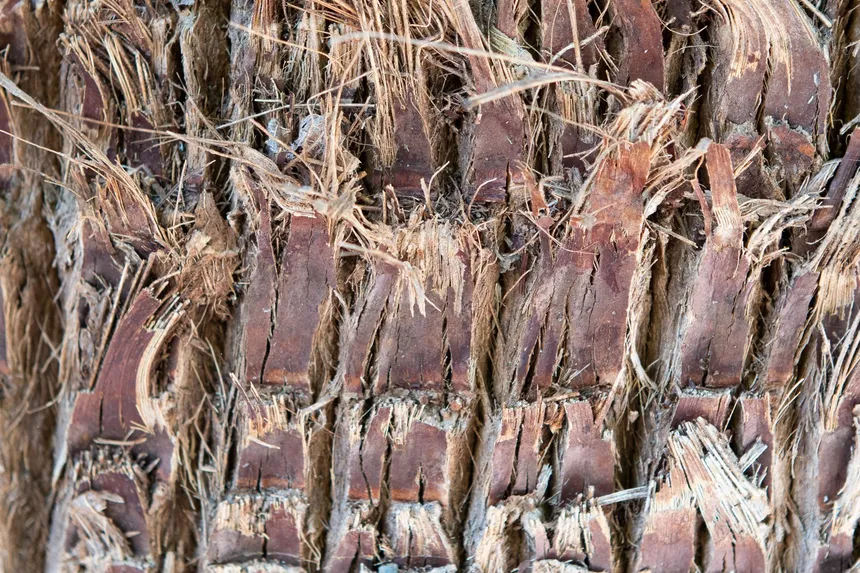
Up close you can see why. This isn’t bark with a living layer underneath: it’s old leaf bases and fibre, with more of the same below. There’s no ring for shoots to come from.
What does cause trouble is what’s left underneath. A palm’s roots aren’t a couple of thick roots that taper off, but a dense, tightly packed mass of fine roots that all look alike. It doesn’t rot at the same rate or break down in the same way, so the hole takes longer to become usable than you’d expect.
And there’s a reason that isn’t about gardening but about plant health: the trunk and the crown of a felled palm are breeding material for the red palm weevil. Leaving them to one side of the plot “until someone makes a trip to the recycling centre” is setting up a breeding ground for the whole neighbourhood. Palm waste has its own way of being treated and removed, and you should ask about it in the felling quote itself. How to recognise the problem before it gets to this point is in red palm weevil symptoms.
The specific rules for handling palm waste depend on the municipality and they change, so don’t rely on what you read (here or anywhere else) and ask your town hall or whoever is doing the job.
What happens with the hole
After stump removal there’s a hole and a pile of chippings mixed with soil. The temptation is to put those chippings back in the hole, since they’re free and right there.
That’s fine if the spot is going to be a path or gravel. It isn’t if you’re going to plant: while the chippings break down they use up nitrogen from the soil, and the new plant is left on half rations in exactly its first year, the one that can’t go wrong. For planting, they’re taken away and the hole filled with soil. And if that patch is also going to be lawn, what’s underneath matters even more than it seems. We cover it in preparing the ground for a new lawn.
In short
Felling doesn’t kill the tree: what’s left has roots, reserves and buds in the collar, and that’s why a stump cut flush with the ground sprouts again. If you’re going to replant, lay a lawn or pave, you have to go below the collar; if it’s in a corner where it doesn’t bother anyone, you can leave it with a clear conscience.
With a palm the question is a different one. It isn’t going to resprout, so there’s no hurry on that side, but what’s left below takes a while to break down and the waste from above is a weevil matter, not a cosmetic one. Ask what will be done with it before you sign for the felling, not after.