Blog · Tree felling and work at height
How to tell if a tree is dangerous before the first storm
The first storm hits and people always say the same thing: “but it looked perfect”. It looked green, which isn’t the same, and the signs had been there for months.
 By Sergio Domínguez9 min read
The first autumn storm hits and the next morning there’s a tree lying across the road, or a branch on a car. And the line is always the same: “but it looked perfect”.
It almost never was perfect. It was green, which isn’t the same thing, and the signs had been there for months. September is a good time to look for them, because there’s still time.
The sign that matters most comes out of the trunk
If a fungus is growing out of the bark (a hard bracket the size of a hand or bigger, sometimes several stacked up), that isn’t the start of a problem: it’s the end.
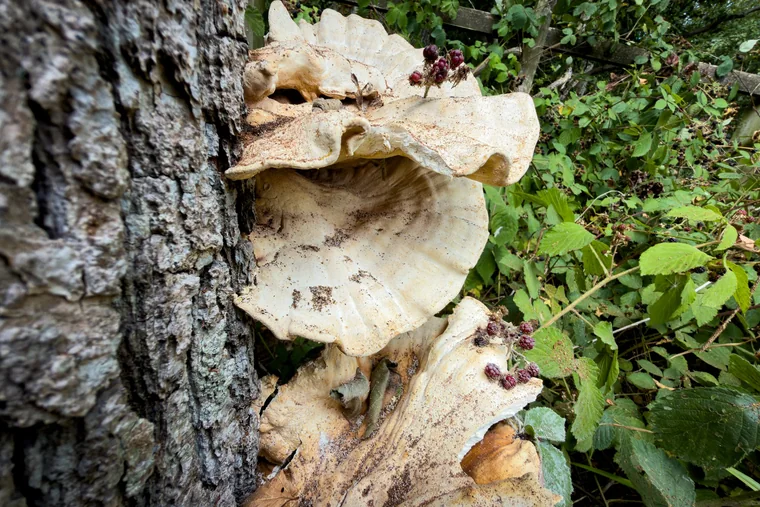
What you see on the outside is the fruiting body, the part the fungus puts out to release its spores. To get to that point, the fungus has been eating the wood inside the trunk for years. By the time it shows, the work is done.
That’s why a tree with fungi on its trunk can have a flawless crown. The wood that carries the weight and the wood that carries the sap aren’t the same: the sap moves through a thin layer just under the bark, so the tree can stay green with a hollow interior. It looks healthy because it is alive. It just can’t hold itself up any more.
The other things to look for
Ten minutes walking round the tree and looking up. You don’t need to know anything about this to spot these five:
- Bark coming away in plates and leaving the wood exposed, especially if it’s dark or soft underneath.
- A vertical crack in the trunk, or a split where two thick branches come out together from the same point. Those tight forks are where trees break.
- Soil lifted or cracked in an arc around the base. It means the roots have already moved.
- A lean that has changed. A tree that has always leaned tells you nothing; one that has started leaning this year tells you everything.
- Dead branches in the crown mixed in with the green ones, especially if they’re right at the top.
And one you can’t see but can know: whether there has been building work nearby in recent years. A trench for a pipe two metres from the trunk cuts thick roots; the tree holds out for a couple of seasons and fails afterwards, when nobody connects the two any more.
Why they fall in autumn and not in August
Here’s the part that doesn’t add up at first sight. In summer it’s windy, the trees have had months of drought and nothing happens. October comes and one comes down overnight. What changes isn’t the wind: it’s what’s underneath.
The same tree, the same wind
All summer: the wind blows and nothing happens. The soil is dry and compact, and the root plate holds.
The first proper rain arrives: in a few hours the soil goes from dry to soaked. The tree hasn’t changed; its anchorage has.
And then the same wind is enough: the plate lifts on the windward side and the whole tree goes over, roots and all.
Dry, compact soil holds the root plate like a screw in wood. After four months without useful rain, the first real storm arrives and that soil goes from dry to saturated in a few hours. The grip is lost, and then the same gust that in August only moved the crown lifts the whole plate on the side the wind is coming from.
That’s why here trees more often come down whole, roots and all, than snap at the trunk. And it’s the same reason the root plate is shallow and wide rather than deep, something we cover in why tree roots lift paving: roots live where the water is, and here the water comes from the irrigation, near the surface.
Somewhere it rains in summer, the soil doesn’t make that jump. It gets wet and dries out all year round, and the tree doesn’t go from anchored to loose overnight.
What’s misleading
Green isn’t healthy. It’s been said above, but it’s the mistake that costs most: people look at the crown, see it’s fine and close the matter.
And ugly isn’t always dangerous. A tree with small leaves, or lichen on the bark, or an old scar that has closed well, can be perfectly sound. Lichens in particular do nothing to the tree: they live on it, not off it.
What decides it isn’t how the leaves look. It’s whether the wood that holds it up is still there and whether the roots still have their grip.
What to do if you see any of them
First, don’t prune it just in case. It’s the usual reaction and it tends to make things worse: taking some crown off a tree with anchorage problems helps, but topping it opens large wounds that let in exactly the kind of fungus we were talking about, and within a few years it leaves branches less securely attached than the ones that were removed. It’s explained on the tree pruning page.
Second, have someone look at it before the storm, not after. And if the tree is in a communal area, put it in writing: in an owners’ community, decisions about the trees change hands every year, and whatever isn’t written down gets lost.
Who is responsible when a tree falls depends on where it’s planted and who owns it, and that’s something you check, not assume: in a community it’s worth asking the property administrator before you need to. How the trees in a communal area are organised is covered in communal garden maintenance.
And felling isn’t the only way out
It’s worth saying, because the leap from “it has a fungus” to “it has to be cut down” happens very fast, and it isn’t always the right call.
A tree with problems can be acceptable if there’s nothing underneath it to protect. Sometimes the solution isn’t to touch the tree but to move what’s underneath it: move the parking space, divert the path, put the bench somewhere else. Other times it’s enough to reduce the crown (cutting back to a side branch, not topping) to take some of the sail out of it.
And other times it does have to come out, and then better on a Tuesday in September with the lorry parked alongside than on a Sunday in a storm with the street closed.