Blog · Community green spaces
Tree roots are lifting the paving: what can be done and what can’t
The first reaction at the AGM is always the same: cut that root. It’s the one that causes most trouble, and it comes from believing roots grow straight down.
 By Sergio Domínguez9 min read
First it was one loose paving slab. Then two. Now there’s a stretch of pavement rising like a wave, someone has tripped, and the matter is on the agenda for the AGM.
And at the AGM the same line always comes up: “well, just cut that root”. It’s the natural reaction, it’s the cheapest thing to say and it’s one of the worst things you can do.
Roots aren’t a mirror image of the crown
Almost everyone imagines a tree as a symmetrical figure: whatever goes up above goes down below. From that come the two ideas that cause the problem: that you can cut whatever shows without consequences, and that planting two metres from a building is no big deal.
The same tree, two ideas
What’s imagined: roots that go as deep as the crown goes high.
What’s really there: a wide, shallow plate that reaches well beyond the tree’s shadow, and runs under the paving.
The reality is the opposite. Most of a tree’s roots live in the top half-metre of soil, and they spread sideways well beyond where the shadow of the crown reaches. It isn’t a column: it’s a plate.
And here the irrigation makes it worse
This part is local, and it explains why the problem shows up sooner in an urbanisation on this coast than in a park further north.
With four months without useful rain, the water in a green area comes from the irrigation, and the irrigation puts it near the surface. Roots go where the water is, so trees surrounded by lawn watered every day end up with a mat of roots right at the surface, just under the paving. It’s the same mechanism that makes a lawn watered little and often grow shallow roots, covered in how much to water the garden in summer.
And on much of the coastal strip there’s another factor: shallow soil over rock. When roots can’t go down, there’s only one direction left.
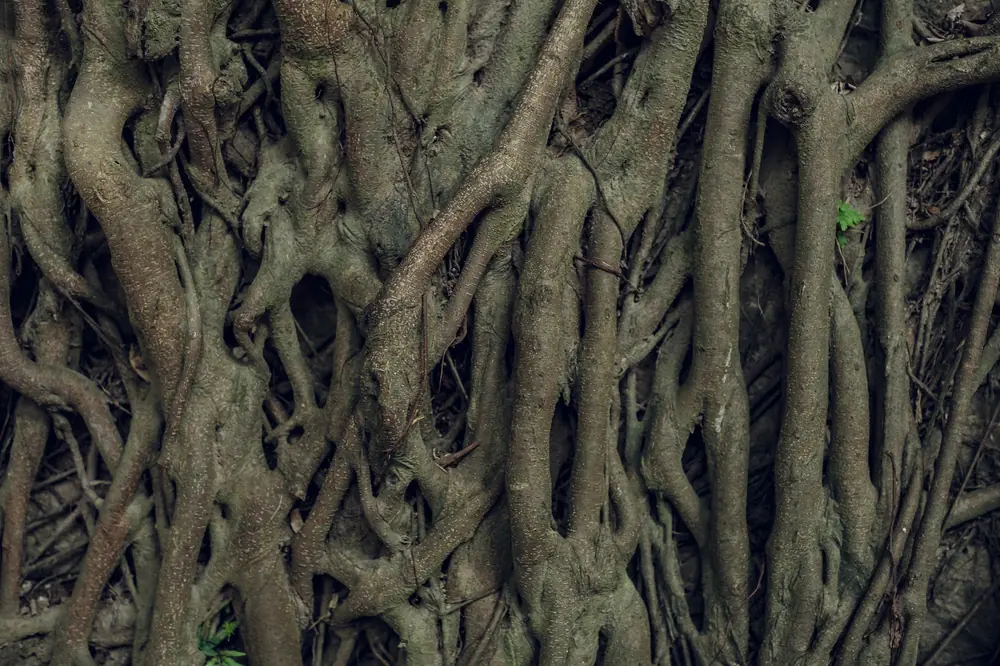
Why cutting the root that’s lifting the slab is a bad idea
Because that thick root you can see sticking up isn’t there to drink. At that thickness and that distance from the trunk, what it does is hold the tree up.
Cutting it has two consequences, and neither shows on the day it’s cut. The first is that the tree loses anchorage on that side, and that gets collected on the day of the levante storm (the strong east wind), not the following Tuesday. The second is that a tree doesn’t heal a root wound the way it heals a cut on a branch: rot gets in there and works its way towards the trunk for years.
What decides whether a cut is acceptable or not is how far it is from the trunk and how thick the root is, and that gets measured, not judged by eye from the pavement. It’s exactly the kind of decision that shouldn’t be made by whoever comes to fix the paving.
What does work
Enlarging the tree pit. Often the conflict is that the tree has a ridiculously small opening and everything else is sealed. Giving it open ground around it solves the present and prevents the future.
Changing the paving in that strip, not the tree. A rigid slab on mortar breaks; flexible paving, a band of compacted gravel or loose slabs laid on sand can be lifted, relaid and forgotten. In communal areas it’s the solution that gets the least argument, because it doesn’t mean touching the trees.
A root barrier membrane when relaying, which doesn’t stop the roots growing but does steer them downwards along the stretch where they’re a nuisance.
And what doesn’t work: pruning the crown to “slow down” the roots. Reducing the tree above doesn’t shrink what’s already below, and it leaves you with a worse tree into the bargain.
When the solution is to change the tree
Sometimes the species is the wrong choice and there’s no good fix. The ficus is the textbook case on this coast: it grows enormous, its roots are aggressive, and lots of them were planted in urbanisation gardens in the seventies as if they were going to stay small. Poplars, willows and eucalyptus are much the same.
If it has to be replaced, the conversation starts with the adult size, not with how the specimen looks at the nursery. Next to paving, trees of contained size work much better (crape myrtle, Judas tree, citrus, olive), and they also need little water. And the time to plant isn’t just any time: here, we plant in autumn.
Before you commission anything, two checks
Who owns the tree. It seems obvious and it isn’t: in many urbanisations the trees lifting the pavement stand on public land, even though the pavement is used by the community. That changes who decides, who pays and who is liable, so it’s worth checking before you hire anyone.
Have it looked at by someone who knows about trees. Mature trees in a communal area are a safety matter as well as an aesthetic one, and the decision whether to cut a root is a technical one. Having it in writing, with what’s done and what isn’t, is exactly what should be in the maintenance contract (we cover it in what to check before signing it).
A local note: where you see this most is in the urbanisations of the sixties and seventies, with trees planted too close to the building when they were still small. We cover it in gardeners in Torremolinos.
In short
The root lifting the slab has been there for twenty years and hasn’t moved: what has changed is that it has grown thicker. It almost always works out better and cheaper to adapt the paving than to attack the tree, and when a cut really is needed, the decision is made by measuring, and with someone who answers for it.