Blog · Palms and plant health
Palm tree pruning: when it’s done here, and why not now
The good window is the cold months, and not because of the plant: because of the weevil. Every fresh cut in summer is a sign put up for it to come.
 By Sergio Domínguez8 min read
The palm has had leaves hanging off it all summer, half dry, and it looks neglected. It’s the end of August, you’d like to get it cleaned up before autumn sets in, and there are people going round the neighbourhood offering to do it.
Wait until it cools down. And it isn’t for the plant’s sake, it would cope: it’s because on this coast the month you go up a palm decides a lot more than it seems.
The good window is the cold months
The reason has a name, and it’s the red palm weevil. A fresh cut on a palm gives off a smell the weevil picks up from a distance, and the weevil flies when it’s warm. Pruning in August is, quite literally, putting up a sign in the month when there’s someone to read it.
That’s why palm pruning here isn’t spread through the year like the pruning of any other tree: it’s concentrated in the cold months, when the insect is inactive. If someone offers to prune your palms in midsummer, it isn’t that they have a gap in their diary: it’s that they don’t know where they are.
And if there’s no choice (a broken leaf hanging over a path, for example), the minimum is cut and the cut is treated. That last part isn’t a garden spray: the products that work require a qualification to apply, and that’s exactly why a palm isn’t part of a garden’s ordinary maintenance.
How many leaves can come off
This is the other big piece of damage, and it’s done with the best of intentions. The rule people who know use is easy to remember: picture a clock face and don’t cut above quarter past nine. In other words, everything below the horizontal can come off; whatever points upwards stays.
The same palm, two prunes
Only what’s already below the horizontal comes off, which is the dead leaves or the ones with little life left. The crown is still a crown.
Green, healthy leaves go too. It looks “groomed”, and in exchange it loses half of what feeds it and leaves the heart exposed.
The “groomed” palm, with four stiff leaves pointing up, is seen across half the Costa del Sol, and that’s why it looks like the right way to do it. It’s the opposite. Every green leaf removed is food thrown away, and a palm has no spare branches: it grows from a single point, so whatever it loses takes it seasons to replace.
And there’s one more reason, a very local one: a stripped crown leaves the heart exposed, which is exactly where the weevil gets in. Severe pruning doesn’t only weaken the palm; it takes away its cover right in the spot that needs protecting.
The trunk isn’t wood, and that changes everything
When you cut a branch off a tree, the tree closes the wound: it forms callus from the edges and eventually seals it. A palm can’t do that, and the reason is clear as soon as you look at the trunk up close.
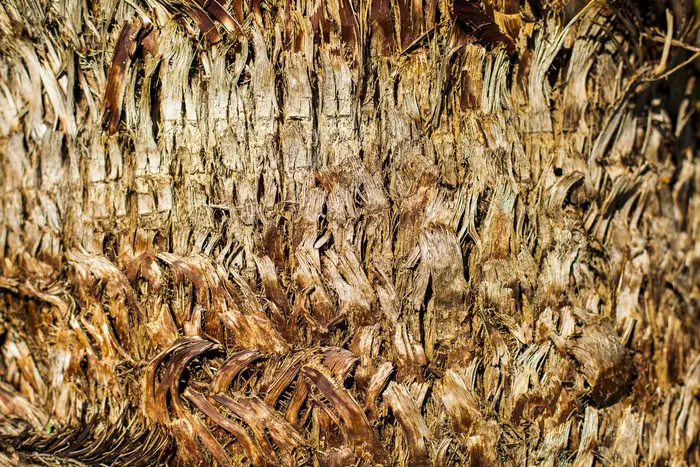
What you see isn’t bark: it’s the bases of old leaves, packed tight and fibrous. There’s no growth layer underneath, no healing is possible and the trunk doesn’t thicken over the years. A wound made there stays open for ever.
Two practical things follow. First, a leaf is cut leaving its base, without cutting close to the trunk. And second, the decorative “skinning” that leaves the trunk smooth, so fashionable in some urbanisations, is a series of wounds that will never close.
Dates and flowers
The flower stalks and the fruit clusters come off too, for two reasons that speak for themselves: they stain and they’re slippery when they fall on a path or into a pool, and producing fruit costs the palm a good deal. It’s done in the same winter visit, not as a separate one.
Why it isn’t a job for a ladder
Apart from the height, which is reason enough, there are two things that surprise anyone who tries. A mature palm leaf weighs a lot more than it looks from the ground, and it falls where it falls.
And the spines. On palms of the genus Phoenix (the Canary Island and date palms, which make up half the Costa del Sol) the base of each leaf carries rigid spikes several centimetres long. A jab from one of those isn’t a scratch: it’s a deep, dirty wound, the kind that gets infected.
When the problem isn’t that it looks scruffy
One last check before you call anyone. If the leaves that are failing are the ones in the centre, this isn’t a question of cleaning: the outer ones age and dry out because that’s their cycle, but the central ones are the new ones and have no reason to be in bad shape.
In that case what’s needed isn’t pruning, it’s a calm look at the crown. The signs that arrive in time and the ones that arrive too late are set out in order in how to tell if your palm is affected. And if what you have is a sago palm and not a true palm (it happens more than you’d think), the rules are different: a sago palm isn’t pruned like a palm.
A note on location: along the coastal strip there’s a palm in almost every plot and almost every communal garden, and it’s where you see most of the summer pruning done by whoever comes round offering it. How we go about it is in gardeners in Mijas.
In short
In winter, not now. As far as the horizontal, not until it looks groomed. Without cutting close to the trunk, because that never heals. And if the problem is in the centre of the crown, don’t call a pruner: call someone who knows how to look at a palm.