Blog · Palms and plant health
A sago palm isn’t a palm, and treating it like one is what ruins it
It’s sold as a little palm, watered like any other plant and stripped bare every spring. Those three things explain why yours hasn’t moved in years.
 By Sergio Domínguez8 min read
You bought it at the garden centre as a “mini palm” or a “sago palm”, planted it with the rest of the garden, and ever since it has done the same thing every year: put out four new leaves, stay the same height and not fill out.
It isn’t a palm. It isn’t that it looks like one and belongs to another family: it belongs to a far older group of plants, the cycads, which were already here when palms didn’t yet exist. And almost everything that goes wrong with it comes from treating it as if it were one.
It grows far more slowly than you think
This is the difference that explains almost everything. A palm puts out leaves steadily through the season. A sago palm puts out one flush a year (sometimes two if the year has gone very well for it, and some years none), all at once, and then stops.
That means the crown in front of you isn’t this year’s. It’s several seasons stacked on top of each other.
What you’re looking at is years
- The outer ones are the oldest. They’re the ones turning yellow, and the only ones it can spare.
- The middle ones are from the previous flush and are still working.
- The short ones in the centre are this year’s, fresh out of the heart. It’s the only point anything grows from.
When spring comes and someone “cleans it up”, leaving it with four stiff leaves, they aren’t pruning: they’re wiping out three years’ work in one go. The plant survives, but spends the following seasons replacing what it had instead of growing. That’s why so many garden sago palms haven’t moved in a decade.
Only what’s completely dead comes off
The rule is short: if the leaf has any green, it’s still paying its way. Even if it looks ugly, even if it’s horizontal or drooping, as long as it keeps its colour it’s still feeding the plant, and above all the heart.
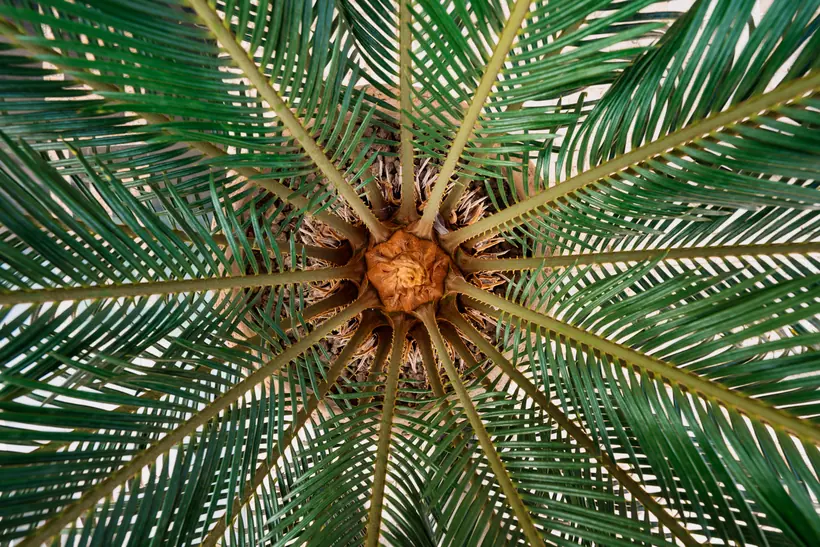
Seen from above, you can see what matters: all the leaves come from a single point, and that point is the centre. There are no spare buds along the trunk and no side shoots that could take over. If the heart rots or gets damaged, the plant has nothing to rebuild itself with.
That’s why it’s worth waiting. The best time to remove old leaves is once the year’s flush has come out and hardened (from late summer onwards), not in March “so the new ones come out clean”, which is exactly when you leave it with nothing while it’s preparing the new growth.
What really kills them here: watering
On this coast the sago palm almost never dies of thirst. It dies of the opposite, and the culprit is usually the same: it’s hooked up to the same irrigation line as the rest of the garden.
It’s a plant made for free-draining soils and for getting through dry spells. Put next to shrubs that are watered three times a week in summer, its base stays permanently damp and the neck ends up rotting. The trouble is that you don’t see it until it’s too late: on the outside it stays green while the centre is falling apart, and by the time the leaves suddenly turn yellow there’s no going back.
The answer isn’t to stop watering it, it’s to water it separately and less often, and to make sure water doesn’t sit around the base. If it’s in an area on general drip irrigation, the simplest thing is to cap the dripper above it and give it its own watering every so often. The longer reasoning behind spacing out watering is in how much to water the garden in summer.
A warning almost nobody gives: it’s toxic
The whole plant is, and the seeds (those orange balls that appear on female plants) are the most dangerous part. For a dog that chews them it’s a serious matter, not a stomach upset.
It’s no reason to pull it out, but it is a reason to know: if you have a dog and the sago palm produces seeds, the sensible thing is to pick them up off the ground as soon as they fall. And if your dog is one that chews everything, think about where the plant is.
How to tell which one you have
If you’ve got this far and still aren’t sure, there are two signs that never fail and don’t need any botany.
Touch a leaf. The leaflets of a sago palm are stiff, with the edge rolled under and a tip that really pricks: run your hand the wrong way along them and it hurts. A palm’s are flexible and bend.
And watch how the new ones come out. This is the real giveaway, and one you won’t forget: a sago palm’s leaves come out coiled up on themselves, like a crozier, and gradually unfurl just as a fern does. No palm does that. If you catch yours mid-flush (in late spring or early summer) you’ll see it beyond any doubt.
Sun, position and patience
It takes the direct sun of this coast without any trouble, and in fact prefers it: in deep shade it puts out long, soft, widely spaced leaves, reaching for the light, and loses the compact shape that makes it attractive.
Beyond that it asks for little. It doesn’t need constant feeding or routine treatments. What it needs is for you to leave it alone and not overwater it, and that runs head-on into the idea that an expensive plant needs a lot of looking after.
And if what you have really is a palm
Then the order of worries is different, and the first of all is the red palm weevil: the signs that arrive in time aren’t the ones you see from below, and by the time the palm “looks bad” the pest has been inside for months. We cover it fully in how to tell if your palm is affected.
A note on location: where you find the most sago palms is in community gardens and on terraces, exactly the places where the irrigation is automatic and the same for everything. How that’s handled when it’s the owners’ meeting that decides is in gardeners in Fuengirola.