Blog · Mediterranean garden design
Xeriscaping: a garden that loses little if one year you can’t water it
It isn’t a garden of stones and cacti: it’s one that lives almost on the rain alone and keeps watering for a small patch. Here it showed in 2023, when watering gardens with drinking water was banned.
 By Sergio Domínguez5 min read
“Xeriscaping” sounds like a garden of stones and a few cacti, which is why some people won’t hear of it. That isn’t what it is. It’s a garden designed to live almost on the local rain alone, keeping watering for a small, chosen patch.
On this coast the difference isn’t a matter of taste. It shows the year you can’t water.
Where the word comes from
Denver Water, the water utility in Denver, coined it in 1981 by combining “landscape” with the Greek word “xeros”, dry. In Spanish it became “xerojardinería”, and both names say the same thing: gardening designed for a dry climate.
US agricultural extension guides sum it up in seven principles, which are still the ones in use. And the New Mexico State University guide is clear about what it isn’t: neither a dry, barren landscape nor a no-maintenance garden.
The local test: November 2023
On 8 November 2023, under the Junta de Andalucía’s decree of very serious water shortage, the eleven municipalities of the western Costa del Sol’s association of councils, the Mancomunidad, agreed to ban the use of drinking water for watering golf courses, gardens and parks, public and private.
For a garden watered from the mains, that means being left with the rain, and in a drought year rain is exactly what’s missing. Nor was it the first time: a drought decree from 2005 wasn’t lifted in Málaga until February 2009.
That’s when you see what each garden is. Whatever relied on watering — the lawn, the thirsty plants, whatever went in that spring — is what’s lost. What’s adapted and already established holds on. A xeriscape is a garden that loses little if one year you can’t water it.
What’s left of a garden when you can’t water it
Watered. Both are green. The one on the left is nearly all lawn, with a bed of thirsty plants; the one on the right has lawn only next to the terrace, and the rest is dry-climate plants with mulch.
No water for the garden. A drought year when you can’t water with mains water, as happened here in 2023. All they get now is the rain, and there’s little of it.
By the end of summer. On the left, nearly everything has dried up, because nearly everything relied on watering. On the right, only the patch of lawn: the dry-climate plants, already established, hold on.
The seven principles, applied here
They’re the same in Denver as in Marbella. What changes is where each one bites.
1. Plan by thirst zones. The garden is divided by how much each part drinks. The New Mexico guide calls the zone that uses the most water the “oasis”, and puts it where people spend the most time: next to the terrace, not at the far end of the plot. How to divide it is in group plants by what they drink.
2. Look at the soil before choosing. Dry-climate plants die more from too much water than too little, so the first thing is that the soil drains. Soil that waterlogs in winter can kill them, even if they aren’t watered in summer.
3. Lawn only where it’s walked on. There’s no need to take it all out: the same guide says lawn has its place, in a xeriscape too. What’s surplus is filler lawn. Where to keep it and what to put in the rest is in a garden without a lawn.
4. Local plants. Rosemary, lavender, myrtle, oleander, olive, carob, plumbago: the ones that get through summer on this coast with very little watering, or none, once established. How to recognise them at the nursery is in what to plant so you’re not watering all summer.
5. Efficient watering. Drip at the root of each plant instead of sprinklers, and each thirst zone on its own sector, with its own schedule. If the plot is on a slope, see pressure-compensating drippers.
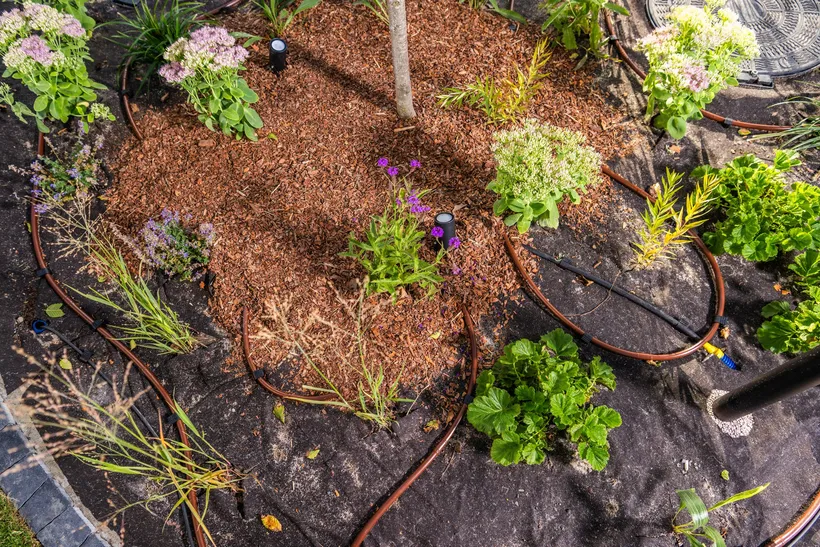
A half-finished bed. The drip line goes round each plant and the bark is covering it: the water reaches the root and doesn’t sit in the sun.
6. Mulch. Bark or gravel over the soil. The New Mexico guide gives it three jobs: it reduces evaporation and erosion, and moderates soil temperature. What that changes in summer is in how much to water the garden in summer.
7. Appropriate maintenance. Less, not none: pruning, weeding, checking the drippers and, above all, cutting back the watering as the plants establish. A xeriscape watered forever as in its first year saves little.
What it isn’t
It isn’t a gravel garden. Gravel isn’t watered, but in the sun it builds up heat, and white gravel dazzles as well. In a xeriscape it covers the soil between the plants, which cover it in turn over the years; it doesn’t replace them.
It isn’t never watering. Anything newly planted needs watering its first summer, even the toughest thing in the nursery, and then less each year. That’s why, in a year without watering, the first thing lost is what had just been planted.
It isn’t a no-maintenance garden. It takes fewer hours, and fewer still in summer, which is exactly when a lawn garden takes the most.
When to start
In autumn. What’s planted now has the winter, with its rain, to establish before its first summer, which is the one that decides. Why the calendar runs the other way round here is in why here you plant in autumn.
And it doesn’t all have to be done at once. You can start with what uses the most water in each garden, which is nearly always the same: lawn that isn’t walked on, and beds where plants that want different things drink together.
If you’d rather we designed it, see landscaping and garden design.
In short
Xeriscaping isn’t a style or a stone garden. It’s a garden where nearly everything lives on the local rain and watering is kept for a small patch, chosen and close to the house.
Here it has a concrete test: the year you can’t water. It’s designed by thirst zones, with lawn only where it’s walked on, local plants, drip, mulch and watering that comes down over the years. And it’s started in autumn.