Blog · Mediterranean garden design
Where to plant the tree that’s going to give you shade
Almost everyone picks the spot at midday, the one time when every position looks equally good. At five o’clock only one of them works.
 By Sergio Domínguez8 min read
In September the garden asks for things, and almost all of them are plants. You think about what to put in the flower bed, changing the hedge, overseeding. And the decision that will change that garden most in ten years’ time costs what a small tree costs and has to be made now, because it’s the only one that can’t be redone.
Here shade isn’t a detail: it’s what makes the garden usable
From June to September, a terrace in full sun isn’t used between twelve and seven. It’s looked at from indoors. That isn’t a furniture problem or an awning that’s too small: it’s that the garden was designed around how it looks, not around when you’re in it.
And shade has one quirk that sets it apart from everything else you put in a garden: you can’t buy it ready-made. An awning or a pergola gives shade the same day, and always the same amount. A tree gives nothing the first year, and ends up covering far more than any reasonable pergola ever will. Every season you put off planting it is a season you don’t get back later.
The mistake isn’t the tree: it’s the time of day you look at the garden
Almost everyone decides where to plant on a Saturday morning or at midday, walking round the plot. And at midday the sun is high, the shadows tuck in under each thing and every position looks equally good. At that time, they are. The problem is that at that time nobody is in the garden.
The same tree, two places
In the morning the east tree covers it. The sun rises low on that side and stretches its shadow over the table. It gives good shade at the time of day you don’t need it, which is what makes it useless.
At midday the sun is high and the shadows shrink. It’s the time people look at the garden to decide where to plant, and it’s exactly the one that tells you least.
And at five, only one covers it. The sun goes down in the west and stretches the shadows eastwards: the tree on the side where it sets is the only one that reaches the table.
The time that counts is late afternoon, when the sun drops and the shadows stretch out. And since the sun sets in the west, the shadows at that time fall towards the east. In practice: the tree has to be on the sunset side of whatever you want to cover, not beside it or behind it.
That’s why so many well-planted trees are no use at all. They’re where they looked balanced on the drawing, and at five o’clock their shadow falls on the neighbour’s hedge.
What to check before you decide on the spot
You don’t need a plan or a compass. You need to go outside three times:
- Any day at five or six in the afternoon. Look at where the sun falls and what you’d like to have covered. That spot, and the direction the light reaches it from, is all you need.
- Look at the façade too. A west-facing wall soaks up sun all afternoon and gives it off into the house at night. Covering that wall with a canopy is often more noticeable than covering the terrace itself.
- And look at what’s underneath and alongside. Pool, washing line, drains, paving and boundary. How close to the plot boundary you’re allowed to plant isn’t the same everywhere: that’s something to ask the town hall before, not after.
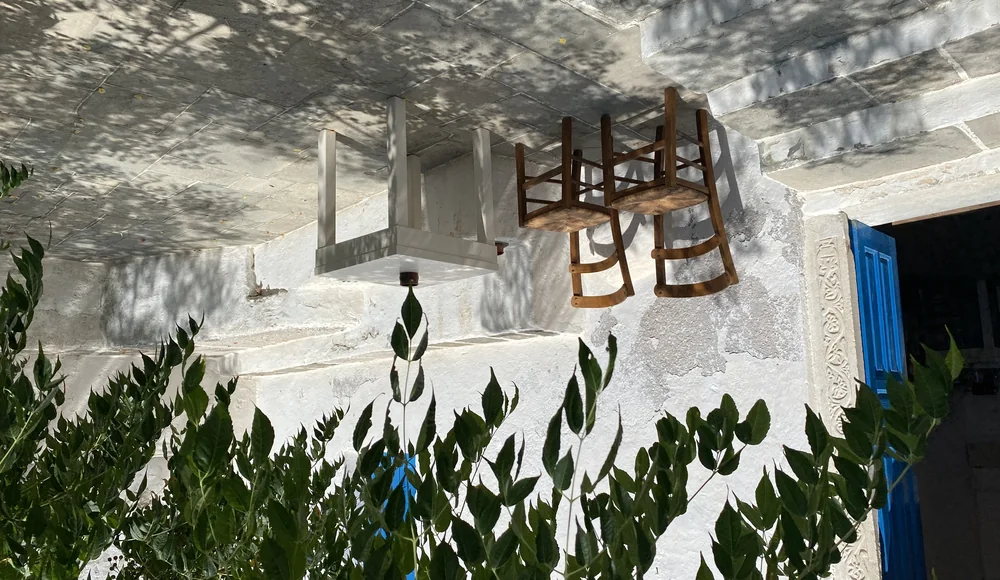
This is what’s being decided. The shade of a canopy isn’t a dark block: it’s dappled shade, which moves and lets light through. It lowers the temperature without making the place gloomy, which is exactly what an awning can’t do.
Which tree, without getting into lists
The specific choice depends on the spot, but there are three questions that narrow the field a lot before you look at any species.
Do you want sun there in winter? If the tree goes in front of a window or over a terrace you also use in January, you want a deciduous one: it covers in summer and lets the sun through when you need it. If what you’re after is a screen against a view or the wind all year round, an evergreen.
What’s under the ground? Some species have aggressive, shallow roots that, next to paving, a wall or a pool, cause problems that take years to show and then cost a lot. It’s the problem of roots lifting the paving, and it’s avoided by choosing well and keeping your distance, not by pruning afterwards.
How much work are you willing to take on? A tree that drops a lot of leaves, fruit or resin onto a terrace or a pool becomes a weekly chore for ever. It isn’t a bad tree: it’s in the wrong place.
The three mistakes that cost dear
Planting it right up against the house. It’s done so it gives shade as soon as possible, and it’s the one that ages worst: in a few years you have to start pruning it on one side, which is how a tree gets spoilt.
Planting it in the middle of the lawn. Lawn and tree want different watering, and the loser is always the tree, because the watering is set for the grass. A mulched circle around the trunk avoids that, and also saves it from knocks from the mower.
Watering it like a shrub. In its first summers it wants few, long waterings, so the roots go down looking for water instead of staying near the top. Watering little and often raises a tree with its roots at the surface, which is a tree that comes down in the first storm. How to recognise a tree that’s already at risk we cover separately.
And why now and not in spring
Because a tree planted in October has all autumn and all winter to put down roots in mild soil, without having to support leaves at the same time. By its first summer it has already taken hold. One planted in April reaches July freshly planted, and spends that whole summer asking for water. It’s the same reason why here you plant in autumn and not in spring, as in half of Spain.
And if what needs solving is an area in full sun that right now you can’t even walk on, it’s worth knowing that no kind of surface fixes it: shade is the only thing that really lowers the temperature. Everything else is choosing what heats up less.
A small, well-placed tree is the cheapest intervention you can make in a garden on this coast, and the only one whose result gets better on its own as time goes by. When the whole garden needs rethinking, it’s the first thing we place in the garden design, before the flower beds and before the lawn.