Blog · Artificial grass: buying decisions
Artificial grass gets hot: where to put it and where not to
You laid it in May and by August you couldn’t walk on it. It isn’t the colour or the brand: a plant cools itself by evaporating water, and plastic has no water to evaporate.
 By Sergio Domínguez8 min read
The question comes in September, almost always with the same words: “I put it down in May and by August you couldn’t walk on it”. And yes, it gets hot. In direct sun it reaches a temperature that has nothing to do with the air’s, and anyone who has tried it barefoot on an August day at five in the afternoon doesn’t need it explained.
What does deserve an explanation is why, because that’s where the only decision that matters comes from: not whether to lay it or not, but on which square metres.
It isn’t the colour, or the plastic, or the brand
The explanation going round is that artificial grass is dark green and dark colours absorb more. There’s something in that, but it’s the least of it, and you can see why straight away: well-watered natural grass is the same green and doesn’t burn.
What really happens is that a plant cools itself. Water comes up through the roots and leaves through the leaves as vapour, and evaporating water uses up an enormous amount of energy. That energy comes from the sun falling on it, and what goes into evaporation is what doesn’t stay behind as heat. It’s the same reason you cool down when you sweat.
Artificial grass has nothing to evaporate. Exactly the same sun falls on it, and there’s no process to carry that energy away, so all of it stays in the fibres and the backing.
The same sun, two surfaces
First thing in the morning, both are cool. With the sun low you can’t tell one from the other, and that’s where the five o’clock surprise comes from.
The same sun falls on both. The natural lawn spends a good part of that energy evaporating water through its leaves, and evaporation cools.
Artificial grass has no water to evaporate. All that energy stays in the fibres and in the backing underneath, and the only way it can leave is as heat.
The nuance is worth pointing out, because it changes the conclusion: the advantage of natural grass is the advantage of natural grass with water. A dry natural lawn in August, yellow and unwatered, loses a good part of that cooling and gets hot too. The honest comparison isn’t “natural versus artificial”, it’s “with water versus without”.
Underneath, it’s a carpet
It helps to see what it’s made of, because once it’s laid you can’t tell. Artificial grass is a fabric: plastic fibres stitched onto a dark backing, supplied in rolls and cut like a carpet.
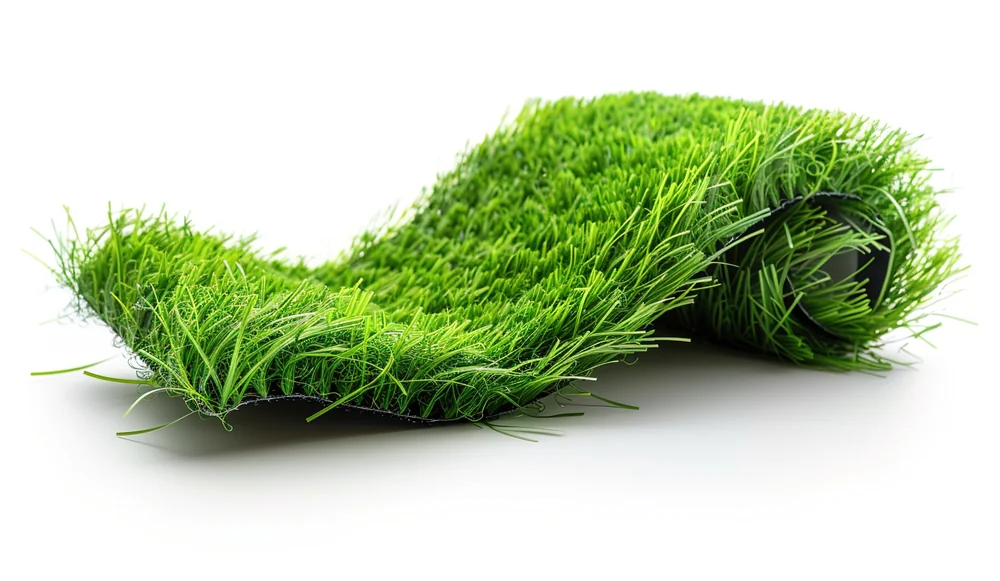
That dark backing is in contact with the air through the drainage holes and heats up the way any dark plastic heats up in the sun. That’s why the heat doesn’t go as soon as the sun drops behind the house: the mass underneath takes a while to let it go.
What changes things here
On the Costa del Sol there are two factors that don’t weigh as much elsewhere.
The first is the hours of direct sun. A terrace that gets sun from eleven to one isn’t the same as one that gets it from nine to seven, and no fibre quality fixes that difference. Before deciding where it goes, it’s worth looking at the area on a Saturday at five in the afternoon in July, not on a Tuesday morning in March.
The second is white walls. A whitewashed wall or a light-coloured enclosure right next to it reflects light onto the ground, and that adds to what comes from above. It’s the reason an enclosed, whitewashed patio behaves worse than its size suggests.
What works and what doesn’t
Shade is the only thing that solves it. A pergola, an awning, a tree with a high crown, or simply choosing the strip that’s already in shade by mid-afternoon. It’s the boring solution and it’s the one that works.
Hosing it down works, and doesn’t last. The temperature drops at once, and after an hour of sun it’s back where it was, because the water has gone and there’s nothing left to keep evaporating. It’s worth saying plainly: if you have to water artificial grass to be able to walk on it, you’ve lost the water-saving argument, which is usually half the reason it gets installed.
The fibre and the infill help a little. A lighter green and a less dense fibre behave somewhat better, and silica sand infill isn’t the same as rubber. They’re real improvements, but of degree: they change how much it burns, not whether it burns. Anyone selling a fibre that “doesn’t get hot” is selling something else.
Watering the base is no use at all. The water drains away, which is exactly what the system is designed for.
Where it is the right decision
With all of that on the table, there are places where artificial grass is simply the best option available:
- Areas in shade for a good part of the day: inner courtyards, north-facing sides, under a pergola. There the heat problem doesn’t come up and you’re left with just its advantages.
- Terraces and roof terraces with no soil, where a natural lawn would need a box of growing medium with its weight, its drainage and its waterproofing.
- Small, heavily used areas, where natural grass never manages to take and ends up as a bald patch that turns to mud in winter.
- Communal areas with no irrigation installed, or where water use is the argument that decides the vote. In communal gardens it’s usually the point that settles the discussion.
And there’s one place where it almost never is: the strip in full sun where the children or the dog run around barefoot. Not because the material is bad, but because there you’re asking it for precisely what it can’t give.
The question isn’t artificial or natural
Almost all the gardens that really work around here are mixed. Artificial where natural grass wasn’t going to take or where there’s no soil; natural where there’s shade and irrigation; drought-tolerant planting in the big sunny areas where neither makes sense. Sharing it out by the square metre works better than picking a side.
If what you have now is natural grass and it comes out of August in a bad way, before ripping it out it’s worth ruling out that it’s something that recovers in autumn. September and October are its two best months, and more than one lawn that was going to be replaced in summer comes back by itself when the nights cool down.
And if the decision is already made, what shows most after five years isn’t the brand of fibre but the preparation underneath: the base, the compaction and the drainage. That’s what we cover on the artificial grass installation page.