Blog · Artificial grass: buying decisions
If artificial grass puddles, the problem isn’t the grass
It’s bought in spring and spends the summer seeing no water but the hose. The first autumn storm is its first real test, and what fails is almost never the grass.
 By Sergio Domínguez7 min read
Artificial grass is almost always bought in spring, to have it ready for summer. And here summer is four months with hardly any rain: from the day it’s bought to the first autumn storm, it sees little water but the hose.
Its first real test is the first autumn storm, which here isn’t a drizzle: it’s a lot of water in a few hours. If a puddle appears that afternoon, the immediate conclusion is that the grass was poor. It almost never is.
The grass doesn’t drain: it lets water through
Artificial grass is a fabric with fibres stitched on top, and the fabric is perforated: a grid of holes the water passes down through. In normal rain it goes straight through. And that’s where its job ends. It doesn’t take the water anywhere: it drops it onto whatever is underneath.
That’s why “free-draining” on the label of the roll is talking about the roll. Whether the garden puddles or not is decided by what’s underneath, and that doesn’t come with the roll: it’s done by whoever installs it.
The same rain, the same grass, two bases
The water goes through the grass on both sides. The backing is full of holes and lets the rain through just the same in one garden as in the other. So far there’s no difference.
The difference is underneath. The gravel lets the water keep going down. The soil gets soaked from the top, the water stays there and, as soon as it can’t take any more, it rises between the blades.
The storm passes, and on the left nothing is left on top. On the right the puddle takes a while to go, and the soaked soil gives a little. The next storm finds the hollow already made and fills it sooner, in the same place.
On soil: what has to be underneath
A well-done installation on soil goes in layers. The top layer comes off, because it has roots and debris that rot and sink. A layer of gravel or compacted hardcore goes down, which lets water through and doesn’t move. On top, the weed membrane and the grass. And a slight fall is left towards somewhere the water can go when more arrives than the ground can soak up.
The cheap version is raking the existing soil, smoothing it and rolling the grass out on top. On day one it looks just as good. The difference shows with water: the soil gets soaked, softens and gives way at the soft spots. Every storm sinks the same hollow a little further, and the hollow is where the puddle forms the next time.
If the soil is the kind that turns to mud, it’s worse: it takes a long time to soak water up, and the water stays just under the backing, which is where you can’t see it. With natural grass something similar happens for a different reason, and there too what’s under the lawn decides whether it lasts.
On tiles or on a roof terrace
Here the water has no soil to go down into. It passes through the grass by the holes and runs over the tiling, under the grass, to the drain. On this coast that’s where a good share of artificial grass goes, and everything depends on four things:
- The fall it already has. A roof terrace is built so the water runs to the drains, and the grass doesn’t change that. What does spoil it is filling in to make everything flat: the water stays in the fill.
- The drains, left visible. If the grass covers them, they can no longer be seen, and whatever comes down with the water (dust, shredded leaves, the sand put on as ballast) ends up inside. The grass is cut away around them and a grate is left that can be lifted.
- A gap underneath. Laid straight onto the tiles, the backing sits stuck to a film of water that takes a long time to dry. A drainage mat or membrane between the tiles and the grass leaves a gap the water runs through and the air gets into. Where there’s a dog, it’s what decides whether the terrace smells.
- If it’s glued, only at the seams and edges. Glued all over, the adhesive blocks the holes and the water has nowhere left to go down.
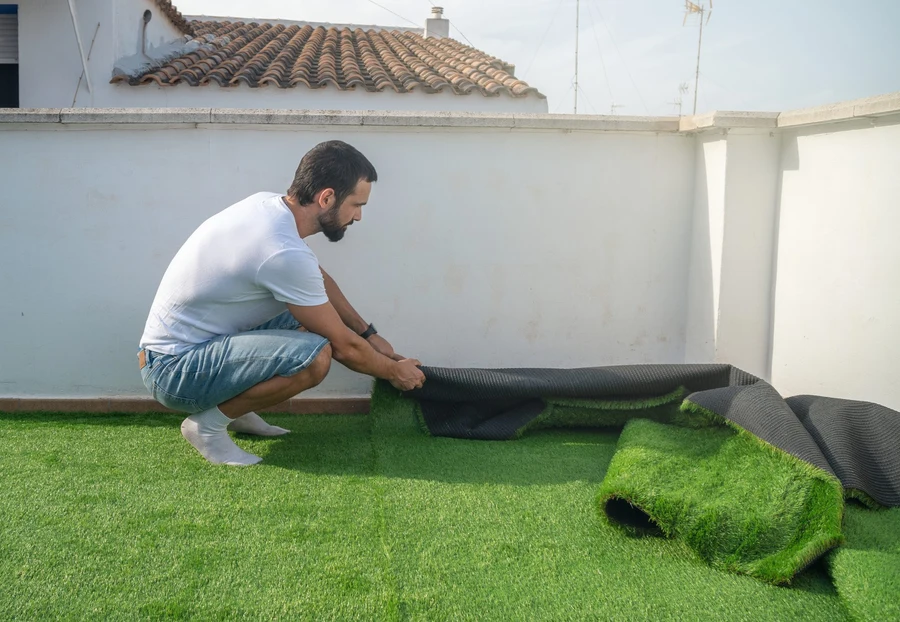
A roof terrace like so many here, with the grass laid over the tiling. What matters isn’t in the photo: where the drain ends up and whether the grate can be lifted when it needs to be.
A roof terrace’s drains are the same ones that need to be clear before it rains, grass or no grass. We cover it for urbanisations in clearing drains before the first storm; with grass on top, the only difference is that you can’t see them.
The water that doesn’t fall on it
A puddle that always comes back in the same place isn’t always from the rain falling on the grass. Often it’s from water arriving from somewhere else: the roof downpipe that empties onto the garden, the terrace above, the neighbour’s plot on higher ground. In an urbanisation on a hillside, the garden at the bottom gets the water from the ones above.
No base can cope if it gets the water from three roofs. That’s solved before the grass goes down, by taking the downpipe to a drain or to an area that can soak it up. It’s the same sum you have to do before paving the garden: water doesn’t disappear, it moves somewhere else.
What to check after the first storm
The good thing about rain here coming all at once is that the first storm works as a test. The next day, look at this:
- How long the puddle lasts. One that goes in a while is normal after a real downpour. One that’s still there the next day isn’t.
- Where it appears. If it always appears in the same place, there’s a hollow underneath, and it will get worse.
- Ripples or bumps where it used to be flat: the base has moved.
- Sand building up at an edge or on the drain grate: the water is carrying the ballast sand to the low point.
- A smell, on a terrace, in the area the dog uses, a few days later: the water is staying underneath.
If any of these shows up, it gets fixed from below: lift the section, redo the base or give the water a way out, and lay the grass again, which can often be reused. Putting more sand on top or swapping it for another roll doesn’t touch the problem.
And before the storm, the cheap part: clear the leaves that have built up and leave the drains clean. The rest of what it needs is in artificial grass maintenance, which isn’t zero.
What to ask before you buy
When two quotes for the same square metres look nothing alike, it’s almost always because of what goes underneath. Three questions clear it up:
- What goes under the grass? If the answer is “nothing, it goes straight down”, you know what you’re buying.
- Where does the water go? Not whether it drains, but where to: downwards, to a drain, to an edge. There has to be a concrete answer.
- On a terrace, will the drains be left visible? If not, ask how they’ll be cleaned.
The rest of the installation (the base, the seams, the edges, and where it makes sense to lay it and where it doesn’t) is on the artificial grass installation page.
In short
Artificial grass lets water through, and that’s where its job ends. If it puddles, what’s failing is underneath: soil with no base that soaks up and gives way, a roof terrace with its drains covered, or the water from another roof arriving whole in the garden.
Here it’s bought in spring, and the first autumn storm is its first exam. If it has left a puddle, look at where it appears and how long it lasts: that tells you what’s underneath better than any label.