Blog · Artificial grass: buying decisions
Artificial grass for dogs: why it smells in summer and what to check before you buy
With a dog, artificial grass ends the mud and the yellow patches. What it brings instead is the August smell, and that’s decided before you buy, by what goes underneath.
 By Sergio Domínguez6 min read
With a dog in the house, a natural lawn has two problems you can see from the window: yellow patches where it always pees and mud where it runs. Artificial grass gets rid of both, which is why it’s one of the most common reasons for putting it in.
What it brings instead shows up in summer: the dog’s corner smells. It isn’t bad luck or a bad product. It’s what happens to urine when there’s no living soil underneath, and it’s decided before you buy, by three things you can’t see once it’s laid.
Why natural grass doesn’t smell and artificial grass does
On a natural lawn, urine goes into the soil. The ground holds on to much of the nitrogen and the roots use it; the yellow patches are the same thing in excess, too much feed on the same spot. They’re a nuisance, but they don’t smell.
In artificial grass nothing uses it. The urine runs through the holes in the backing and stays in the sand infill and in the base. There, bacteria turn the urea into ammonia, and the ammonia, with no soil or roots to hold it, goes into the air. That’s the smell, and heat makes it worse: the same grass smells more in full sun in August than in March.
The same urine, two surfaces
The same on both. A dog pees the same on a natural lawn as on artificial grass. What changes is what lies underneath.
A few days later. In soil, the ground holds on to much of the nitrogen and the roots use it. In artificial grass nothing uses it: it turns into ammonia and goes into the air, and that is the smell.
Water takes it away. A rinse that reaches the base flushes it out. In winter the rain does it; from June to September it hardly rains here, so the water has to come from you.
What takes it away is water: a rinse that reaches the base and flushes it out. In winter the rain does it without anyone noticing. Here, from June to September it hardly rains, and for those months someone has to supply the water. If the house is shut for weeks, or the dog stays with someone who doesn’t know, September is when you notice.
What to decide before you buy
The pile is what people look at in the shop and what matters least here. What decides whether the dog’s corner smells is underneath.
The base: give the water somewhere to go
Under the grass there needs to be a layer of compacted gravel or aggregate that drains, not the bare soil or a concrete slab with no fall. If the rinse water can’t keep going down, it takes nothing with it: it stays underneath, soaks the infill and the smell is still there, only damp now.
On a terrace or over tiles the base can’t be changed, and what matters is leaving a gap for the water to run to the drain. How that’s done is in artificial grass drainage.
The backing: holes, or permeable throughout
The backing is the fabric the fibres are stitched into. The most common kind is perforated: water goes down through holes spaced along the roll. For dog areas there are backings that are permeable across the whole surface, letting liquid through wherever it lands and not just through the holes. Ask which one you’re being offered, because you can’t tell by looking at the grass from above.
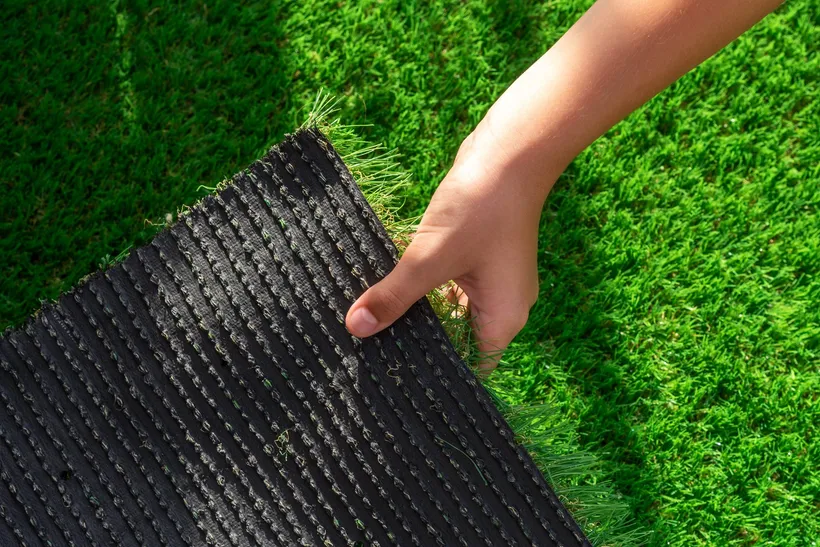
The backing seen from underneath: the fabric with the rows of stitches that hold the fibres. Whatever lands on top only goes down where this fabric lets it through.
The infill: what sits between the fibres
Most artificial grass has silica sand between the fibres, as ballast, to stop it moving and keep the fibres upright. Sand doesn’t neutralise anything: it’s just where whatever lands ends up. There are mineral infills designed for pet areas — zeolite is the most common — that hold on to some of the ammonium instead of letting it into the air. They help; they don’t replace water.
The spot: where the dog does its business
A dog doesn’t use the whole garden equally: it almost always goes back to the same two or three spots. If those spots are in full sun, the smell will be stronger in summer, and the grass will also be hotter under its paws. How hot, and why, is in does artificial grass get hot. If the garden allows it, it’s worth giving the dog’s corner afternoon shade and a tap nearby.
The upkeep that does come with a dog
- Solids, every day. Picked up completely, not left for the next rinse.
- Rinse the dog’s corner properly. A soaking that reaches the bottom, not a sprinkle on top. In summer, often; in winter it’s hardly ever needed, because it rains.
- Brushing. Lifting the fibres lets the water in and spreads the infill, and shows up any spots where the sand has caked.
If it still smells after that, the problem is underneath: the base isn’t draining or the infill is saturated, and it’s fixed by lifting that section, not by pouring more water on top. The rest of the upkeep, the part that has nothing to do with the dog, is in artificial grass maintenance.
Wouldn’t natural grass be better?
It depends on where the dog does its business and on who’ll be at home in August. Natural grass doesn’t smell, but with a dog it will get patches and a bald strip along its favourite route, and it still needs watering all summer. Artificial grass doesn’t stain or turn to mud, but it needs that rinse in the dry months.
There’s a middle way: grass where people play and a corner of gravel or well-drained soil where the dog is trained to go. That corner is rinsed in a minute and the rest of the garden never knows.
What to ask for in the quote
With a dog, what you want to see in writing is what goes underneath: which base, which backing and which infill. If the quote only talks about pile height and price per square metre, the important part is missing. How we do it is in artificial grass installation. And if the house is shut for spells, the summer rinse can be part of a garden maintenance plan.
In short
Artificial grass with a dog works: the mud and the patches are gone. What needs solving is the smell, which doesn’t come from the fibres but from what stays underneath, and which shows up here in summer because it doesn’t rain.
It’s decided before you buy: a base that drains, a backing that lets water through and, if you like, an infill designed for pets. After that, in the dry months, a proper rinse of the dog’s corner.