Blog · Artificial grass: buying decisions
Artificial grass isn’t zero maintenance: it’s different maintenance
It’s sold as needing nothing doing to it. What actually happens is that the work changes shape: the watering and mowing go, and something else comes in that nobody mentions before you sign.
 By Sergio Domínguez8 min read
The sales pitch for artificial grass is always the same: lay it and forget about it. No watering, no mowing, no feeding, no lawnmower in the shed.
All four are true. What isn’t true is the conclusion, because what follows from them isn’t “zero maintenance”: it’s that the maintenance changes shape. And hardly anyone tells you about the new kind before you sign.
What really goes
Let’s start with the good part, which is a lot and is real. The watering stops, and on this coast that’s the biggest item. The mowing stops, along with everything it brings (the machine, the fuel, the clippings, the Saturday noise). The feeding and the overseeding stop, and so does the problem of the areas where natural grass never takes: the paths, the deep shade, the strip right against the wall.
It’s a real relief, and anyone looking for it is right to. The mistake isn’t laying artificial grass: it’s in the sums, in budgeting zero hours a year because the brochure hints at it.
What comes in instead
Brushing. The fibres get flattened by feet and by the weight of the furniture, and a flattened fibre doesn’t stand back up by itself. Brushed against the grain it recovers; left unbrushed, the flattening becomes permanent and you get that shiny, trodden-down look that gives artificial grass away from ten metres.
Removing what falls on it. This is the part that surprises people. On a natural lawn, whatever falls disappears: it gets chopped up by the mower, breaks down and ends up as soil. On artificial grass nothing disappears, because there’s nothing underneath to digest it. It stays.
And here that matters more than elsewhere. We’re coming out of four months without a single rain to wash anything away, so there’s a layer of fine dust on everything outdoors. If there’s a pine nearby (and on half this coast there is), the needles fall all year round, not in one autumn drop and that’s it. And if there’s a hedge, every trim leaves its share.
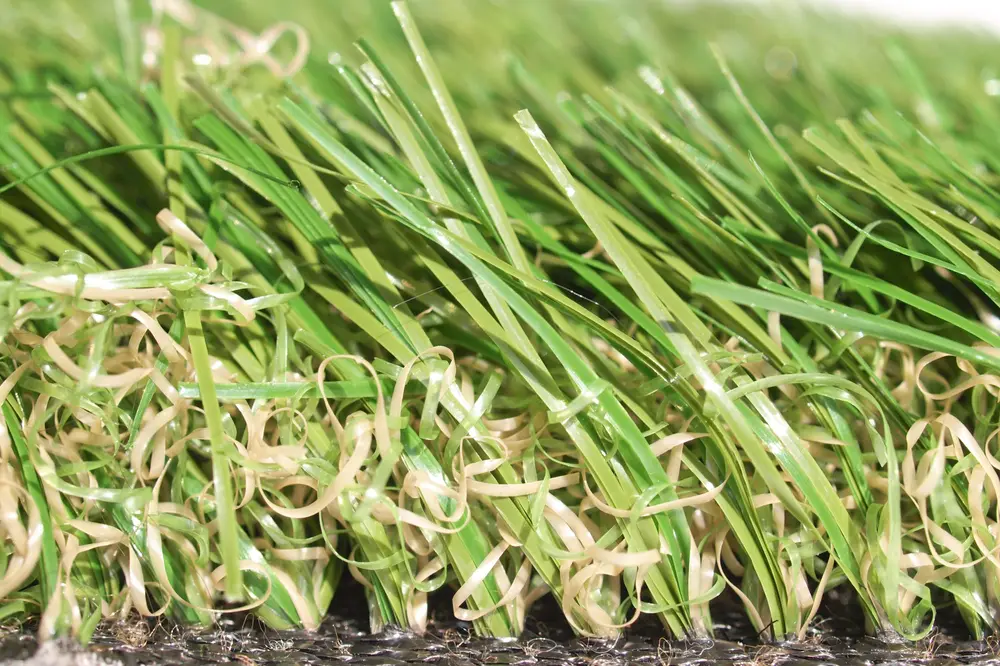
Seen side-on, the problem makes sense. It isn’t a rug: it’s loose blades over a curly tangle, and everything that lands on top ends up down there, between the curl and the backing, where neither the broom nor the rain can reach it.
Where the weeds really come from
This is complaint number one, and it’s almost always aimed at the wrong thing. A weed comes up in the artificial grass and the immediate conclusion is that the weed membrane was no good or was badly laid.
Usually the membrane is fine and doing its job. The problem is that the weed isn’t coming from below.
The same lawn, three autumns
Newly laid, the weed membrane does its job. Nothing underneath gets through. This part hardly ever fails, which is why the complaint that “the membrane was no good” is usually aimed at the wrong thing.
Over the months, everything that falls builds up among the fibres. Dust from four dry months, pine needles, shredded leaves, trimmings from the hedge next door. It sinks to the base and stays there, compacting.
That layer is soil, and with the first rain things take root. The weed hasn’t come up from below: it has grown on top, in what didn’t get swept. That’s why brushing isn’t just cosmetic.
All that build-up of dust, needles and shredded leaves that sinks to the base of the fibres is a growing medium. It doesn’t look like one because it’s a thin layer hidden among the blades, but it has what’s needed: organic matter, mineral and a gap to take hold in.
So as soon as the first proper rain arrives, any seed that has landed on top takes root there. No sheet in the world stops something growing on top of it. And here, without a winter that really stops things, that can happen in almost any month.
That’s why sweeping and brushing aren’t cosmetic: they’re removing the soil before it forms. It’s the same logic as clearing a drain before the storm instead of after (we cover it in clearing drains before the first storm): the cheap work is the work done beforehand.
The seams and the edges
If anything is going to come up, it comes up there. The joins between rolls and the finish against the wall, the kerb or the tree pit are where most dirt builds up and where the fibre holds worst.
They’re worth checking twice a year, and above all after the first storm, which is when the water carries debris along and leaves it right at the edge. A lifted edge can be put back in ten minutes; a lifted edge that has been like that for a year has already warped the roll.
And the heat, which is a separate matter
There’s one part of the maintenance that on this coast is really a design decision, not a cleaning one: where it goes. Artificial grass in full July sun can’t be walked on barefoot, and no amount of care afterwards fixes that. It’s solved beforehand, by choosing the spot or adding shade (we explain it in why artificial grass gets so hot).
So is it worth it?
Often yes, and by quite a lot. But it’s worth comparing it with what it really is, not with zero. Compared with a natural lawn on this coast, artificial grass swaps several hours a month of watering, mowing and feeding for a little brushing and clearing of debris, plus checking the edges a couple of times a year.
It comes out ahead on time and water, which is usually what people are after. What it isn’t is free in hours, and whoever buys it believing it is ends up with flattened grass, a layer of dirt on top and weeds they can’t work out the source of.
If you’re at the point of deciding, the rest of the conversation (grades, base, drainage, and where it makes sense and where it doesn’t) is in artificial grass installation.
In short
Artificial grass takes away the watering, the mowing and the feeding, which is a lot. In return it asks you to brush the fibres and not let whatever falls on it build up.
That second part is what decides whether after three years it still looks like a lawn or looks like an old rug with weeds. And it isn’t hard: it’s a matter of remembering.