Blog · Garden renovation
Before you pave the garden: where the water is going to go
The question people start with is usually which material to use. The one that decides the result is another: in the first October storm, where does the water that floor no longer soaks up end up?
 By Sergio Domínguez9 min read
Garden makeovers on this coast tend to look alike: the lawn comes out, you gain a sitting area, tiles or decking go down, and it looks better than before. The conversation always starts with the material — porcelain, stone, imprinted concrete, wood — and how it’s going to look.
There’s another question that hardly anyone asks and that decides more: when the first October storm comes, where is the water that floor no longer soaks up going to end up?
Water doesn’t disappear, it changes door
An earth garden, with or without a lawn, drinks almost everything that falls on it. Not because it’s magic, but because it has pores and a volume underneath to put it in. That’s why you’ve never had to wonder where it goes: it went down, right under your nose, without a sound.
When you pave that surface, the rain that falls on it is exactly the same. The only thing that changes is that one of the exits has been closed. And since water doesn’t evaporate as fast as it falls, all of it leaves by the other two.
The same terrace, before and after
An earth garden drinks up almost the whole downpour. Some stays in puddles and some runs off the edge, but that’s the least of it. That’s why you’ve never had to think about where the water ends up.
Paving doesn’t make it rain less. What it does is close the door underneath. The rain that falls is the same, and the surface that used to drink it now drinks nothing.
So all of it goes out through the other two. It sits in puddles on top, or runs off the edge. And on a terraced plot, “the edge” isn’t an abstract place: it’s your wall, or the terrace below, which may be your neighbour’s.
Why it matters more here
This is textbook hydrology and it happens everywhere. What makes it so noticeable here is two things that come together, and that elsewhere don’t coincide.
The first is the way it rains. It doesn’t rain little: it rains all at once. We go four months with nothing and then a few hours bring what in another climate is spread over six weeks. Under that regime, not even bare soil can soak it all up in time, so taking away absorbing surface has a much harsher effect than where it rains gently and often.
The second is the shape of the plots. Here almost everything is on a slope and built in terraces. That means “the edge” of your paved area isn’t an abstract idea: it’s a specific place, and it’s usually one of two things. Either the back of your own retaining wall, or the terrace below, which is often someone else’s.
When someone tells us that after the makeover “the wall has started to move”, it’s almost never that the wall has gone wrong. It’s that water is reaching it that didn’t reach it before.
The three questions to answer first
You don’t need a study. Answering these three, in this order, avoids most of the grief:
- Which way does it fall? Every surface has to have a slope, and that slope decides where the water goes. The question isn’t whether it has one, but which way you’ve sent it. Sending it towards the house or towards the wall are the two classic ways to get it wrong.
- Where is it collected? If the water is going to reach a point, there has to be something at that point: a grate, a channel drain, a drainage pit. A drain thought of after the paving means cutting into brand-new work.
- And from there, where does it go? This is the one everyone skips. A drain that empties onto the same edge of the terrace hasn’t solved anything: it has concentrated into one jet what used to fall spread out, which is often worse.
Not everything you walk on is waterproof
The simplest way not to have this problem is not to close the door completely. Some finishes are just as good to walk on and still let water through: compacted gravel in cells, pavers with open joints, slabs bedded on aggregate with gaps between them, decking on battens with drainage underneath.
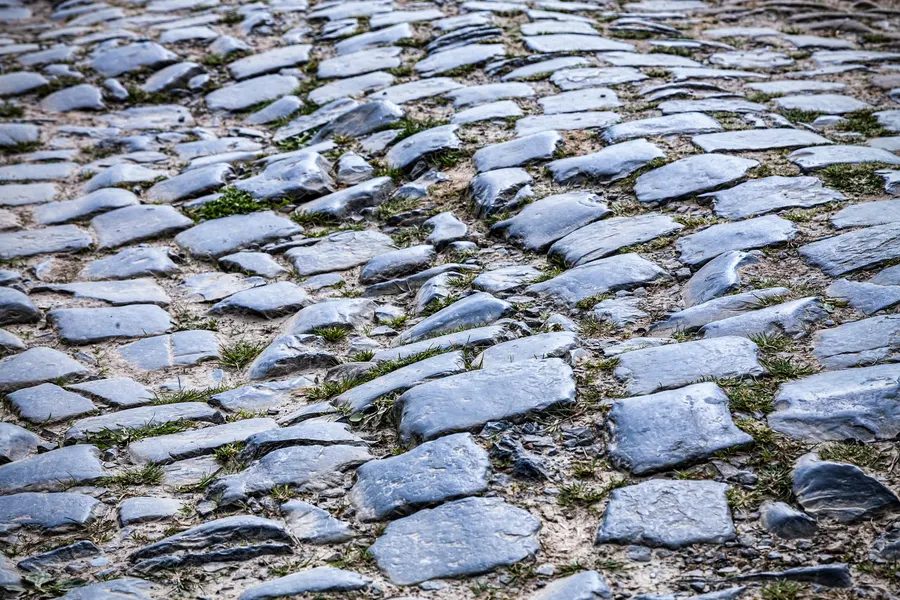
This gets walked on every day and still lets water through. The proof is in the joints: if grass grows there, water and air are getting in, which is exactly what doesn’t happen under sealed tiling.
They’re not a universal solution. Open joints need maintenance, in an eating area they get dirty, and with a wheelchair or a trolley not everything works. But for paths, side access and through-routes, a sealed finish is often chosen without anyone having even raised the alternative.
And there’s a middle way that works very well: seal only the area that really needs it — the table, the barbecue, the main path — and leave the rest permeable. Most makeovers pave quite a few more square metres than are actually used as hard floor.
What you gain besides avoiding the problem
Leaving surface that absorbs isn’t just prevention. It’s also what keeps alive whatever stays planted around it: every sealed metre is rainwater that no longer gets into the soil where the roots of your trees and hedges are, and that you’ll have to make up with watering.
It’s the same reasoning as dividing up the watering, seen from the building work instead of from the plant. We cover it in group plants by what they drink.
And if a tree is going to stay in the paved area, the tree pit isn’t an aesthetic detail: it’s the only door that tree has left to drink and breathe. Tree pits that are too tight are behind half of the roots that end up lifting the paving. That’s covered in roots lifting the paving.
When it’s done
Now, and not by chance. Earthworks and bedding a paved surface don’t go well with soaked ground, and they go even worse with having the job half-finished when the first storm arrives: an unfinished terrace with no drain fitted is exactly the situation this article is trying to avoid, only concentrated.
So if the makeover is happening this season, the water part is decided before ordering materials, not when the tiles are already down and you have to find a way to get the water out.
In short
Paving doesn’t make it rain less: it closes the exit that took away almost all the water without anyone noticing. That same water will leave by the two that remain, pooling on top or running off the edge, and on a terraced plot the edge is your wall or the terrace below.
Before choosing the material, answer which way it falls, where it’s collected and where it goes from there. And ask yourself whether the whole surface needs sealing, or only the part that’s really used as hard floor.