Blog · Garden renovation
Building work at home: what breaks in the garden and doesn’t show until July
Here houses get renovated in autumn and winter, with nobody in them. The garden becomes the storeroom, and what really breaks doesn’t show itself until the first summer.
 By Sergio Domínguez8 min read
Here houses get renovated out of season. In autumn and winter, with the house empty and no holidaying neighbours to disturb, the builders move in: a kitchen, a bathroom, the pool being redone, the façade. And the garden, which is what lies between the street and the house, becomes the storeroom.
What gets damaged in plain sight — the lawn under the pallets, a hedge scraped by the wheelbarrow — is seen and fixed. What really breaks can’t be seen, and shows itself months later, when the work has been paid for and nobody connects one thing with the other.
The roots are where things get unloaded
Everyone’s idea is sensible: materials away from the tree. They’re left a few paces from the trunk, outside the shade of the canopy, and it’s assumed they’re not in the way there.
The problem is that roots don’t stop where the canopy stops. They carry on quite a way beyond it, and nearly all of them run close to the surface, which is where the water and the air are. The spot “away from the tree” is usually right on top of them.
The same tree, before and after the building work
Roots don’t stop where the canopy stops. They carry on well beyond it, and almost all of them run near the surface. That’s why the spot “away from the tree” where the pallets are unloaded is usually right on top of them.
The weight crushes the soil, and with it the air they breathed. From above you hardly notice anything: the lawn yellows a little and looks as if it will recover.
The work ends and the soil stays compacted. The tree gets through the winter, which here is mild and damp, and the damage shows in the first summer without rain: the canopy thins, often on the side where the work was.
What harms them isn’t a knock, it’s the weight. A pallet of bags, a skip or a small machine going back and forth crushes the soil and closes the gaps the air used to get in through. The root underneath isn’t cut: it slowly suffocates. And the soil doesn’t recover by itself when the pallets are taken away. The pallets go; the compacted soil stays.
Add to that the trenches: for the drain, for the garden lighting, for the pool’s new pipe. A trench near the trunk cuts through every root it crosses in one go. That’s why recent building work nearby is one of the signs that a tree may be dangerous, even if it looks healthy.
Why here it shows in July
Where it rains in summer, a tree with part of its roots damaged gets by: water keeps reaching it, even if through fewer roots. Not here. The winter is mild and damp, and the tree gets through it without giving any sign. Then come four months without rain, and it has to draw all its water through the roots it has left.
That first July is when the canopy thins, often on the side where the work was, because each side of the canopy depends mainly on the roots on its own side. If a tree starts losing leaves on one side the summer after a renovation, that’s the first thing to suspect.
What else gets broken
The buried irrigation
Irrigation pipes run shallow, and a loaded wheelbarrow or a small machine crushes them without anyone noticing. It comes to light in spring, when the watering is switched on: a zone the water doesn’t reach, a puddle where there never was one. If someone marks where they run before the work starts — a few photos will do — you can say where nobody goes.
The soil where things get washed
The cement mixer, the trowels and the buckets get washed somewhere, and if nobody says otherwise that somewhere is a flower bed. Water with cement or lime residue leaves the soil very alkaline, and afterwards almost nothing takes root there. The garden drain won’t do either: what settles inside blocks it, and you find out with the first storm. It’s the same thing you need to check in the drains before the first storm, with the building work on top.
The lawn
It’s what shows most and matters least. Under a pallet it yellows in days, but it can be overseeded or replaced. If you have to choose where to unload, better on the lawn away from the trees than the other way round.
What to agree before anyone comes in
All of this is avoided with a conversation before work starts, and it costs far less than any repair afterwards. With whoever is doing the work, and ideally in writing in the quote:
- A fenced-off area around each tree that matters, with a simple fence reaching at least to the edge of the canopy. Inside it, nothing is unloaded, nothing parks and nobody walks through.
- Where the materials go. On the paving, if there is any. If not, on boards that spread the weight, and in the part of the garden furthest from the trees.
- Where the machine comes in, if it has to, and always along the same route: better to crush one strip than the whole garden.
- Where things get washed. Never on the soil or in the drain.
- Trenches near a tree, if there are any, are decided beforehand with someone who knows about trees: where they go, and whether they can be rerouted or dug by hand in the stretch nearest the trunk.
- The irrigation layout, marked or photographed before the work starts.
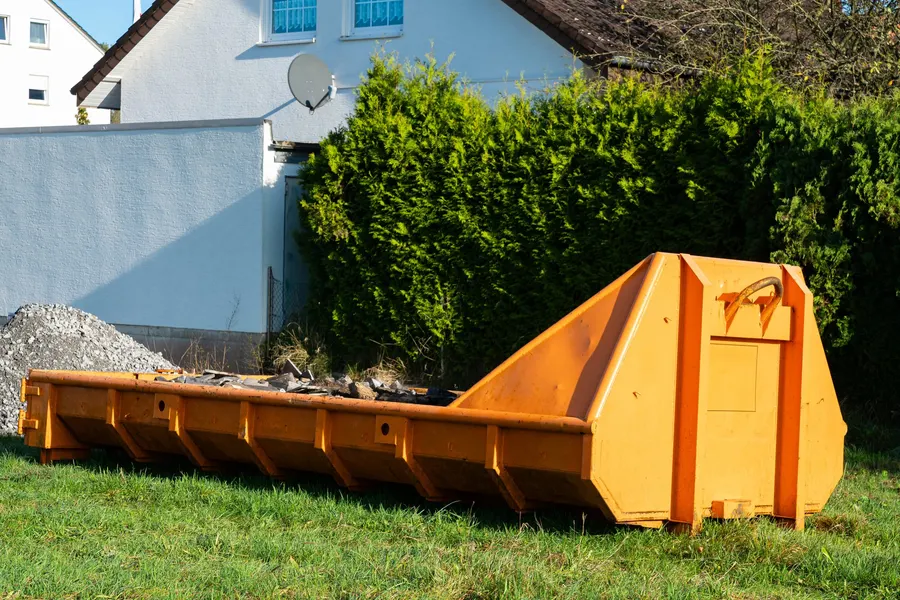
This is how it usually ends up if nobody agrees anything: the skip on the lawn and up against the hedge, and the gravel next to it, on the grass too. From above you only see flattened grass. What carries the weight for the whole job is the hedge’s roots, which reach that far.
If the house is going to be empty during the work, which here is normal, whatever is agreed has to be in writing. Nobody will be there to remind anyone on the day the lorry arrives.
If the work has already been done
If the renovation has already happened and the garden served as the storeroom, there are two things you can do now. The first: don’t park or unload again where the materials were stored. The second: keep an eye on the tree in its first summer. If it thins on one side, don’t just make up for it with more water: what it lacks isn’t water, it’s roots to drink it with, and over-watering compacted soil waterlogs it. Have someone look at it before you decide.
And if what’s coming next is a makeover of the garden itself, that has its own questions. The first is usually where the water goes when you pave the garden. The rest is on the garden renovation and construction page.
In short
In building work, what breaks in the garden isn’t what you can see. The roots reach past the canopy and lie under the spot where things are unloaded; the irrigation runs shallow; the soil is ruined where things get washed. None of it shows in winter, and here it shows in July.
It’s avoided before you start: a fenced-off area around each tree, a place for the materials that isn’t on top of their roots, and a place for washing that isn’t the soil. It costs less than any repair, and with the house empty it’s the only thing that works.