Blog · Lawn care
Reviving a lawn after summer: what to do in September
Before you buy a bag of seed there’s one question to answer: does your lawn look bad in summer or in winter? Depending on which, the September plan is the opposite.
 By Sergio Domínguez8 min read
By the end of August, half the lawns on the Costa del Sol are a picture: yellow in places, bald in others, and with the odd strange ring where there used to be grass. The natural impulse is to go and buy a bag of seed.
Hold on a moment, because in half of cases that bag is money down the drain, and it makes next year harder too.
First: does your lawn look bad in summer or in winter?
It’s the only question you need to answer before touching anything, because on this coast two families of grass live side by side that work the opposite way round from each other, often in the same urbanisation.
Summer grasses (the warm-season ones: Bermuda grass, kikuyu, zoysia, St Augustine grass) grow with heat. In July they’re at their best if they have water, and what they do in winter is turn straw-coloured and stop. They spread by stolons: creeping stems that cover the ground by themselves.
Winter grasses (ryegrass, tall fescue) are exactly the opposite: green from October to May and struggling from July to September. And they grow in clumps, each plant in its own spot, with no runners exploring around it.
If you don’t know which one you have, you don’t need a manual: think about which month it looks bad. And pull at a blade on the edge of a bare patch. If a long stem comes up lying flat on the ground, with nodes and little roots every few centimetres, it’s a summer grass. If a loose clump comes up, it’s a winter one.
The difference isn’t a botanical curiosity. It decides what happens to the bare patches.
The same bare patch, two endings
Bermuda, kikuyu, zoysia, St Augustine
It spreads by stolons. With water and feed in September it closes the gap by itself, without you buying anything.
Ryegrass, tall fescue
It grows in clumps: it fills out a little at the edge and stops there. If the patch is going to close, you close it by overseeding.
Second: look at it side-on, not from above
A lawn seen from above tells you almost nothing. Seen side-on it tells you everything, and there are three layers: the green blade, the soil with the roots, and in between, a brown mat of old stems and debris. That is called thatch, and it’s suspect number one when a lawn behaves oddly.
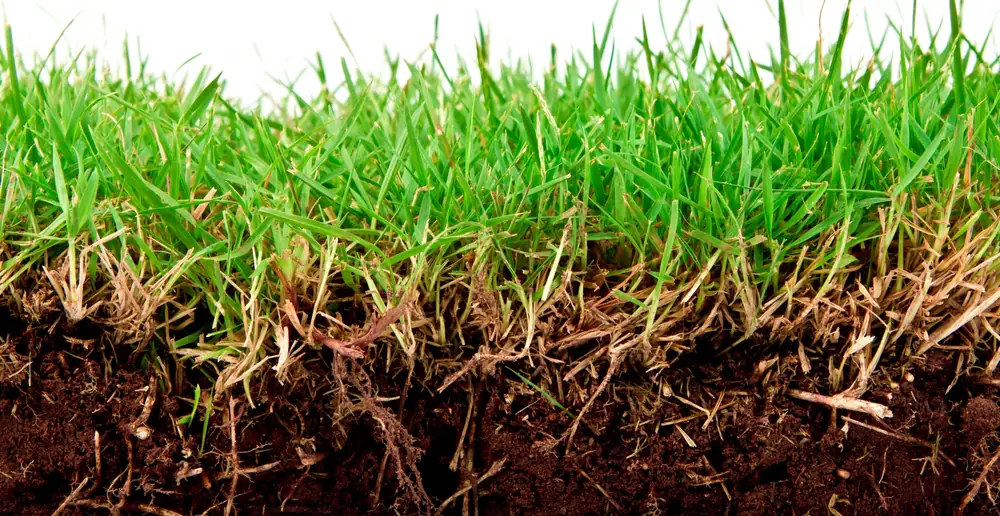
A little thatch is normal, even good. The problem is when it gets beyond a couple of centimetres, because then it works like a sponge that keeps the water: you water, the mat soaks it up, the soil underneath stays dry, and the roots, which go where the water is, move up into the mat. That’s where they cook as soon as the sun gets going.
It’s worth checking before you blame the watering. With a spade, lift a ten-centimetre plug of lawn and look at it side-on. If the brown layer is thick and spongy, you know where to start: scarify, which means raking the lawn with blades to tear out that mat. September is a good month precisely because it gives the lawn time to recover.
The plan if your lawn is a summer grass
Good news: it isn’t dead, it’s coming to the end of its good season. What you need to do is make the most of the last weeks of heat, which are the ones that count most.
Water long and spaced out instead of a little every day, so the roots go down rather than staying near the surface (it’s explained in detail in how much to water the garden in summer). Feed it, because it’s going to use a lot closing gaps and needs something to do it with. Mow regularly: frequent cutting is what encourages the stolons to branch. How often and at what height is in what height to cut the lawn. And above all, let it get on with it: small bare patches close up by themselves if the lawn has water, food and a few weeks ahead of it.
What isn’t a good idea is the classic temptation: sowing ryegrass over the top so it looks green in winter. People do it, and on golf courses it makes sense. In an ordinary garden the result is that in May you have two lawns fighting each other, one trying to get going and the other dying off, with a good month of it looking scruffy. If you don’t mind the lawn going straw-coloured for a few months, don’t do it.
The plan if your lawn is a winter grass
Here there is real damage and you do need to overseed, because nobody is going to replace the clumps that have died. The window is from mid-September to the end of October: the soil still holds the summer heat, which is what makes seed germinate, and the air no longer punishes the way it does in August.
The order matters. Scarify and remove the thatch, loosen the surface of the bare patches with a rake (on compacted soil the seed won’t take), sow, cover with a thin layer of compost and keep the surface moist until it comes up. That last part is the opposite of everything else you’ll hear about watering: the seed is in the top centimetre, and there it really is a little and often, until it has roots of its own.
And an honest warning: on this coast a winter grass is a lawn you’ll be patching up every autumn. It’s not that you’re doing it wrong, it’s that you’re keeping a northern plant somewhere July lasts six weeks longer than it can take. That autumn going-over (scarifying, aerating and reseeding) is one of the jobs in natural lawn care.
What the summer doesn’t explain
Before you call the problem solved, it’s worth ruling out three things that look like heat damage and aren’t.
Compaction. If the bare patch is where everyone walks, it wasn’t the sun that killed it, it was the footfall. Seed is wasted there: it needs aerating first.
Uneven watering. Bare patches shaped like a wedge or a strip are usually a sprinkler that’s been knocked round, blocked by a shrub or broken. You can see it by putting a few glasses around the garden and letting a cycle run: if some fill up and others don’t, the problem wasn’t the summer.
Fungus. Round rings and patches with a dark halo at the edge aren’t thirst. A summer grass watered at night and with plenty of thatch is the perfect setting for it, and overseeding on top only feeds the problem.
A note on where: real lawns are concentrated in areas of townhouses and communities with gardens, more than in city courtyards, where almost everything is in pots. We cover that difference in gardeners in Málaga.
And if you’re fed up with the lawn
That’s a valid answer too, and it’s worth saying even though we make a living looking after gardens. In this climate a lawn is the most expensive thing you can have to maintain: it’s the plant that asks for the most water, needs the most mowing and is the first to complain. If every September you end up having the same conversation, maybe the problem isn’t how you look after it.
Cutting the lawn back to the part that really gets walked on and turning the rest into Mediterranean planting with mulch is the change that takes the most work out of a garden here. And if you’re going to do it, the time to plant is the same as the time to overseed, for the same reason: here you plant in autumn.