Blog · Lawn care
What height to cut the lawn, and why scalping it costs you in water
The cutting height is the cheapest adjustment there is in a garden and hardly anyone touches it. Here it decides how much water you’ll have to put down for the rest of the summer.
 By Sergio Domínguez9 min read
Of everything you do in a garden, mowing the lawn is what gets repeated most often and what gets the least thought. The height comes factory-set on the mower, nobody touches it, and the usual reasoning is that the lower you cut, the longer it will be before you need to do it again.
That reasoning makes sense, and it’s exactly the opposite of what you want. The cutting height is the cheapest adjustment there is in a garden, and on this coast it decides a good part of what you’ll spend on water for the rest of the summer.
The blades are also a roof
What you see of a lawn is leaf, and the leaf does two things at once. The one everyone has in mind is feeding the plant. The other is covering the soil.
A long lawn casts shade on its own soil all day. Underneath, the ground is cooler and loses a good deal less water. A scalped lawn leaves that soil uncovered, and here, four months a year, uncovered means in full sun.
The same lawn, two heights
A long lawn shades itself. The blades you see on top are also a roof: underneath, the soil is cooler and loses a good deal less water than it would if it were bare.
Scalp it, and that roof is gone. From above it looks just as green, which is why it seems nothing has happened. What has changed is underneath: the sun now beats straight down on the soil.
And you end up making up the difference. Soil in the sun dries out sooner, so the same lawn needs more minutes of watering to get through the same week. Raising the cutting height is the cheapest adjustment there is in a garden.
That’s why the same lawn, with the same watering, either lasts the week or doesn’t, depending on the height it was cut to. It’s not that the plant is being fussy: you’ve taken the shade away from the place it drinks from. The other things that really save water are in how much to water the garden in summer.
And the same happens underneath
There’s a second reason, less visible and with bigger consequences in the medium term. The roots of a grass keep a fairly stable proportion with the leaf above them: a lawn kept long develops more root than the same lawn scalped.
More root means more depth to drink from, and that’s exactly what separates a lawn that gets through a week of drought from one that yellows in three days. Scalping it doesn’t just take away its shade: it cuts back its larder too.
The rule you do have to respect
I’m not going to give you a number for the exact height, because it depends on the species you have and on the mower, and a made-up number here is no use to you. The rule that is universal, and that you can apply today, is a different one:
Never take off more than a third of the height in one pass. If the lawn is fifteen centimetres tall, don’t go below ten. If it has got to twenty, don’t take it down to eight, even if eight was its usual height.
The reason is the same as with pruning a tree: removing a lot of leaf at once leaves the plant with nothing to make food with, so it draws on its reserves and stops. You notice it straight away, because a lawn that has had too much taken off at once goes straw-coloured for two or three weeks.
The local case: coming back to find it long
This is what happens most often on this coast and hardly gets written about anywhere, because it only happens where there are lots of holiday homes.
The house is shut up, the lawn keeps growing (here it almost never stops completely), and when someone comes back they find a lawn up to their ankles. The natural reaction is to run the mower over it at the usual height and leave it as it was. And that’s a cut of seventy or eighty per cent in one go.
What you do in that case is bring it down in two or three passes spread over a week or ten days, taking off a third each time. It doesn’t look perfect on the first day, but it’s the difference between a lawn that recovers and one that spends the next month yellow. If someone looks after the garden for you, this is something you can ask for in writing: that it isn’t scalped in one pass, even if it has grown long. What else is worth putting in writing is in the garden maintenance contract.
How often, which is the other half
Height and frequency aren’t two decisions, they’re one. If you want to keep it long and respect the third, you have to mow more often while it’s growing fast; if you mow only now and then, you’ll be forced to cut more than you should.
Frequency isn’t decided by the calendar but by looking: you mow when it has grown enough that you can take a third off and leave it at the height you want. In spring that might be every week; in August, with the plant half stopped by the heat, much less.
And it’s worth saying clearly here: the lawn doesn’t stop growing in winter. It slows down, but with these temperatures you have to keep cutting it, less often. Put the mower away in October and don’t get it out again until March, and in March you’ll find exactly the problem from the previous section.
What to do with the clippings
If you cut often and haven’t taken much off, the clippings are small and can be left on the lawn instead of being collected. As they break down they return to the soil part of what the plant took, and in the meantime they act as mulch, which is the same thing again: less bare soil, less evaporation.
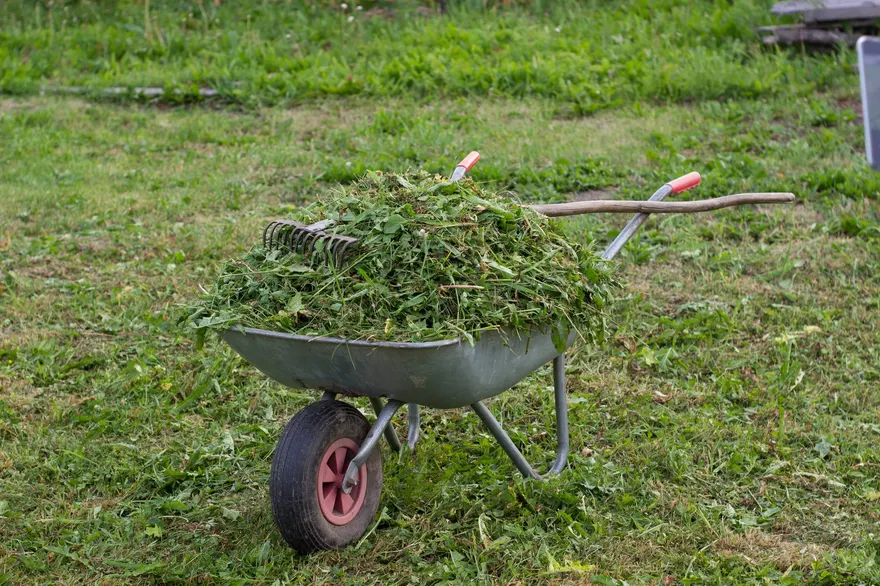
This is what comes off a long lawn, and it’s why it can’t be left on the grass: there’s no way that breaks down spread out. A maintenance mow produces a fraction of this.
What you can’t do is leave the clippings when the cut has been a long one. That amount doesn’t break down; it packs into layers that smother whatever is underneath and end up leaving bare patches. When the lawn has grown long, the clippings are collected; when it’s a maintenance mow, they stay.
Two signs you’re cutting it wrong
- It goes straw-coloured for a couple of days after every mow. That’s the symptom of taking off too much at once, and of a blunt blade: a worn blade doesn’t cut, it tears, and the torn tip dries out and looks white.
- The soil dries out much sooner than it used to. If the watering hasn’t changed and the lawn starts asking for water sooner, the first thing to check isn’t the irrigation controller: it’s the height the mower is set to.
In short
Cutting low looks as if it saves work, and what it does is increase the watering, because it takes away the shade the lawn was giving itself and the roots that went with it. The exact height depends on the species, but the one-third rule always applies: never take off more than a third in one pass.
And if you come back to find it long, bring it down in two or three goes over a week. It’s the only part of all this that allows no shortcut, and it’s exactly where everyone takes one.