Blog · Lawn care
Scarifying a lawn: when it’s due here, and when it isn’t needed
Only if the thatch is more than about a centimetre thick, and while the grass is growing: on this coast, winter grass now, in October, and summer grass in late spring.
 By Sergio Domínguez6 min read
Scarifying means tearing out the thatch: the mat of stems, roots and debris that builds up between the leaf and the soil. It’s done while the grass is growing strongly, so it quickly closes whatever is opened up, and only if the mat has thickened. On this coast that means two calendars: winter grass now, in October; summer grass, better in late spring.
And not every lawn needs it every year. Before you hire a machine, check two things: how much thatch yours has, and which family it belongs to.
First, check whether it’s needed
With a spade, lift a plug of lawn about eight centimetres deep and look at it side on. Between the green leaf and the soil you’ll see a brown, spongy layer: that’s the thatch. The University of California’s lawn guide (UC IPM) puts the limit at half an inch, just over a centimetre. Below that, leave it; above it, it’s time to scarify.
A little thatch isn’t a bad thing: a thin layer makes it harder for weeds to germinate and slows evaporation. The trouble starts when it thickens. Water, air and feed stay in the mat without reaching the soil, the roots stay up there with them, and the lawn suffers sooner from drought and from fungus. What that profile looks like, and what it does to watering, is in reviving a lawn after summer.
There’s another clue that needs no spade: if the lawn feels springy underfoot, like a mattress, the thatch is building up. And don’t confuse it with loose dry grass lying on top: that comes off with an ordinary rake. Thatch is underneath, between the base of the blades and the soil, which is why you have to look at the plug side on.
Why some lawns need it and others don’t
It depends mainly on the species. Those that spread by creeping stems, like Bermuda grass and kikuyu, build thatch quickly: UC IPM says Bermuda grass may need scarifying every year, and warns that kikuyu produces heavy thatch. Tall fescue and ryegrass, which grow in clumps, make little, and can go several years without needing it. A winter lawn sown with the fescue mixes sold here doesn’t usually need it every year.
The rest is down to whoever looks after it. The mat thickens with a lot of nitrogen feed, with short, frequent watering and on heavy clay soil. A timer set to a few minutes every day is exactly that: the water doesn’t get past the mat, and the roots stay where the water is. Watering long and less often, as we explain in how much to water the garden in summer, is what stops it coming back.
When: your grass decides, not the month
There’s one rule: you scarify while the grass is growing strongly, because that’s when it closes the wounds quickly. UC IPM puts that window in mid-to-late spring or early autumn. But here two families of grass that grow in opposite seasons live side by side, often on the same urbanisation (which is which is in the best lawn grass for the Costa del Sol), so the right month isn’t the same for everyone.
- Winter grass (tall fescue, ryegrass): October is its month. It’s in full growth, the soil still holds the summer’s warmth and it has the coast’s mild winter ahead to close up. It’s also when you overseed, so scarifying and overseeding the bare patches go together.
- Summer grass (Bermuda grass, kikuyu): better in late spring, when it takes off strongly and has the whole summer ahead. It’s still growing in early autumn, but every week of October leaves it less time before it stops, and whatever is opened up late stays open until spring.
- St Augustine grass is a case apart. Its thick runners are easily damaged. The University of Florida and Clemson guides call for a single pass, in one direction only, with the blades set wide apart and between spring and summer: several passes can kill it.
How it’s done
Beforehand, mow a little lower than usual and leave the soil slightly moist. On a small lawn a scarifying rake, the one with blade-shaped tines, and some elbow grease are enough. On a large one, a scarifier: a machine with vertical blades that cut through the mat and slightly into the soil. It goes over in one direction and then again at right angles, except on St Augustine grass.
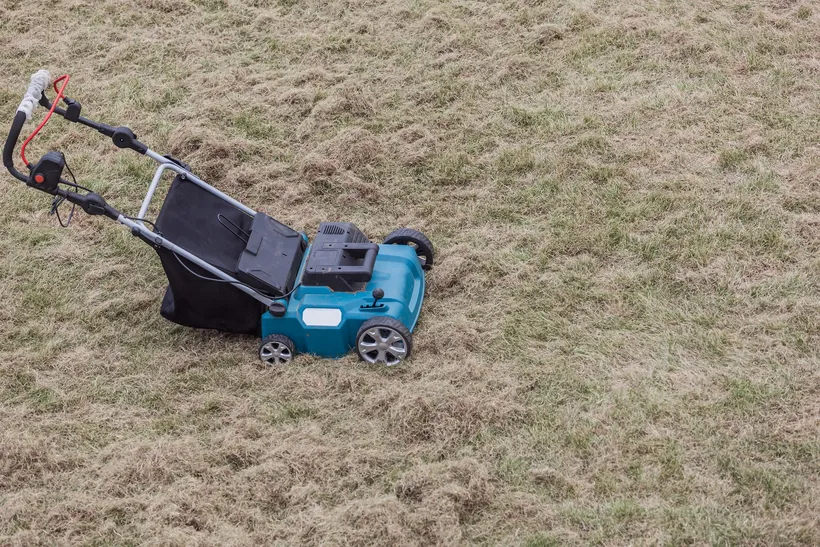
A scarifier on a lawn that has just been done. What it tears out sits on top, brown and loose: that’s what a scarified lawn looks like before it’s raked up.
It’s alarming, and it’s what should happen. What you see on top is the mat that was underneath, and the grass, if it’s in its season, fills the gaps.
What a scarifier does to the lawn
Before. Between the leaf and the soil a brown mat of stems, roots and debris has built up: the thatch. Once it’s more than about a centimetre thick, water and air stay in it, and so do the roots.
Scarifying. The blades cut down through the mat and slightly into the soil. What they tear out comes to the top and is raked off, and the lawn is left thin and brown for a while.
After. If it was done while the grass is in its growing season, it fills the gaps. The thatch is left thin, water reaches the soil and the roots go down after it.
And afterwards:
- Rake up everything that has come out and take it away. Leaving it on top gives the lawn its mat back.
- Aerate if the soil is compacted, feed and water, so it closes up as soon as possible.
- Overseed the bare patches. On a winter lawn, now is the time; how, in sowing a lawn or laying turf.
- And don’t do it while weeds are germinating: the gaps scarifying leaves are exactly where they take hold.
Scarifying isn’t aerating
The two are often confused, and some guides treat them as the same thing. They aren’t. Scarifying cuts vertically and pulls out the mat at the top. Aerating lifts plugs of soil or spikes the ground to relieve compaction: it works on the soil, not the thatch.
A bare patch where everyone walks is usually compaction, and scarifying won’t fix it. A springy lawn that won’t take in water is usually thatch, and aerating falls short there. If it needs both, scarify first and aerate afterwards.
And artificial grass isn’t scarified: it’s brushed. We cover that in artificial grass isn’t zero maintenance.
If you’d rather we did it, scarifying, aerating and overseeding are part of lawn care.
In short
Scarifying means removing thatch, and it’s only needed when the thatch is more than about a centimetre thick. It’s done while the grass is growing: winter grass now; summer grass in late spring; St Augustine grass with a single pass. Afterwards, rake up, feed, water and overseed the bare patches.
And if it’s the same again every year, look at the watering before the machine: the mat is fed by little water every day.