Blog · Natural lawns and turf
Should you sow a lawn or lay turf?
Yes, sowing is cheaper, in materials. What you buy with turf is the three weeks in which a sown lawn can be lost entirely through one slip.
 By Sergio Domínguez8 min read
The question always comes in this order: first “I want a lawn”, and two minutes later “wouldn’t it be cheaper to sow it?”.
It is cheaper, yes. In materials. And that’s exactly the comparison that loses people money, because what separates one from the other here isn’t the price of the bag: it’s who takes on the next three weeks.
What you buy with turf isn’t grass: it’s skipped time
Turf arrives with the grass already grown and its roots already formed. It’s laid on a Monday and by Monday afternoon there’s a lawn. It hasn’t rooted in (that takes a while), but it’s alive and complete from the first minute.
A sown lawn starts from zero. Between the day the seed goes down and the day it’s a lawn there’s a period when there’s nothing to look at and everything to lose. That period is the real product being compared, and hardly anyone puts it in the sums.
Why that period is more dangerous here than in the manual
Seeding manuals are written for climates where damp soil stays damp for a while. On this coast, in September, the top centimetre of soil in the sun goes from soaked to dust in a matter of hours, and with the levante (the east wind) even sooner.
And that’s the detail that decides everything, because it isn’t intuitive: the risk isn’t constant, it’s concentrated in one very specific window.
The same seed, three moments
Just sown, it holds out. As long as the seed stays closed, the top centimetre drying out does it no harm: it just sits there waiting for the next water.
Once it germinates, it can no longer wait. The newly emerged root is in that top centimetre and nowhere else. If it dries out before it gets further down, it doesn’t recover: it’s lost.
And once it reaches the moist soil, the risk is over. From then on it drinks from below and can forgive a lapse. All the work of sowing is getting it to that point.
While the seed is still closed, it doesn’t care if the surface dries out: it waits. And once the root has gone down into the moist soil, it doesn’t matter either: it drinks from below. The problem is the stretch in between, when the seedling has come up but still lives entirely in the centimetre that dries out. There, one forgetful afternoon can’t be undone: that part doesn’t regrow, it gets resown.
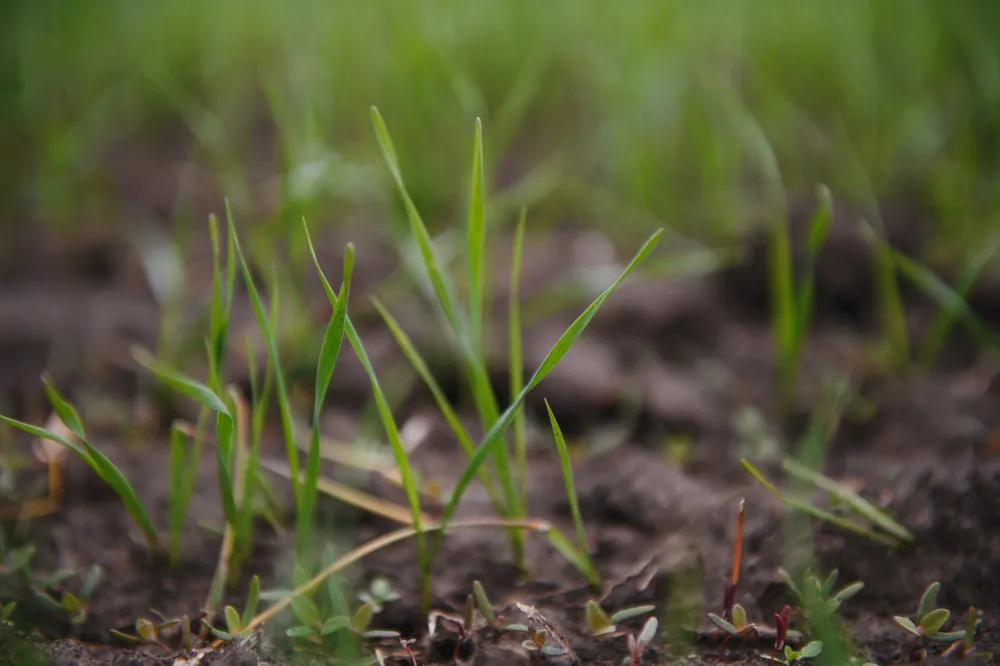
This is a sowing that has germinated. It isn’t a thin lawn: it’s all there is after the hard part, and each of those blades lives entirely in the centimetre of soil you can see around it.
That’s why a September sowing needs very short, very frequent waterings for weeks, which is the opposite of what a normal garden needs (and the opposite of what an automatic system set up for an established lawn does). Sow and go away for the weekend, and you start again.
The other cost you don’t see: what comes up with the seed
Bare soil watered every day for three weeks doesn’t only germinate what you’ve sown. It germinates everything that soil had in it, and on a plot here that’s quite a lot.
With turf that doesn’t happen, not because turf is magic but because the soil is covered from the first day and no light reaches anything.
So when is sowing the right call?
It isn’t a rhetorical question: there are clear cases where seed is the sensible option.
- Large areas. Beyond a certain size the difference in materials stops being a detail and becomes a lot of money. If the area also can’t be seen from the house and there’s no hurry, sowing makes perfect sense.
- When there’s a well set-up automatic system and someone keeping an eye on it. The risk with seed is a risk of consistency. If the system can give several short waterings a day and someone is watching how it goes, the dangerous window passes without a scare.
- For repairs and overseeding. Filling bare patches in a lawn that already exists is a different thing: the grass around protects the seed, shades it and holds the moisture. There, sowing is the normal thing to do.
And the other way round: if it’s a small area, very much on show, in a hurry, or if nobody is going to be watching it every day for the next three weeks, turf isn’t a luxury. It’s what stops you paying twice.
Both share what really decides the result
It’s worth saying because it gets lost in the argument: seed or turf, what will decide whether that lawn lasts five years or two is what’s underneath. The levelling, the soil that’s brought in and the drainage are the same for both options, and they’re the part of the job that never shows in a photo. Why that decides the result, and how to check it in your garden with a screwdriver, is in what’s under the lawn. That’s what we cover in natural lawn installation.
Choosing wrongly between seed and turf costs you a season. Preparing the ground badly costs you the whole lawn, with either.
And a third answer that’s sometimes the right one
Before choosing between the two, it’s worth ruling out that you need neither. A lawn that comes out of August yellow and thin looks dead and often isn’t: September and October are its two best months, and more than one that was about to be dug up completely comes back by itself as soon as the nights cool down.
And if the area in question is a narrow strip, heavily walked on or in deep shade, where natural grass won’t take either way, then it’s a different conversation, and one worth having once you know what artificial grass does in the sun.