Blog · Lawn care
Lawn fungus in autumn: why it appears now and what to change in the watering
Overnight mushrooms and patches that spread in a circle are two different things. The one that harms the lawn appears in October because of how it’s watered.
 By Sergio Domínguez7 min read
The first October rains arrive and the lawn changes within a week: mushrooms appear where there was nothing and, in some gardens, brown patches that spread in a circle. Both get called “fungus”, but they have nothing to do with each other, and what you do about each is different.
Mushrooms: they aren’t the disease
The mushrooms that pop up after rain are the fruit of fungi that live in the soil breaking down whatever is rotting: dead roots, the remains of a stump, buried wood. They were there all year; the rain just makes them fruit. They don’t attack the grass.
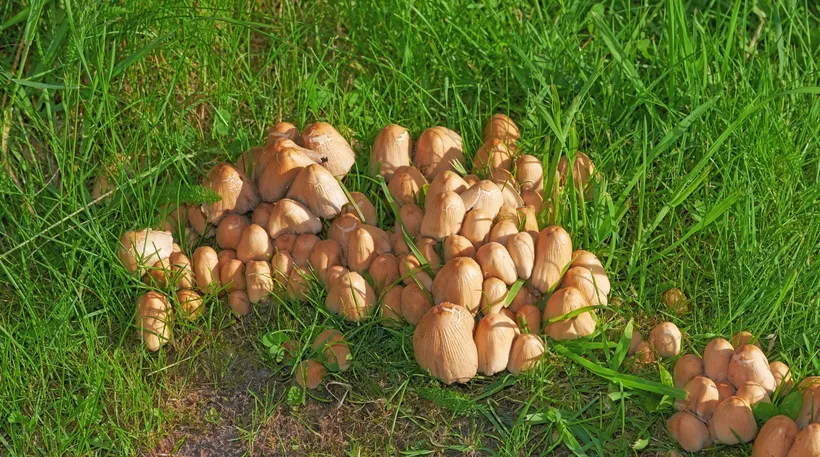
A clump of mushrooms in a lawn. They don’t attack the grass: they live off something rotting underneath, often buried roots or wood.
Sometimes they come up in a ring, with a band of darker or drier grass: it’s the same fungus growing outwards from one point, what’s known as a fairy ring. If they always appear in the same place, there’s usually wood underneath. What happens to a stump left in the ground is in removing a tree stump.
Pick them by hand, wearing gloves and before you mow, because the mower spreads the spores; and they disappear on their own when the ground dries out. The only thing that matters with them is that children and dogs don’t eat them: many garden mushrooms are poisonous and you can’t tell them apart by eye. Mushrooms on the trunk or at the base of a tree are another matter, and they are a warning sign: see signs a tree is dangerous.
The patches: that is a sick lawn
What damages the lawn is a different set of fungi, the ones that attack the blade. You can tell them by their shape:
- Brown patch. Circles of brown grass that can be more than a metre across, often with a darker edge in the morning. It comes with humid heat and warm nights.
- Dollar spot. Coin-sized, straw-coloured spots that gradually merge. In the morning, with dew, you may see something like a white cobweb on top.
- Rust. The grass turns yellow and leaves orange dust on your shoes or your hand when you run it through.
None of them is fixed with more water or more feed. And all three feed on the same thing.
Why now: the wet night
These fungi need the blades wet for many hours in a row and mild temperatures. In October, the coast brings all of that together: the first rains, nights that are still mild and dew in the small hours.
And there’s a fourth thing the garden supplies itself: the irrigation controller is still on the summer programme. Plenty of people water at night so the water doesn’t evaporate, and in July that makes sense. In October, that ten o’clock watering wets the blades hours before the dew arrives, and keeps them wet until the sun dries them mid-morning.
The same watering, at two different times
The dew is the same. In autumn, in the small hours, the grass gets wet with dew in both gardens, and it doesn’t dry until the sun reaches it.
The same watering, at another time. Watered at ten at night, the blades are wet for hours before the dew arrives. Watered at dawn, the water lands on blades that were already wet.
The difference is hours of wet blades. Lawn fungus needs the blades wet for many hours in a row. Night watering gives it them; dawn watering adds almost nothing.
What to change
- The watering time: at dawn, not at night. Set to finish at first light, the water lands on blades that were already wet with dew and the sun dries them straight away. It’s the change that does most, and it costs nothing.
- The amount: less, as soon as it rains. Once the first rains come, the summer programme is too much. Cut the frequency and, if it’s been a rainy week, skip waterings. How to check whether it needs water is in how much to water the garden in summer, and it works just as well in autumn.
- Mowing: never when the grass is wet, and with a sharp blade. Mowing wet carries the fungus from one patch to the next, and a blunt blade tears the grass and opens the door to it. Don’t cut lower than usual either. The right height is in lawn mowing height.
- Feeding: neither too much nor too little. A lot of nitrogen at once favours brown patch, and a hungry lawn gets dollar spot. What works is little and often, not a binge in autumn.
- Thatch: if there is any, out it goes. A layer of thatch between the grass and the soil holds moisture against the base of the blades. How it’s removed is in reviving a lawn after summer.
What about a fungicide?
We’re not going to recommend products here. What does matter is the order: first you put right the watering, the mowing and the feeding, which is often enough. If, with all that put right, the patch keeps spreading, the next step is to find out which fungus it is before applying anything, because each is treated differently. If you’d rather we had a look, see lawn care.
In short
The mushrooms that come up with the rain aren’t the disease: you pick them and they go on their own. The patches that spread in a circle are, and here they appear in October because the first rains, the mild nights and the summer watering still running all come together.
What holds them back most is moving the watering to dawn and cutting it back as soon as it rains. After that, mow when it’s dry with a sharp blade, and feed little and often.