Blog · Pruning calendar
Pruning a pine tree: when it’s done here, and why it’s never topped
The pine is the tree of half this coast and the one that takes a bad cut worst: it won’t regrow from wood without needles. What it’s pruned for, what you can’t ask of it and when to do it here.
 By Sergio Domínguez7 min read
On this coast the pine is the tree of half the urbanisations: stone pines and Aleppo pines inside the plots, over the roofs and leaning across the pools. And the call is usually the same: it’s grown too big, it drops needles everywhere, a branch is already touching the house. “Can it be cut down to size?”
It can be pruned, and sometimes it needs to be. What it can’t be is treated like an olive or a ficus, because a pine doesn’t forgive a bad cut: whatever is cut wrongly stays that way for good.
Before you touch it: where the living part is
Look at a pine from underneath. The needles are on the skin of the crown and at the ends of the branches. Further in, towards the trunk, the branch is bare wood. That isn’t a sign of disease: it’s how the tree grows, because the inner needles, which get no light, drop off over the years.
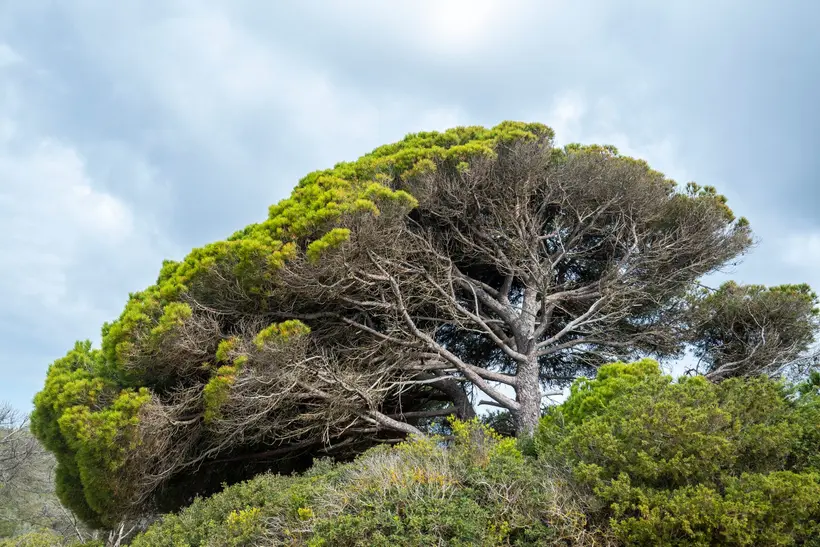
A stone pine with needles only on the skin of the crown. Inside, and in the part that has lost them, there’s only grey wood: nothing will grow from there again.
This is what decides everything, because a pine only sprouts where it has needles. An olive, a ficus or an oleander will push out new shoots from a bare trunk after a hard cut. A pine won’t: wood without needles has nowhere to grow them from.
Why a pine is never topped
Topping means cutting the tree off at the top, or cutting the branches back halfway, to make it lower. On most trees it’s bad pruning; on a pine it’s a mistake you can’t undo. If the cut falls in the bare part, that piece of branch never grows needles again and dries out. And if the leader at the top is removed, the tree tries to replace it by turning side branches upwards, and ends up with several weak tops where it had one.
The same pine branch, two cuts
The same branch, inside. On a pine the needles are at the tips and on the young shoots. Towards the trunk, the branch is bare wood.
Two cuts. On the left, just past a side shoot that has needles. On the right, into the bare part, which is what topping does.
The following year. The left branch is still alive and green. The right one produces nothing, because a pine won’t sprout from wood without needles, and the stub dries out.
The practical rule is simple: every cut goes either to the trunk or just past a branch that has needles. Never in the middle of the bare wood. If shortening a branch would mean cutting inside the green, you don’t shorten it: you take it off completely.
There’s one exception worth knowing: the Canary Island pine, which can resprout from the trunk. The local ones, the stone pine and the Aleppo pine, can’t.
What a pine is pruned for
- Removing dead wood. Dead branches are the ones that come down in the autumn storms, and on a big pine a dead branch is heavy enough to break a pergola or a car.
- Keeping it off the house. Branches rubbing the walls, resting on the roof or filling the gutter with needles. They come off whole, from where they start.
- Lifting the crown. Removing the lower branches so you can walk underneath and, above all, so a fire on the ground has no ladder up to the crown. On a plot next to the hillside it’s one of the most useful things you can do.
- Thinning, in moderation. Taking out the odd inner branch on a very dense crown lets the wind through. Hollowing it out leaves the weight at the tips, which is worse than not touching it.
When lifting the crown, the mistake is overdoing it: a long, bare trunk with a tuft of needles on top catches more leverage from the wind than a pine with its whole crown. You lift only as far as you need. How much you can take off a tree in one go is in how much you can prune a tree.
And to stop it growing any bigger?
It’s the most common question, and the honest answer is that a mature pine can’t be kept small by pruning. The only thing that holds back a pine’s growth is pinching out its “candles”, the new shoots it puts out in spring, and that’s done on young, small pines, Japanese-garden or pot-grown, not on a fifteen-metre one.
If the pine is already too big for where it is, the real options are three: live with it, prune it so it bothers you less (keep it off the house, lift it, take out the dead wood), or fell it. Felling a big pine may need a permit from the town hall, so it’s worth asking before you hire anyone. If what worries you is that it might come down, the warning signs are in how to tell whether a tree is dangerous.
When: from 15 October
In Andalusia the high fire-risk season runs from 1 June to 15 October, according to the Plan Infoca, the regional government’s forest-fire plan. Taking a chainsaw to a pine in those months, with dry needles on the ground and plots right up against the hillside, is asking for trouble. And on forest land, the regional rules also restrict work with machinery.
So the window for pines here is the cool season, from mid-October to the end of winter. With the tree at rest, the cut bleeds less resin, and in spring, when the candles come out, the year’s growth is left alone.
There’s one more reason to do it in winter: that’s when the processionary caterpillar nests are visible, and the same pruning can remove the tips that carry them, with the protection that requires. How to remove them without regretting it is in the processionary caterpillar nest.
And whatever the season, the cuttings go. Freshly cut pine wood left piled on the plot draws pine shoot beetles and other pine borers, which breed in it. It gets chipped or taken away, not left stacked for weeks next to the pines that remain.
What not to do
- Topping it to make it lower. Whatever is cut into the bare wood dries out, and the tree is left with stubs and several weak tops.
- Leaving branch stubs, or cutting flush with the trunk. The cut goes just outside the branch collar, the swelling where the branch meets the trunk, which is where the tree seals the wound.
- Climbing a pine that’s staying with spikes. Every spike is a wound in the trunk. Spikes are for a tree that’s being felled; one that’s being pruned is climbed on ropes.
- Pruning a big pine from a ladder, with a chainsaw. A ladder against a trunk that moves, with a machine in your hand, isn’t DIY. Above what you can reach from the ground, it’s work at height.
Who does it
A garden pine here easily grows past twelve metres, and whatever is cut up there has to be lowered on a rope, not dropped onto the roof or into the pool. It’s a job for someone who climbs in a harness or works from a platform, depending on where the tree is. What drives the price of that is covered in how much it costs to prune a tree.
If the pine is in the communal gardens, the decision belongs to the community, and the quote should say which branches come off and why before anyone goes up. The most plot pines are in East Marbella, from Cabopino to Las Chapas; we cover that in gardeners in Marbella. And if you’d rather we did it, it’s in tree pruning.
In short
A pine only sprouts where it has needles, so every cut goes to the trunk or just past a green branch, never into the bare wood. That’s why it’s never topped, and why a mature pine can’t be kept small with shears.
It’s pruned to remove dead wood, keep it off the house and lift the crown just enough. Here it’s done from 15 October, when the fire-risk season ends, until the end of winter, and the cuttings are always taken away.