Blog · What it costs
How much it costs to prune a tree: it’s not the tree that pushes the price up
Two identical trees can get quotes that look nothing alike, and it isn’t a rip-off: what you pay for is what’s under the tree, how it’s reached and what comes down. What to ask so you can compare.
 By Sergio Domínguez7 min read
There’s no honest figure for “pruning a tree” without seeing the tree, and anyone who gives you one over the phone is giving you a come-on. What you can know before asking for a quote is what moves the price. And that’s good for something more useful than a figure: understanding why two quotes for the same tree look nothing alike.
The tree is the least of it
Intuition says a bigger tree costs more. That’s true, but it’s the thing that counts least. Two identical trees, with the same branch to take off, can be two very different jobs depending on what they have underneath.
The same tree, the same branch, two gardens
The same tree. Just as tall, the same crown and the same branch to remove. Seen from the street, the quote ought to be the same.
What changes is what’s underneath. In one garden there’s lawn. In the other, the branch hangs over the pool, and nothing can drop there.
Same tree, different job. Over the lawn, one cut and the branch drops. Over the pool, the same branch is cut into pieces from the tip inwards, and each piece is held on a rope and lowered by hand.
Where there’s lawn underneath, the branch is cut and drops. Where there’s a pool, a glass wall, the neighbour’s roof or a cable, nothing can drop: it’s cut into pieces, each piece is held on a rope and lowered under control. It’s the same cut with a lot more work around it, and it’s what explains why your quote looks nothing like the one your neighbour got for a tree in the middle of the lawn. When the whole tree has to come out, the same thing happens on a bigger scale: we cover it in tree felling.
How the crown is reached
There are four ways to reach the crown, and each costs something different:
- From the ground, with a pole. For young trees or low branches. It’s the quickest and cheapest way, and it has a clear ceiling.
- With a ladder. Only for what’s close. A ladder leaning on the branch that’s being cut is how accidents happen, and anyone who works properly doesn’t use one for that.
- With a cherry picker. Quick and convenient, but the vehicle has to get right up to the tree and needs firm ground to stand on.
- Climbing, on ropes. It reaches anywhere and it’s slower. Whoever climbs has to be trained for work at height and secured, and it’s worth asking.
Here this counts for more than elsewhere. On the hillside urbanisations of this coast the tree is often at the end of a flight of steps, behind a pedestrian gate or on a terrace no vehicle can reach. The cherry picker can’t get in, so the tree gets climbed. If the access is like that, the quote will reflect it, and it’s not because of the tree.
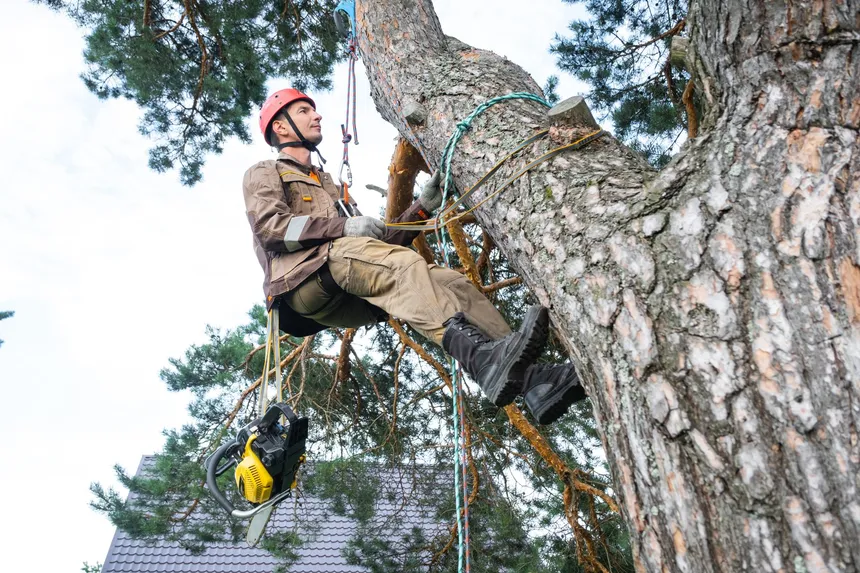
This is what climbing work looks like: sitting in the harness, held by the rope from above and by another round the trunk, with the chainsaw hanging so both hands are free. And underneath, the roof of the house. It’s slower than a cherry picker, and it gets to places a cherry picker can’t.
What comes down: the waste
Pruning a mature tree brings down a lot of branches and leaves, and that has to be chipped, or loaded up and taken to an authorised site. It’s a real cost, and it’s the one that most easily disappears from a quote so the bottom line looks lower.
Always ask whether green waste removal is included. If it isn’t, the cheapest quote can end up the most expensive, or leave you with a pile of branches in the drive. It’s the most common surprise in the trade, which is why we also cover it in how prices are worked out.
What kind of pruning you’re asking for
Taking out the dead wood and thinning the crown isn’t the same as reducing its size. And there’s one kind of pruning that always works out cheaper the first year: cutting everything to the same height and leaving the tree as a set of stubs.
That saving gets paid for later. The tree responds by pushing out a forest of fast, weakly attached shoots that have to be removed again, higher up each time and with more risk. Why that happens is in how much you can prune a tree.
What really brings the price down
- Doing several trees on the same visit. The setting up, the travel and the chipper are shared out.
- Pruning little and often. A tree that’s pruned regularly brings down less each time, and never ends up needing a rescue job.
- Pruning at the right time. Out of season the tree suffers more and the work doesn’t last. The calendar for this coast is in when to prune on the Costa del Sol.
How to ask for a quote you can compare
With some good photos a price range can be given without a visit. For them to be useful, send four:
- The whole tree, with a person or a door next to it for scale.
- What’s underneath and around it: pool, roof, cables, the neighbour’s wall.
- The way from the street to the tree: gates, steps, slope.
- Where the cuttings could be left while the work is going on.
And in the quote, ask for four things in writing: what’s going to be cut, how the crown will be reached, whether green waste removal is included and who does the work. With that, two quotes can be put side by side. If you’re torn between a fixed price and an hourly rate, we explain it in fixed quote or hourly rate. And what we do on each pruning job is on the tree pruning page.
In short
The price of pruning a tree isn’t decided by the tree. It’s decided by what’s underneath it, how the crown is reached and how much comes down. That’s why your neighbour’s tree, identical to yours, can cost something different.
Ask for the quote to say what’s being cut, how it’ll be reached, whether the waste is taken away and who does it. And be wary of the cheapest pruning when the difference lies in leaving the tree as stubs: that one gets paid for twice.