Blog · What it costs
Land clearing cost: what weighs more than the square metres
The square metres say little about the price of a clearance. What decides it is what grows, the slope, the access and what happens to the cuttings, the half that gets forgotten.
 By Sergio Domínguez6 min read
“How much to clear a thousand square metres?” is the question people ask most, and the one that can least be answered that way. Two plots of the same size can be a morning’s work or a week’s, and the difference isn’t in the area: it’s in what grows there, how you get in and what happens to the cuttings.
We’re not going to give a price per square metre here, because any figure without seeing the plot would just be bait. Why, in gardening prices. What we can explain is what drives the price, so you can compare quotes and know what to send to get a real one.
What grows there: dry grass isn’t brambles
A year’s dry grass is cut in one pass, with a brush cutter or a tractor if the plot allows it, and the cuttings stay on the ground. It’s the quickest clearance there is.
Brambles, cane and woody scrub are a different job. They’re cut at ground level, in pieces, often by hand, and the cuttings don’t stay: they’re bulky, they don’t chop down well and they have to be taken away. Inland, in Coín, Alhaurín or Cártama, it’s what grows along the boundaries and the streams of plots that haven’t been touched for years.
And how long it’s been left matters. A year’s growth comes off in one pass; three years of neglect is three years of wood.
The same area, two clearances
The same area. Two plots of the same size. On the left, a year’s dry grass; on the right, brambles and cane that have been growing for a while.
Cutting doesn’t cost the same. The grass is cut in one pass with a machine. Brambles and cane are cut at ground level, in pieces, and often by hand.
And the cuttings have to go. The cut grass stays on the ground. Woody growth is bulky, doesn’t chop down well and has to be loaded and taken to an authorised site: the half of the job you can’t see in the square metres.
Slopes and terraces
On flat ground with access, the machine does the work. On a hillside or on terraces, like those in the Guadalhorce valley or on the lower slopes of the Sierra de Mijas, the machine can’t get in and it’s done with a shoulder brush cutter, terrace by terrace, taking care not to damage the stone walls. More hours for the same square metre, and more risk.
How you get in
If a vehicle can’t get to the plot, everything that’s cut is carried out by hand to wherever it can be loaded. Plots between developments on the coast usually have access; on inland fincas, sometimes the way in is a footpath. It’s one of the first questions you should be asked, and if nobody asks it, the quote has been worked out by eye.
What nobody puts in the first quote: the cuttings
Cutting is half the job. The other half is what happens to what’s been cut, and it’s the part that varies most from one plot to the next:
- Chop it and leave it, if it’s fine. That’s normal with grass, and the cheapest.
- Load it and take it away to an authorised site, if it’s woody. Cut brambles take up far more space than they seemed to standing.
- Burning it isn’t the free way out it seems. In Andalusia, from 1 June to 15 October no fire may be lit on forest land or within 400 metres of it, and outside those dates, in those areas, you have to ask for permission or give notice first. On top of that, waste law bans burning plant waste as a general rule, with exceptions. Before counting on it, check what’s allowed on your plot.
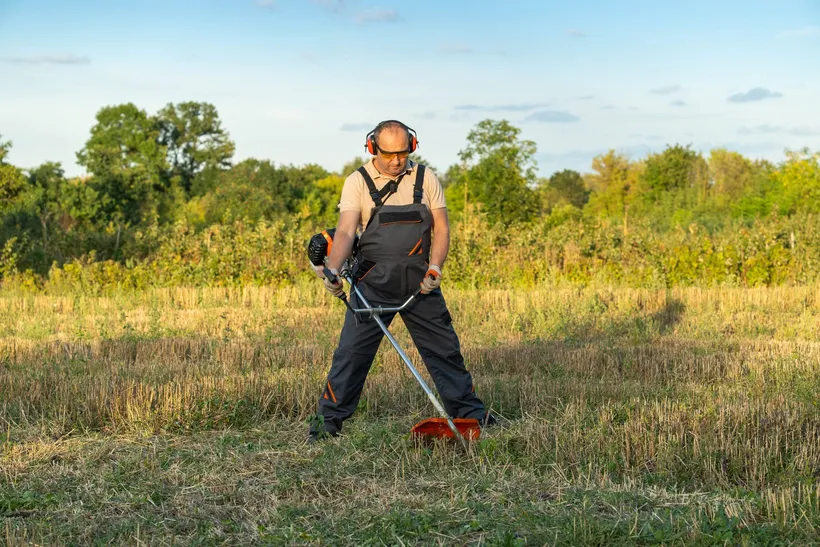
One pass of a brush cutter over dry grass: the cuttings stay on the ground. With brambles or cane, the same would have to be loaded and taken away.
That’s why two quotes with the same total may not be comparable: one includes taking it away and the other leaves it for later. How to read that, in fixed price or hourly rate.
When: woody growth in autumn, grass in spring
Whatever doesn’t depend on the season, such as old brambles, a cane thicket or low scrub, doesn’t need to wait until May. In mid-October the high wildfire-risk season ends, the ground softened by the rain lets the roots come out, and you’re not competing with the pre-summer rush.
The pass over the grass, on the other hand, belongs in spring: what’s cut in October is tall again by April. The sensible thing on a plot with both is to split them: the hard part now and a once-over before the heat, which is quicker because what grows back is soft.
What to send so the quote is a real one
- Photos from several spots, and one of the way in.
- Where it is: the location or the cadastral reference.
- What grows there: grass, brambles, cane, trees to keep.
- What you want done with the cuttings, if you know.
- Whether it’s to comply with a notice from the town hall, and by when: the deadline comes before the season.
With that, we can give a fixed price without visiting, or tell you that it needs seeing and why. How we do it, in plot clearance. And if the plot is inland, in gardeners in Alhaurín and Coín.
In short
The square metres say little about the price of a clearance. What decides it is what grows there, the slope, how you get in and, above all, what happens to the cuttings, which is half the job and the part left out of the first quote.
Woody growth is best done in autumn and winter; the pass over the grass, in spring. And to compare them, quotes that say the same thing: with removal included or not, but in writing.